The Role of 4000mAh Battery in Handheld Fan Runtime Expectations
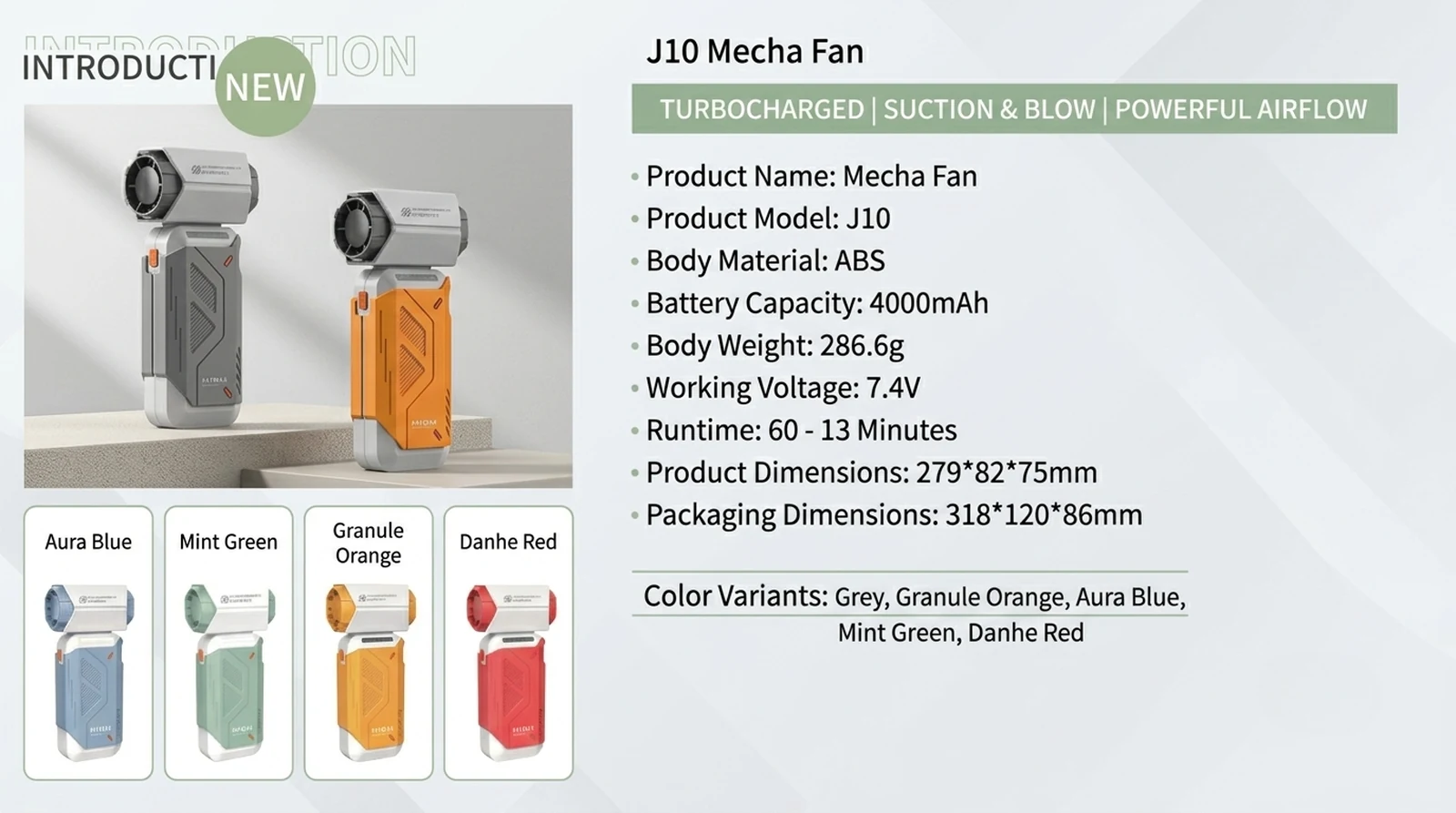

Buyers sourcing handheld fans for retail, promotional, or private-label programs often treat battery capacity as a single number on a spec sheet. The reality is that a 4000mAh rating interacts with motor draw, airflow mode, and form-factor choices to determine how long the device actually runs between charges. For B2B importers evaluating the J10 Mecha Fan and competing platforms, understanding this relationship is the difference between accurate marketing claims and customer complaints.
Understanding mAh: Why Battery Capacity Matters in Handheld Fans
Milliampere-hour (mAh) measures how long a battery can deliver a given current before depletion. A 4000mAh cell can theoretically supply 4000mA for one hour, 2000mA for two hours, or 1000mA for four hours. In a handheld fan, the actual draw depends on motor speed, blade design, and whether additional functions such as LED indicators or heating elements are active.
For B2B importers, the mAh number is best understood as a ceiling rather than a guarantee. Two fans both rated at 4000mAh can deliver markedly different runtimes if one uses a high-efficiency brushless motor drawing 800mA at top speed and the other uses a brushed motor drawing 1400mA. The capacity figure describes the energy reservoir, not the consumption rate.
This distinction matters when translating Chinese factory specs into Western retail listings. A 4000mAh rating is meaningless without the matching discharge context. Importers who request runtime data at multiple speed settings from their OEM partner gain a clearer picture of what end-users will actually experience.
The 4000mAh Benchmark in the Handheld Fan Category
Across the handheld fan category, 4000mAh has emerged as a practical middle-ground capacity. It is large enough to support several hours of mixed-use operation while keeping the device light enough for pocket carry. Sub-2000mAh fans typically struggle past two hours on medium settings, while 6000mAh-plus units tend to push total weight above 350 grams and compromise one-handed ergonomics.
The J10 Mecha Fan positions its 4000mAh cell at this benchmark, paired with an ABS housing that brings total weight to 286.6 grams. This balance reflects a deliberate engineering choice: enough capacity to justify a "full workday" runtime claim, while keeping the form factor competitive against lighter but less capable alternatives.
For importers comparing platforms, the relevant question is not whether 4000mAh is good, but whether the rest of the bill of materials is sized to take advantage of it. A 4000mAh battery paired with an inefficient motor yields the same result as a 2500mAh battery with efficient electronics — shorter runtime than the spec implies.
Real-World Runtime vs. Lab Runtime: What B2B Importers Should Verify
Factory spec sheets almost always report runtime under ideal conditions: room temperature, low-to-medium speed, no dust loading, fresh battery from a full charge. Real-world use introduces variables: high ambient heat, turbo bursts, partial state-of-charge cycles, and battery aging after 200–300 charge cycles.
A useful import-side due diligence step is to ask the factory for runtime data at three points: low speed, medium speed, and maximum speed, plus a typical-use profile that mixes all three. For the J10 Mecha Fan's turbocharged mode, the runtime gap between minimum and maximum draw can exceed a factor of three. Our runtime testing breakdown walks through how that gap appears in actual product samples.
Importers should also clarify whether published runtimes assume a brand-new cell. Lithium-ion capacity typically degrades to 80 percent of nominal after 500 full cycles. For a fan used daily in a warehouse or outdoor work environment, that degradation timeline is relevant to warranty policy and replacement-part planning.
Turbocharged Modes and Their Battery Trade-Offs
Turbo or "violent" fan modes push the motor to its maximum RPM, often 30–50 percent above the standard top speed. On the J10 Mecha Fan, this turbocharged setting is the headline feature that justifies the mecha-inspired industrial styling. It also concentrates battery draw into a short window.
In turbo, runtime from a 4000mAh cell can compress to under two hours, compared to four to six hours on lower settings. For B2B applications such as outdoor event staffing, construction site cooling, or promotional giveaways used in hot climates, the turbo burst is valuable but should be positioned as a feature rather than a default operating mode.
Importers marketing turbo modes should pair the claim with a clear runtime disclaimer. End-users who expect sustained turbo output will be disappointed; those who understand turbo as an on-demand boost tend to view the product more favorably. This framing also protects the brand from return-rate spikes tied to unrealistic expectations.
Suction vs. Blowing Dual-Use: How Function Affects Drain
Dual-function fans that both blow and pull air through a reverse-flow nozzle add another variable to the runtime equation. The J10 Mecha Fan includes this dual-use design, which is useful for clearing debris from work surfaces, cooling components, or inflating small items.
Reverse-flow operation generally draws similar current to forward-flow at the same RPM, but the perceived airflow is different. Users may run the fan at higher speeds in suction mode to feel equivalent output, which compounds battery drain. Importers should request separate runtime data for both modes if their target market emphasizes the suction function.
For industrial or trades-channel buyers, the dual-use feature can justify a price premium over single-direction fans. For consumer-gift channels, the suction function may be underused, and the marketing emphasis should shift to runtime and ergonomics instead.
Charging Time, Cycle Life, and Battery Health for OEM/ODM Programs
A 4000mAh cell charged via standard USB-C at 5V/1A typically requires four to six hours for a full top-up. Faster charging protocols (PD, QC) can cut that to two hours but require compatible wall adapters — an accessory rarely included in the box.
Cycle life is the second number that matters for program planning. Most 18650 or lithium-polymer cells rated at 4000mAh deliver 500–800 cycles before reaching 80 percent capacity. For a consumer product used a few times per week, that translates to three to five years of service life. For heavy commercial use, the cycle count matters more than the calendar age.
OEM/ODM partners should be asked whether the battery is user-replaceable or factory-sealed. Sealed designs improve water resistance but complicate end-of-life recycling compliance in Europe and parts of North America. Importers serving those markets need to plan for collection and recycling programs, often through producer-responsibility organizations.
Battery Sourcing and Compliance for Cross-Border Distribution
Lithium-ion cells used in handheld fans typically originate from a small set of large Asian manufacturers. The brand on the spec sheet is rarely the cell maker — most OEMs source from tier-one or tier-two cell producers and integrate them into a battery pack with a protection circuit board.
For B2B importers, the compliance chain matters as much as the cell brand. CE, FCC, UKCA, RoHS, and REACH documentation must trace back to the actual component suppliers, not generic certificates. UN38.3 testing is mandatory for lithium battery air transport, and MSDS sheets are required for sea freight.
Factories that help obtain the relevant certifications rather than simply claiming them provide a smoother customs clearance experience. Importers should request the full compliance dossier — including cell-level test reports — before placing a production order. For a deeper look at how this documentation flows in a typical OEM program, our sourcing guide at gaborhub.com covers the end-to-end workflow.
Capacity vs. Weight: The Form-Factor Trade-Off Importers Face
Every additional 1000mAh of battery capacity adds roughly 20–30 grams to a handheld fan and 2–4 millimeters of thickness. A 4000mAh cell in the J10 Mecha Fan fits inside a 286.6-gram ABS shell without compromising the industrial silhouette, but pushing to 6000mAh would push weight past 320 grams and force a grip redesign.
This trade-off is the central product decision for any handheld fan program. Buyers serving outdoor worker markets prioritize runtime and will tolerate heavier units. Buyers serving fashion, gift, or daily-carry markets prioritize weight and aesthetics.
Clearance channels and retail packaging also interact with weight. Heavier fans raise per-unit shipping costs in air freight and require sturdier retail boxes. Importers should model the landed cost impact of capacity upgrades before approving specification changes.
Communicating Runtime to End-Users Without Overpromising
The single most common complaint in handheld fan reviews is "didn't last as long as advertised." That gap almost always traces back to marketing copy that quotes maximum-runtime figures under ideal conditions. Importers who localize product copy for their target market can reduce return rates significantly.
Effective runtime communication uses ranges tied to specific scenarios: "up to 5 hours on low, up to 2.5 hours on turbo." Pairing the runtime figure with the use case lets the buyer self-select the right expectation. Visual icons or speed-mode labels on retail packaging reinforce the same point.
For B2B channels where the fan ships in a kit (such as corporate gifts or tradeshow bundles), runtime claims should match the most likely use scenario. A fan given to outdoor event staff should not be marketed on its low-speed runtime, while a desk-cooling unit should emphasize quiet-mode duration.
Related Articles
For more on the J10 Mecha Fan's engineering choices and how it compares to other handheld platforms in the same capacity class, see our runtime testing breakdown and the battery safety checklist for importers shipping lithium-powered devices across borders. As the category matures, expect 4000mAh to remain the practical sweet spot for handheld fans through the next product cycle.
Frequently Asked Questions
How long does a 4000mAh handheld fan actually last on a single charge?
Runtime varies significantly with speed setting. On low or medium speeds, a 4000mAh handheld fan like the J10 Mecha Fan typically delivers four to six hours of operation. On turbocharged or maximum settings, runtime can compress to under two hours. Always request multi-speed runtime data from the factory rather than relying on a single headline figure.
Does a higher mAh rating always mean longer runtime?
Not necessarily. mAh describes battery capacity, not efficiency. A 4000mAh fan with an efficient brushless motor can outlast a 5000mAh fan with a less efficient brushed motor. The combination of capacity, motor type, and speed setting determines real-world runtime. Importers should evaluate the full bill of materials rather than the capacity number alone.
What certifications are required to ship a 4000mAh handheld fan internationally?
Most markets require UN38.3 testing for lithium battery transport, plus regional compliance such as CE, FCC, UKCA, RoHS, and REACH. Air freight requires MSDS documentation, and sea freight has separate labeling rules. Work with an OEM partner that helps obtain these certifications rather than simply claiming them, and request the full compliance dossier before placing a production order.
For OEM/ODM specifications, custom packaging, or J10 Mecha Fan sourcing details, contact Gabor Lu at gaborlu@jlhy.cc or WhatsApp +86 18038304628.