Turbo Fan Sample Evaluation: How 2026 Importers Stress-Test Units
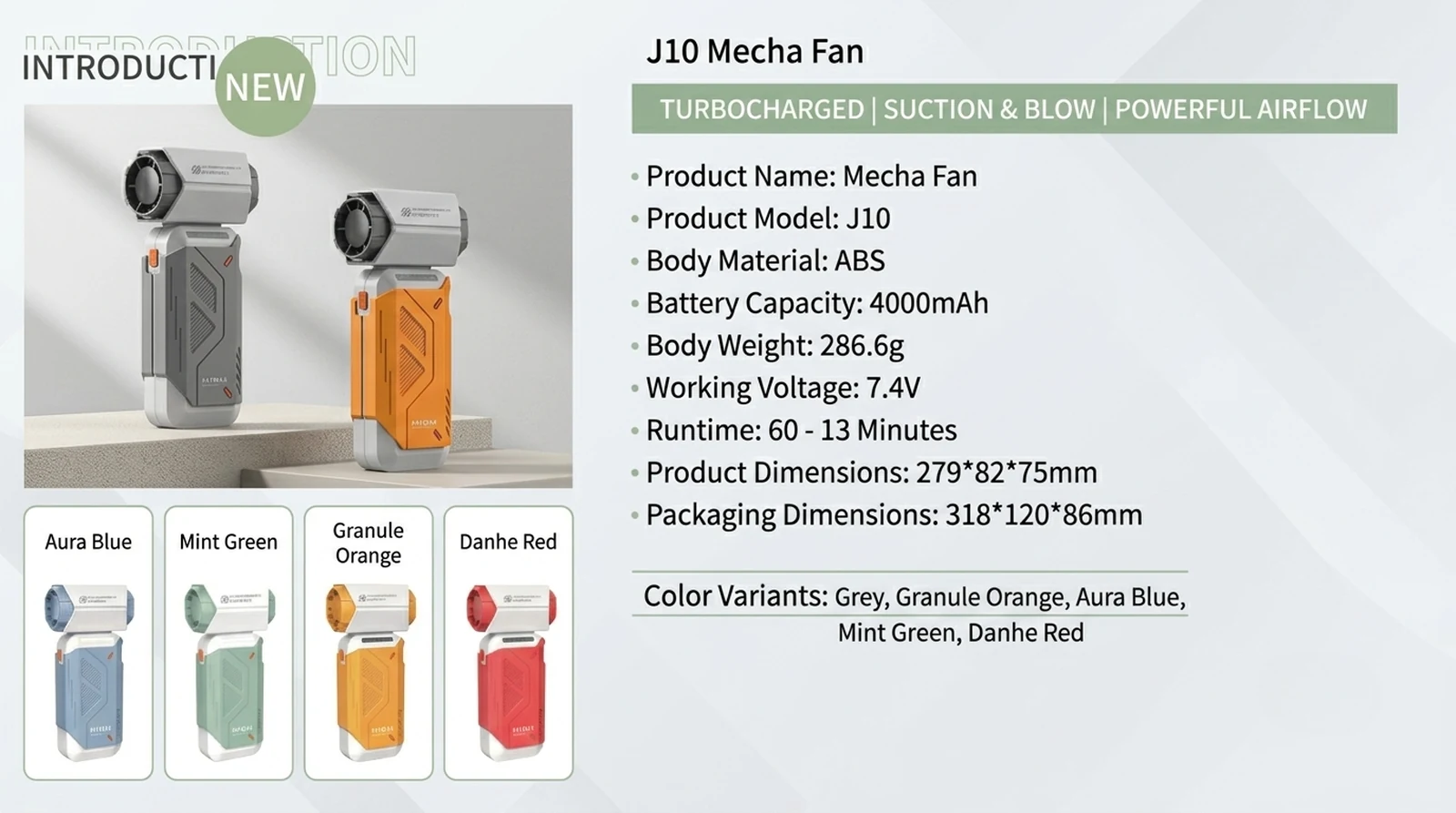

In 2026, importers evaluating turbocharged portable fan samples are working with a more disciplined framework than the buyers of even two years ago. Lithium cell scrutiny is tighter, dual-use functionality is being tested rather than assumed, and the gap between a glossy marketing sheet and a real production unit is being closed by structured evaluation protocols. The J10 Mecha Fan has emerged as a frequent benchmark in this space — a 4000mAh, 286.6g unit with both suction and blowing modes — because importers can stress-test every claim against a single reference design. Below is the working framework that experienced buyers are using to qualify turbo fan samples for commercial release.
The 2026 Sample Evaluation Framework
Modern importers no longer treat a sample as a free demo. It is a contract-grade artifact that should mirror what arrives in a 20GP or 40HQ container six to ten weeks later. The first pass is therefore procedural: confirm the supplier's MOQ flexibility (often 500/1000), request the production-line version rather than a hand-built prototype, and lock down lead time expectations before any functional test. A 2026 framework typically assigns weighted scores across battery cycle life, airflow output, noise signature, build quality, dual-mode reliability, and compliance documentation. This structured approach eliminates the subjective "it felt good in the hand" judgment that historically caused post-shipment disputes. Buyers increasingly require suppliers to ship the sample with its production-line tooling, calibration data, and batch trace sheets so the evaluation matches real production variance rather than a one-off cherry-picked unit.
Documentation Bundle Review Before Opening the Box
A turbo fan sample that arrives without paperwork is a red flag. Importers now treat the documentation pack as the first deliverable and only unbox the hardware once the papers pass a desk review. Standard expectations in 2026 include a full spec sheet with measured weights and dimensions (the J10 reads 286.6g on a calibrated scale, not 280g or 290g), an MSDS for the lithium cell, UN38.3 test summary, in-house QC report covering drop and vibration cycles, and a sample log identifying which production batch the unit was pulled from. A factory capable of running 150,000+ units per month should also provide a calibration record for the airflow bench and the decibel meter used during in-line checks. If the supplier hesitates on any of these documents, the importer learns more from that hesitation than from the hardware itself.
Battery Cell Sourcing and Cycle Verification
Battery performance is the single most expensive failure mode in a portable fan return cycle, and 2026 buyers treat it accordingly. A 4000mAh cell with a properly specced BMS should survive at least 500 full charge cycles before dropping below 80% of its original capacity, and importers typically ask suppliers to disclose the actual cell manufacturer rather than just the wrapper brand. Voltage sag under load — particularly when the turbocharger is running at peak — is a meaningful indicator of how the unit will feel in week three of real-world use. Sample evaluation now includes a controlled discharge test at room temperature and a 40°C chamber run, with logging every 30 seconds. Buyers also weigh the battery against regulatory expectations: UN38.3 for air freight, MSDS for customs, and IEC 62133 if the destination market applies it. The suppliers that help obtain these documents in advance dramatically shorten the importer's time-to-shelf.
Turbocharger Output and Airflow Benchmarking
A turbo fan earns its name from sustained high-RPM output, and importers quantify that rather than trust the marketing copy. Sample-stage benchmarks typically include peak airflow in cubic feet per minute, static pressure in mmH₂O, and time-to-peak from a cold start. A 4000mAh unit such as the J10 Mecha Fan is expected to sustain peak output across multiple five-minute cycles without thermal throttling — a benchmark that exposes the difference between a robust brushless motor and a cheaper brushed alternative under stress. Professional buyers use a hot-wire anemometer at a fixed 30cm distance and a static pressure rig at the intake. They repeat each test three times to surface variance. Any sample that drops more than 8% across the three runs is generally rejected at this stage, regardless of the supplier's marketing claims.
Noise Signature Across Operating Modes
Decibel readings alone mislead buyers because character matters as much as volume. A fan that hits 78dB with a clean broadband signature is far more marketable than one at 72dB with an irritating 4kHz whine. Importers in 2026 log dB readings at 1 meter and at the user's ear position across all available speed steps, including the boost or turbo mode. They also listen for rattle, bearing noise, and mode-transition clicks that signal loose internal tolerances. For dual-use units, the suction mode often produces a different acoustic profile than the blowing mode because of the altered intake geometry. The J10 is frequently benchmarked here because its dual-mode switching is smooth across the full RPM range. Audio samples recorded during evaluation are increasingly attached to the supplier scorecard so that the downstream marketing team can align the sound profile with their brand positioning.
Material Integrity, Weight, and Drop Testing
A turbo fan is meant to be carried, dropped, and stuffed into a backpack, so the sample must demonstrate that the production tooling delivers consistent shell integrity. ABS remains the dominant body material in this category because it balances impact resistance, weight, and mold cost. Importers weigh a five-unit sample on a calibrated scale and reject any unit that deviates more than ±2% from the published weight — for the J10, the expected figure is 286.6g, and drift above that range often indicates filler substitution or thicker-than-spec wall sections that hurt ergonomics. Drop testing follows: six faces, 1.2 meters onto hardwood, with functional re-test after each drop. The evaluation also includes a grip stress test simulating a one-handed carry, which exposes seam lines, button wobble, and port cover retention. For a broader cross-category view of build-quality criteria, see our OEM personal care appliance sourcing checklist.
Dual-Use Mode Stress Testing
Dual suction-and-blowing functionality is one of the most differentiated claims in the 2026 turbo fan category, and it is also one of the most often oversold. Importers therefore run the sample through a specific dual-use protocol: five minutes blowing on max, instant switch to suction on max, five minutes suction, repeat for three full cycles. Runtime is logged at each transition to catch battery sag under the more demanding suction load. The intake mesh and dust compartment are then inspected for retention under sustained draw — a common failure point when the mesh is undersized or the compartment seal is loose. For a unit like the J10, importers also verify that the LED indicators remain accurate across mode swaps, because buyers increasingly use indicator behavior as a proxy for internal firmware quality. The dual-use evaluation is also where counterfeit or "inspired by" designs typically surface, since the engineering burden of a real reversible turbo stage is non-trivial.
OEM/ODM Customization Acceptance Criteria
A 2026 sample evaluation rarely stops at stock configurations, because the importer's downstream retail program usually requires at least one round of customization. Buyers now score suppliers on colorway responsiveness, branding surface area (UV print area, deboss depth, silk-screen durability), accessory bundling, and packaging lead time. A serious OEM/ODM partner should be able to present a Pantone-matched color sample within ten business days and a branded packaging mock-up inside two weeks. The 15-engineer R&D bench at a mature Dongguan supplier is usually the differentiator here: teams of that size can run mold tweaks, color compounding, and accessory redesign in parallel rather than sequentially. Importers also probe the supplier's appetite for minor firmware changes — fan curve presets, indicator behavior, sleep timers — because these details increasingly decide shelf placement. A sample that arrives already customized to the importer's first-draft spec is a strong positive signal for the entire partnership.
Compliance Path Mapping for Target Markets
Documentation alone is not compliance. Importers in 2026 map the regulatory path for each destination market before signing any purchase order. For Europe, that means CE, RoHS, and REACH; for the UK, UKCA; for North America, FCC plus any state-level lithium transport rules. The supplier's role in this map is to help obtain the relevant certifications, supply test reports from accredited labs, and provide a Declaration of Conformity template. A sample evaluation should include a signed statement from the supplier identifying which certifications are already in hand, which are in progress, and which require fresh testing on the importer's behalf. Suppliers running 4-stage QC at 150,000+ units monthly typically have standing relationships with TUV, SGS, or BV, which compresses certification timelines from months to weeks. Importers increasingly treat this compliance speed as a hard scoring criterion, not a soft preference.
MOQ Flexibility, Lead Time, and After-Sample Workflow
The final pass on a turbo fan sample is procedural, not technical. The importer confirms MOQ flexibility — the standard tiers in this category are 500 and 1000 units — and locks down the deposit and balance structure used across the industry. Production lead time is quoted against the sample's documented tooling, and a credible supplier should be able to ship a 1000-unit reorder in 25–35 days, with a 40HQ full-container run scaling proportionally. The post-sample workflow is also negotiated here: who owns the tooling, what the rework loop looks like for cosmetic defects, and how RMA units are routed back to the factory for credit. A supplier operating at 150,000+ units monthly with a 4-stage QC process typically has written answers to all of these before the question is asked. As portable fan retail continues to consolidate around dual-use, turbocharged designs, the buyers that treat this post-sample discipline as a baseline rather than a differentiator will be the ones still standing in 2027. For a deeper look at how spec sheets translate into commercial outcomes, see our turbo fan evaluation checklist.
Related Articles
- OEM personal care appliance sourcing checklist
- Turbo fan evaluation checklist
- How importers benchmark dual-use portable fans
Frequently Asked Questions
What documentation should a turbo fan sample ship with in 2026?
A 2026 sample pack should include a full spec sheet with calibrated weights and dimensions, an MSDS for the lithium cell, UN38.3 test summary, in-house QC report covering drop and vibration cycles, and a sample log identifying the production batch. Suppliers running 4-stage QC at 150,000+ units monthly typically provide all of these by default.
How many battery cycles should a 4000mAh portable fan sustain?
A 4000mAh cell with a properly specced BMS should retain at least 80% of original capacity after 500 full charge cycles. Importers verify this through controlled discharge testing at room temperature and at 40°C, with voltage sag logged every 30 seconds under peak turbo load.
How do importers benchmark dual suction and blowing modes?
The standard protocol runs five minutes of blowing at maximum, switches instantly to suction at maximum, runs suction for five minutes, and repeats for three full cycles. Runtime and battery sag are logged at each transition, and the dust compartment is inspected afterward for retention. This protocol exposes undersized intake meshes and loose compartment seals that single-mode testing would miss.
For OEM/ODM specifications, custom packaging, or J10 Mecha Fan sourcing details, contact Gabor Lu at gaborlu@jlhy.cc or WhatsApp +86 18038304628.