Evaluating a Turbocharged Portable Fan Sample from China — A Remote Buyer's Guide

Sourcing a turbocharged portable fan from a Chinese OEM/ODM partner involves trust built across thousands of miles and several time zones. Without the ability to walk a factory floor or kick a product's tires in person, importers must develop a structured remote-evaluation framework that turns a single sample into actionable intelligence. The sample is more than a product — it is a contract in physical form, revealing whether the supplier's quality systems, materials, and engineering match their sales pitch. This guide walks through the documentation, physical inspection, performance testing, and certification checks that an experienced B2B buyer uses to qualify a turbocharged fan sample before committing to a production order.
Why a Single Sample Tells More Than a Sales Deck
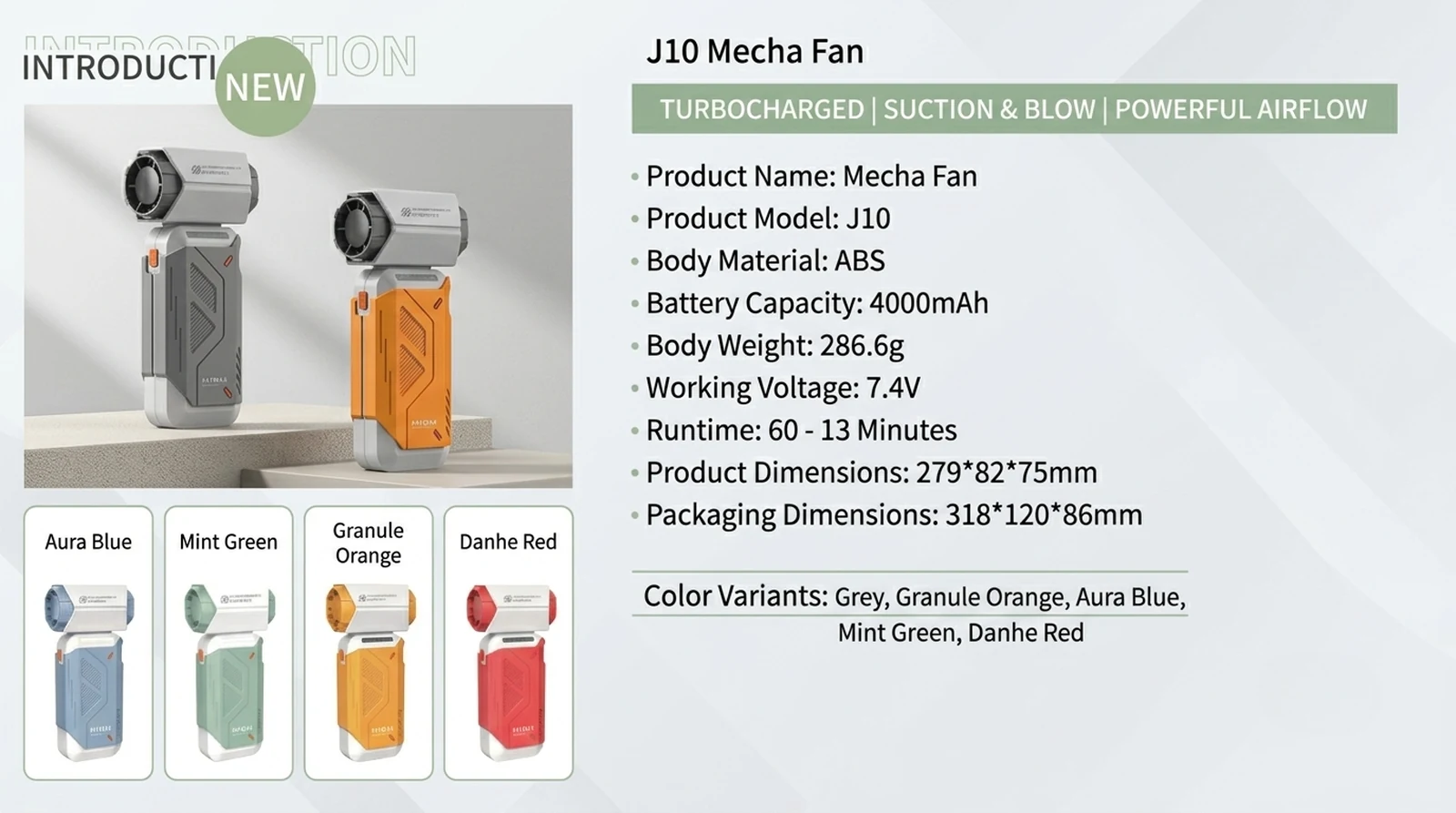
The turbocharged portable fan category has attracted dozens of OEM/ODM factories across Dongguan, Shenzhen, and the wider Pearl River Delta, which means importers see a flood of similar-looking catalogs and "factory-direct" pitches. A physical sample cuts through that noise because it forces the supplier to commit real materials, real tooling, and real assembly labor to a tangible unit. When a J10-class mecha fan arrives in its retail-style box, the buyer is holding in one hand the cumulative output of mold quality, PCB design, motor sourcing, and assembly discipline.
A sample is also the importer's only true chance to discover what the supplier has changed, upgraded, or quietly downgraded from the version shown in marketing renders. Many Chinese factories will photograph a premium prototype and then ship a cost-reduced sample unless the buyer specifies component lock-in. Treating the sample as a forensic object rather than a freebie changes the entire evaluation mindset.
For OEM/ODM buyers specifically, the sample answers three questions that no quotation sheet can: Is the mold mature or still showing flash lines? Is the stated 4000mAh battery a nameplate cell or a real spec? Will the stated airflow survive a 30-second turbo run without thermal throttling? Each of those answers is observable with basic tools in any home office or small warehouse.
Documentation to Request Before the Sample Ships
Before any unit leaves the factory, request a documentation packet that travels with the parcel. The minimum set should include a signed proforma invoice matching the unit's exact BOM, a material declaration sheet listing ABS grade, battery cell manufacturer, and motor supplier, and a one-page QC report from the supplier's own outgoing-inspection line.
Ask for high-resolution photographs of the sample in unboxing, top, bottom, and exploded view. A supplier unwilling to share a teardown photo of their own product is signaling something the importer should note. For a turbocharged handheld fan with a 4000mAh lithium pack, the documentation should also include a UN38.3 test summary for the battery and a basic MSDS sheet. These are not certifications — they are pre-certification paperwork that supports later CE, FCC, UKCA, RoHS, and REACH filings.
Finally, request the sample's serial number range and a copy of the supplier's outgoing-inspection checklist. If the factory uses a 4-stage QC system, ask which stages have been signed off for this specific unit. That paperwork becomes the baseline when comparing bulk-production samples against the qualification sample six months later.
Physical Build Quality Checks on Arrival
When the carton lands, the first ten minutes of inspection determine whether the rest of the evaluation is even worth running. Open the box on a clean, flat surface and photograph every step before discarding packaging. Look for visible mold flash along the parting lines, inconsistent surface gloss, and any color shift between mating plastic parts — these are classic indicators of a worn tool or a mixed ABS batch.
The J10-class mecha fan weighs approximately 286 grams assembled, and a deviation of more than 10 grams typically signals a thinner shell, a smaller battery, or a missing component. Use a small digital scale and log the weight against the spec sheet. Flex the housing gently along the seams; ABS should resist light torsion without creaking. A creak usually means the wall thickness was reduced to save material cost.
Check the buttons, the charging port flap, and the LED indicator for tactile feedback. Buttons that wobble, a flap that does not seat flush, or an LED that bleeds light around the bezel all suggest assembly tolerance problems that will compound at scale. Photograph anything suspicious and timestamp it.
Battery Cell Verification and Capacity Testing
A 4000mAh portable fan battery is the single most variable component in any Chinese sample shipment. Start by removing the battery compartment cover if user-serviceable, or asking the supplier for an exploded view showing the cell brand, format, and date code. Common nameplate cells include 18650 and 21700 formats from manufacturers such as EVE, BAK, or CATL; off-brand or unbranded cells are a major red flag for any product entering Europe or North America.
Charge the unit fully with a USB power meter inline to verify the actual charge current and termination behavior. A genuine 4000mAh cell at 5V/2A input should pull roughly 8–10Wh before the charger negotiates a taper. Then run the fan continuously on turbo mode and time how long it sustains usable airflow before dropping to a lower speed. Compare the runtime against the supplier's published spec — a 25% shortfall is a discussion point, a 40% shortfall is a stop-ship.
For deeper confidence, send one cell to a third-party testing lab for a full UN38.3 cycle or capacity verification. The cost is modest compared to a 5,000-unit production run that fails customs holding.
Motor and Airflow Performance Validation
The "turbocharged" claim on a handheld fan is only meaningful if the motor can sustain peak RPM without thermal protection cutting in. Use an anemometer at a fixed 30cm distance from the intake or output to record peak airflow in m/s, then convert to CFM for comparison against the supplier's stated figure. Take readings at low, medium, high, and turbo modes and log ambient temperature.
Run the fan on turbo for a full five minutes while monitoring the housing temperature with an IR thermometer at the motor cowling. A well-designed brushless motor should plateau around 45–55°C; anything above 65°C on the exterior surface suggests either a marginal motor or an insufficient heat path design. Listen for any rise in pitch, clicking, or bearing noise during the run — these are early signs of bearing wear that will worsen at scale.
If the supplier quotes a specific wind distance (for example, 7 meters of throw), validate it with a ribbon or paper strip at measured intervals. A 7-meter throw should noticeably move a tissue paper at that distance.
Noise Level and Vibration Assessment
Noise specifications on portable fans are notoriously inflated in Chinese marketing copy. A real-world decibel reading is one of the cheapest and most revealing tests an importer can run. Place the unit on a soft foam pad in a quiet room, hold a calibrated dB meter at 1 meter, and capture readings across each speed mode.
For context, a typical handheld turbo fan on turbo mode will produce 70–85 dB at 1 meter; anything marketed as "whisper quiet" above 60 dB should be questioned. More important than the absolute number is the tonal quality — a high-pitched whine at one specific RPM usually points to an unbalanced impeller or a loose magnet in the motor housing.
Vibration matters too. Hold the unit in a relaxed grip and note whether the housing buzzes against the palm. Excessive vibration on a 286g handheld is fatiguing and indicates either a bearing issue or a poorly tuned impeller. Both will generate warranty claims in the destination market.
Safety Certifications and Compliance Paperwork
A reputable Chinese OEM/ODM factory will assist the importer in obtaining the certifications required for the destination market — CE, FCC, UKCA, RoHS, REACH — but will not typically hold these certifications in the supplier's own name for an unbranded sample. What the buyer should expect and verify is the test readiness: EMC pre-scan reports, a RoHS material test on the actual production ABS, and a battery UN38.3 summary.
Ask the supplier which accredited lab they use — SGS, TÜV, BV, and Intertek are common across the Pearl River Delta — and request the lab contact so the importer can independently confirm report authenticity. Counterfeit or "shared" test reports are a recurring problem in this category. For products containing lithium batteries, also confirm the supplier can ship via air freight with the correct dangerous goods documentation, since some sample couriers will refuse lithium-bearing samples without proper paperwork.
A supplier who actively helps compile the technical file — circuit diagrams, BOMs, label artwork, user manual drafts — is signaling a mature export operation. A supplier who only forwards a generic PDF is signaling risk.
Packaging Integrity and Drop Test Indicators
Packaging is often the first casualty of cost-cutting on a Chinese OEM sample, and the importer pays for that later in transit damage rates. Inspect the retail box for board caliper — a digital caliper at the corners tells you instantly — print registration, and internal fit. The fan should sit snugly with no more than 4mm of lateral play inside its tray.
Conduct a simple drop test: drop the sealed retail box from waist height onto a hard floor from each of six faces. Open and inspect for cracked housings, displaced buttons, or a battery that has shifted internally. If the sample fails this informal test, expect a 2–4% transit damage rate at scale, which translates directly into margin erosion or customer complaints.
Also verify that the shipping carton for bulk export uses adequate EPE foam, corner protectors, and a double-walled outer. Ask the supplier for photos of their last export pallet loaded into a container.
Sample-to-Production Consistency Signals
The single biggest mistake a new importer makes is treating the qualification sample as identical to what arrives in the first 5,000-unit container. Chinese factories routinely approve a sample built on a fresh tool, then ramp production on a tool that has drifted, a cheaper cell lot, or a sourced motor from a secondary vendor.
To protect against this drift, lock the sample's BOM in writing before placing the production PO. Specify the exact battery cell manufacturer and model, the motor supplier, the ABS grade, and any branded components. Require the factory to retain the qualification sample on-site for the duration of the production run and to pull a comparison unit from each shift for visual and weight verification against the locked sample.
For buyers sourcing through an OEM/ODM partner in Dongguan like the network behind Xinmeili Technology, requesting a retained golden sample is standard practice and a strong signal that the supplier understands export-quality workflows. A supplier who refuses to hold a golden sample is telling the buyer that production may diverge, and the buyer should price that risk into the order. As more importers tighten their sample-evaluation playbooks, the factories that consistently meet remote qualification standards will rise to the top of the global B2B shortlists.
Related Articles
For an in-depth look at the J10 Mecha Fan's full specification profile, see our complete product breakdown. Buyers weighing battery safety protocols across multiple portable categories will also find the J10 battery and certification guide useful as a companion read. For a broader discussion of how Chinese OEM/ODM partners structure their pre-shipment inspection routines, see the turbocharged fan OEM/ODM sourcing guide on our sister editorial site, and a related portable fan import checklist for first-time buyers.
Frequently Asked Questions
How long does a thorough Chinese portable fan sample evaluation take from arrival to decision?
Most B2B importers allow 7–14 days for a complete qualification cycle, including unboxing and documentation review on day one, physical and battery tests across days two through four, motor and airflow validation across days five through seven, and a final certification review and supplier discussion in the second week.
What is the single most revealing test to run on a turbocharged handheld fan sample?
A continuous five-minute turbo run with IR thermometer and dB meter monitoring reveals more about motor quality, thermal design, and bearing integrity than any spec sheet. It surfaces thermal throttling, rising pitch, and vibration that would otherwise remain hidden in a short showroom test.
Can a B2B buyer qualify a Chinese OEM sample without ever visiting the factory?
Yes, with discipline. A structured remote workflow combining pre-shipment documentation, on-arrival physical inspection, instrumented performance testing, third-party battery verification, and a written BOM lock can identify a reliable OEM/ODM partner without an in-person factory visit.
For OEM/ODM specifications, custom packaging, or J10 Mecha Fan sourcing details, contact Gabor Lu at gaborlu@jlhy.cc or WhatsApp +86 18038304628.