Five Questions Importers Ask About J10-Style Mecha Fans Before Shipment
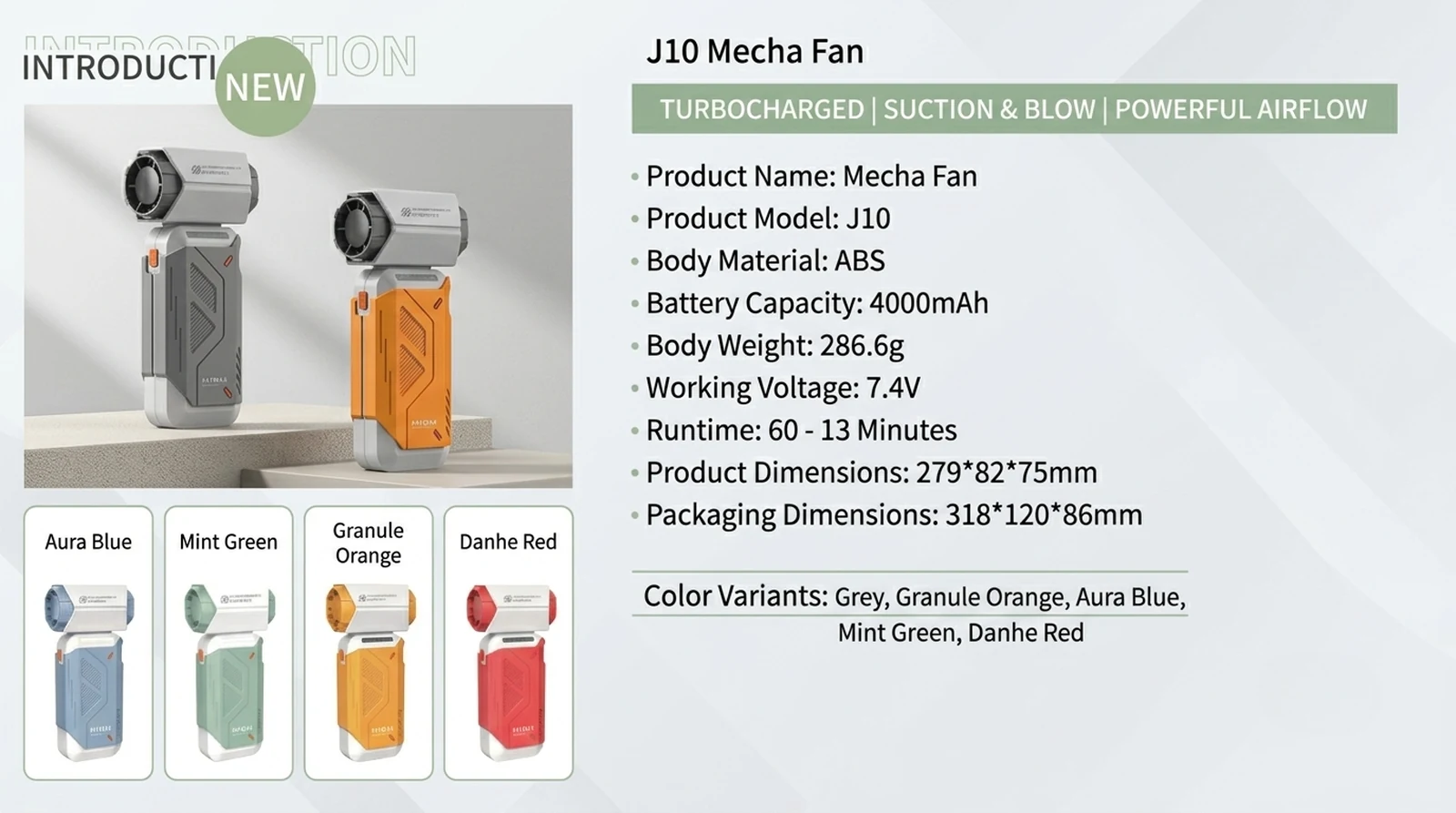

Handheld mecha fans built on a 4000mAh platform have moved from novelty shelves to mainstream retail in under three years, and the J10 has become a reference design that importers benchmark against. Before any container is booked, experienced buyers tend to ask the same handful of hard questions — not about the marketing brochure, but about the engineering, the supply chain, and the day the pallet arrives at their warehouse. This guide walks through the five questions that surface in nearly every serious J10-style inquiry, plus the supporting context that turns a generic product into a defensible SKU.
1. Which battery cell grade is actually inside the J10-style mecha fan, and can it be verified?
Battery misrepresentation is the single most common issue flagged in handheld fan QC reports. A spec sheet promising 4000mAh can hide a 3000mAh cell, a recycled 18650 pulled from a laptop pack, or a unit labeled with a tier-B manufacturer that the importer has never heard of. Before shipment, buyers should request the cell maker's datasheet — not the marketing one — and cross-check the model number against the manufacturer's own product line. A genuine 4000mAh cell from a tier-A supplier will be traceable to a published datasheet with cycle life, nominal voltage, and continuous discharge rating that matches the fan's load profile.
The J10 platform typically pairs the battery with a battery management system that protects against over-discharge, over-charge, and short circuit. Ask for the BMS cut-off voltage and the protection IC part number, both of which can be confirmed against the IC maker's website. An importer who skips this step is one customs hold away from a container of fans that swell, fail, or fail to ship under UN38.3 rules. For broader context on battery sourcing patterns that show up across handheld electronics, see our overview of B2B handheld fan sourcing on gaborhub.
2. How is motor RPM and airflow tested against the published spec?
The J10's violent or turbocharged performance comes from a high-RPM brushless motor, typically rated in the tens of thousands of revolutions per minute. RPM is easy to claim and hard to verify without the right equipment. Before shipment, ask the factory how they measure motor speed — a stroboscope, a tachometer, or an in-line current draw reading — and how often the test is performed during a production run.
Airflow, measured in CFM or cubic meters per minute, is the figure end-users actually feel. A responsible factory will have a wind tunnel or calibrated anemometer setup, even if it is a simple bench rig. Request a sample test report showing airflow at the highest speed setting with the fan held at a fixed distance from the sensor. Compare the result against the spec sheet; a deviation of more than 10% across five random samples is a red flag. For a deeper look at how motor performance is validated across the broader personal care appliance category, our analysis of high-speed motor QA on gaborhub walks through the same logic applied to hair dryers.
3. Are the plastics and surface coatings compliant for our target market?
The J10's housing is ABS, a tough, impact-resistant plastic that holds up well to drops and the heat generated by a high-RPM motor. ABS itself is generally considered compliant for most consumer markets, but the additives matter. Flame retardants, plasticizers, and colorants can introduce restricted substances that fail REACH in Europe, California Prop 65 in the United States, or similar frameworks elsewhere.
Before shipment, request a recent third-party test report — ideally less than 12 months old — covering heavy metals, phthalates, and the specific flame retardant family used. For European buyers, RoHS and REACH SVHC declarations are non-negotiable. For North American buyers, CPSIA applies to products marketed to children, which the J10 sometimes is given its toy-like appearance. If the importer cannot produce a clean report, the shipment can be detained at customs even if the fans themselves work perfectly.
4. What does a pre-shipment inspection actually look like?
A pre-shipment inspection, often called PSI or AQL-based inspection, is the importer's last chance to catch defects before the container is sealed. The most widely used standard is ANSI/ASQ Z1.4, with sampling levels tied to lot size and an Acceptable Quality Limit usually set at 1.0, 1.5, or 2.5 depending on how critical the defect category is.
For a J10-style fan, a thorough inspection will cover cosmetic checks such as scratches, color uniformity, and finish; functional checks across all speed modes, USB-C charging, and battery indicator accuracy; and mechanical checks on button tactile feel, grille stability, and a one-meter drop onto hardwood. A buyer who has never run an inspection should commission a third-party agency — Bureau Veritas, SGS, Intertek, or a domestic equivalent — rather than rely solely on the factory's own final QC. The factory's internal QC is typically a four-stage process covering incoming components, in-process assembly, pre-final testing on every unit, and a random audit of finished goods, which gives the importer a clear picture of where to layer their own third-party inspection.
5. How is the 4000mAh platform packed, and what fits in a standard carton?
Logistics is where many first-time importers leave money on the table. The J10 weighs 286.6g and measures within a footprint that packs efficiently into standard corrugated cartons. A typical export carton holds 30 to 60 units depending on inner tray configuration, with each unit individually poly-bagged to prevent surface scratching.
Before booking freight, ask for the factory's master carton dimensions and weight, then run a container-loading calculation. A 20-foot container typically accepts around 10,000 to 15,000 units depending on packaging choices, while a 40-foot high-cube can nearly double that. Including accessories — charging cable, lanyard, and any regional plug variants — adds weight that should be accounted for in the volumetric calculation, especially for air freight where chargeable weight is governed by dimensional rules. Lead time for a first order typically runs 30 to 45 days from deposit to ex-factory, plus ocean transit of 25 to 35 days to most major ports.
Why ABS is the right call for a mecha-style housing
ABS remains the dominant material for handheld fan housings because it balances three properties that matter for this category: impact resistance, heat tolerance, and surface finish quality. Polycarbonate blends offer higher heat resistance but cost more and are harder to mold into the textured, multi-color finishes that distinguish the mecha aesthetic. Polypropylene is cheaper but feels flimsy and does not hold paint or coatings as cleanly.
For an importer sourcing J10-style fans, the practical question is not whether ABS is correct — it usually is — but whether the specific ABS grade is rated for the temperature range the motor generates under continuous high-speed operation. A motor running at 40,000 RPM in a sealed housing can push surface temperatures higher than a casual user expects, and a low-grade ABS will deform over time. For buyers comparing the J10 platform to other handheld fan designs in the same category, our side-by-side comparison on j10fan lays out the spec differences in detail.
The 286.6g factor in shipping economics
A handheld fan's weight influences three numbers: per-unit freight cost, retailer's shelf or e-commerce fulfillment fee, and end-user perception of build quality. At 286.6g, the J10 sits in a sweet spot — heavy enough to feel substantial in the hand, light enough to keep parcel shipping costs reasonable.
For importers shipping by air, a 286.6g product with retail packaging that pushes the total parcel weight to around 400g is competitive against premium competitors that often weigh 500g or more. For ocean shipments, the per-unit freight cost difference between a 286g product and a 350g product is small but compounds across a container load. Heavier housings also tend to absorb vibration better during long sea voyages, reducing the rate of cosmetic defects on arrival.
What dual-use really means in product testing
The J10 is marketed as a suction-and-blowing fan, meaning the same motor and impeller assembly can either push air outward or, with the grille reversed, draw air inward for tasks like inflating air mattresses or clearing debris from work surfaces. This dual functionality is not just a marketing line — it changes what a tester should verify.
In a standard inspection, the suction mode is often skipped entirely because it requires a different airflow direction and a seal check on the reversible grille. A thorough buyer will ask the inspector to test both modes, confirm that the grille locks firmly in either orientation, and verify that the motor does not overheat when running continuously in suction mode against a blocked inlet. Skipping this step leaves a common warranty claim — grille loosening or motor stall in suction mode — entirely uncovered.
Lead time and capacity for first-time orders
Most reputable factories operating on a J10-style platform run a monthly capacity of 150,000+ units across their product lines, with the J10-specific line typically scaling to several tens of thousands per month. A first-time importer placing an MOQ of 500 to 1,000 units will sit at the front of the queue for the next production slot rather than waiting for a dedicated run.
MOQ flexibility is one of the more underrated advantages of working with an established OEM/ODM factory rather than a trading company. The factory can often accommodate small first orders because the J10's components — motor, BMS, ABS housing, USB-C port — are already in regular rotation. A trading company, by contrast, has to coordinate between the importer and the actual manufacturer, adding communication friction that surfaces as longer lead times and less direct feedback on quality issues.
Documentation importers should expect with each shipment
A clean shipment arrives with a specific set of documents: commercial invoice, packing list, bill of lading, certificate of origin (Form A, Form E, or Form F depending on the destination), and any required compliance certificates. For battery-powered products, the UN38.3 test report and the Material Safety Data Sheet are mandatory for air freight and increasingly requested for ocean freight as well.
Importers targeting Europe should also expect a Declaration of Conformity, the technical file, and any test reports supporting CE marking. For North America, FCC declarations apply if the device has any wireless functionality, which the J10 does not, but importers sometimes add a wireless charging variant that does. Documentation that arrives late or incomplete is one of the most common causes of customs delays, and it is almost always preventable with a documentation checklist shared at the PO stage.
Related Articles
For more on sourcing decisions that affect the J10 platform, see our battery sourcing guide for handheld electronics on j10fan and our overview of OEM/ODM personal care appliances on the XMT main site.
Frequently Asked Questions
How can I verify the J10 fan's 4000mAh battery capacity before shipment?
Request the cell maker's datasheet, not the marketing spec sheet. Cross-check the model number against the manufacturer's published product line and confirm cycle life, nominal voltage, and continuous discharge rating match the J10's load profile. A tier-A cell will be fully traceable to a public datasheet.
What should a pre-shipment inspection cover for a J10-style mecha fan?
A thorough PSI should include cosmetic checks (scratches, finish, color uniformity), functional tests (all speed modes, USB-C charging, battery indicator accuracy), and mechanical tests (button feel, grille stability, one-meter drop). Most buyers use ANSI/ASQ Z1.4 AQL sampling with limits of 1.0 to 2.5 depending on defect criticality.
How many J10 fans fit in a standard 20-foot container?
Depending on inner tray configuration, a 20-foot container typically accepts 10,000 to 15,000 units. A 40-foot high-cube nearly doubles that figure. Exact numbers depend on packaging choices and whether accessories like charging cables and lanyards are included in the master carton.
For OEM/ODM specifications, custom packaging, or J10 Mecha Fan sourcing details, contact Gabor Lu at gaborlu@jlhy.cc or WhatsApp +86 18038304628.