Portable Fan Runtime: Spec Sheet vs Real-World Testing — B2B Guide
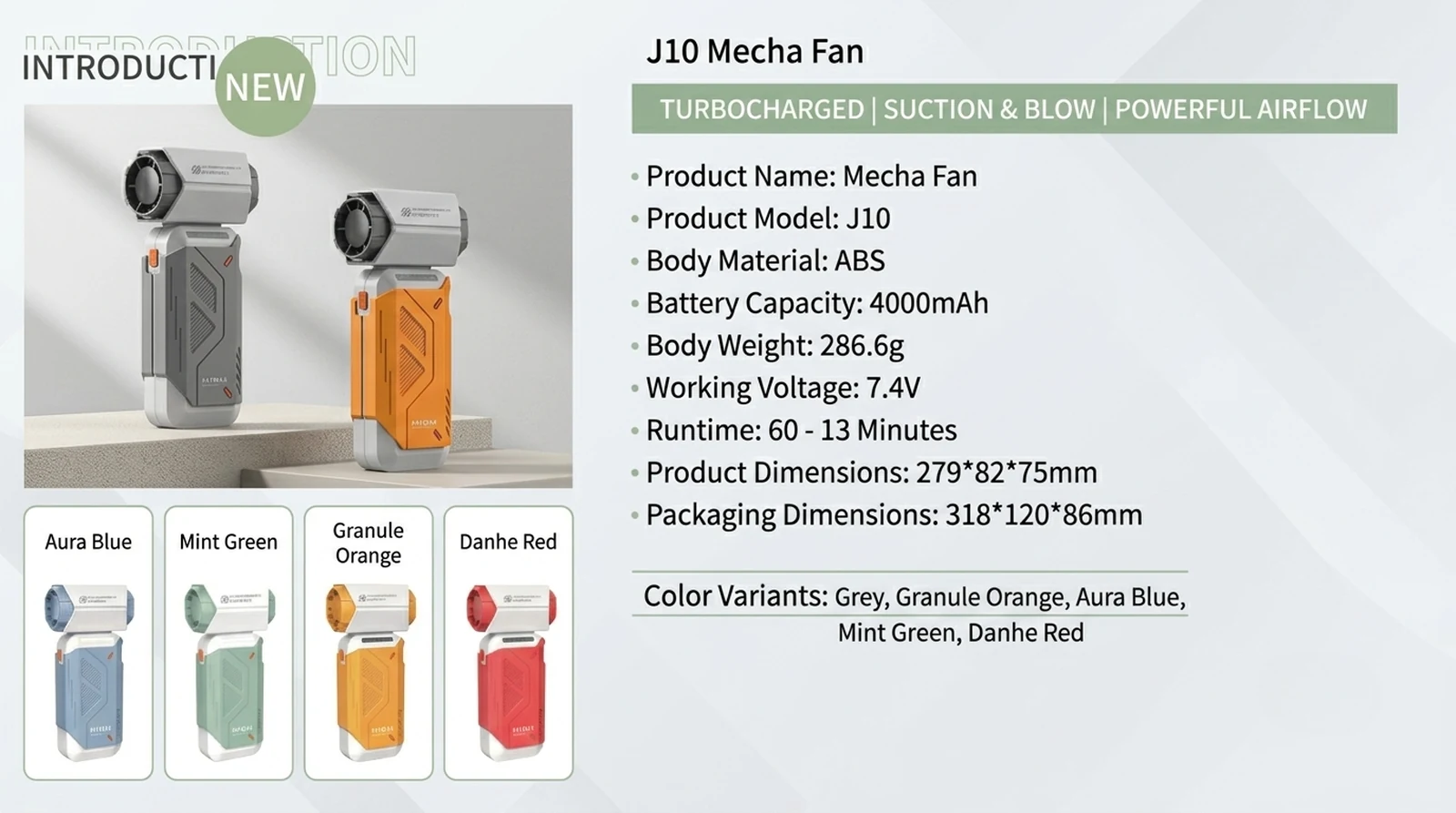

Portable fans have become one of the most spec-driven categories in personal care appliances, and runtime is the number buyers read first. Yet the gap between a printed claim and what a unit actually delivers in a user's hand has never been wider. For B2B importers, that gap is a brand risk before a unit even leaves the factory. Understanding where the divergence starts is the first step toward sourcing products that survive consumer review.
Why spec sheet runtime numbers deserve a second look
Spec sheet runtimes are usually measured at the lowest speed setting with a freshly charged battery at room temperature. That is a narrow, optimized condition that almost never matches how a real consumer uses a fan. Most end users run a portable unit at mid or turbo speed, often outdoors, and often for short bursts rather than continuous hours. When a buyer sees "X hours" on a product page, the assumption is that the number applies across the speed range. It almost never does.
Importers who skip this nuance end up with negative reviews months after shipment, by which point the cost of the problem is far higher than the cost of a more honest spec sheet from day one. A two-line clarification on the carton — speed, temperature, accessories off — is worth more than any marketing claim a factory adds to a one-pager.
The variable no spec sheet fully explains: speed setting
Every portable fan with more than one speed has at least two runtime numbers — one for low, one for high — and most modern units have three or four. The relationship between speed and battery drain is not linear; doubling the RPM often triples the current draw because motor load grows faster than speed. A unit rated for 8 hours at low speed may deliver only 2.5 to 3 hours at turbo, even though both numbers are technically accurate.
The honest spec sheet shows both ends of that range. The marketing-led one highlights only the longer figure and buries the rest. As an importer, asking the supplier for the runtime curve across all gears is a small request that catches a large class of misrepresentation early. If a factory cannot produce that curve on request, the printed headline number should be treated with caution.
How independent reviewers actually test portable fan runtime
Reviewers who publish credible battery test results usually follow a fixed protocol: full charge, rest the unit to room temperature, set a single speed, and log time to auto-shutdown. Some use a constant airflow chamber; others simply time the unit on a desk with a stopwatch. The stronger reviews run the same fan at three speeds and publish all three numbers, often with an ambient temperature reading alongside.
When you compare a fan's published spec against a reviewer's number, check whether the test was done at the same speed and same room temperature the spec implies. Mismatched conditions explain most of the apparent contradictions you will see between a manufacturer's page and a YouTube teardown. A 6-hour claim tested at low speed in a 22°C room is not the same statement as a 6-hour claim tested at mid speed outdoors in summer.
Battery capacity is only half the equation
Battery capacity, measured in mAh, tells you how much energy is stored, not how efficiently the fan uses it. Two portable fans with the same 4000mAh cell can have runtimes that differ by an hour or more depending on the motor controller, the blade design, and the parasitic drain of LED indicators and Bluetooth modules. The cell chemistry also matters: a lithium polymer pack rated at the same mAh as a lithium-ion 18650 array will deliver different usable capacity under high discharge.
Importers evaluating portable fans should treat the mAh number as a baseline input rather than a finished answer. Real runtime is the product of capacity times efficiency, and efficiency is rarely printed on the spec sheet. Asking the supplier for the no-load current draw and the rated-load current draw gets you closer to the true number than any headline figure.
Motor design and its hidden impact on endurance
Brushless high-speed motors are now standard in the premium portable fan segment, and they deliver measurably better runtime per watt than older brushed designs. The catch is that the controller electronics around the motor also consume power, and a poorly tuned driver can erase the motor's efficiency advantage. Variable frequency drives that ramp up smoothly generally outperform fixed-frequency designs on battery life because they avoid inrush spikes.
For B2B buyers sourcing higher-tier units, asking the supplier which motor platform is used and whether the controller is purpose-built or off-the-shelf can reveal where the runtime story really comes from. A custom controller on a quality brushless platform will almost always outperform a generic driver on a similarly rated motor. That single conversation can move an entire product tier.
Environmental factors that swing runtime by 30% or more
Ambient temperature, airflow direction, and humidity all affect how hard a fan has to work to move the same perceived volume of air. In hot weather above 35°C, the motor's internal resistance rises and the battery's effective capacity drops, sometimes shaving 20 to 30 percent off the rated runtime. Running a portable fan in direct sunlight compounds the effect because the housing absorbs heat and forces the motor to work against a higher thermal load.
None of this appears on the spec sheet, but all of it shows up in the consumer's experience. Importers shipping to tropical and subtropical markets should ask the supplier whether the runtime figure was validated at a realistic high-temperature setpoint, not only at the standard 25°C reference. A unit tested at 25°C and shipped to a 40°C market is a guarantee of disappointment.
What to ask your OEM supplier before signing off
A short list of questions separates a serious OEM partner from a quotation-only supplier. Ask for the runtime data at each speed setting, not just the headline figure. Ask whether the test was done at 25°C or some other reference temperature. Ask for the battery cell brand and the rated cycle life, since a cell rated for 300 cycles behaves very differently from one rated for 800. Ask whether the runtime figure includes LED indicators or Bluetooth active.
Each of these is a small, reasonable question that any capable factory should answer in writing. The answers, taken together, form a much more honest product specification than the marketing line on the front of the box. They also create a paper trail that protects the importer if a claim is later challenged in a consumer review or a regulatory audit.
Building a simple in-house runtime QC routine
For importers who want to verify claims themselves, a basic QC protocol is straightforward to set up. Pick three random units per shipment, charge to full, set to a fixed mid speed, and record time to shutdown at a controlled room temperature. A spread of more than 10 to 15 percent between units is a signal to investigate; a consistent shortfall against the rated runtime is a signal to escalate with the factory.
Even this lightweight routine catches the most common production issues — battery cell inconsistency, controller drift, motor variation — long before they reach end consumers. The cost is a few hours of technician time per batch, and the payoff is a return rate that stays in the single digits. As volume scales, the same routine scales; only the sample size needs to grow.
Setting honest consumer expectations from the spec sheet
The best portable fan brands in any market are not the ones with the longest printed runtime — they are the ones whose printed runtime matches what the user actually experiences. Publishing a runtime range instead of a single number is one of the simplest ways to build that trust. Pairing the figure with the conditions that produced it — room temperature, speed setting, with or without lighting — gives the consumer something to compare against their own use case.
For B2B importers, this is a positioning lever. A spec sheet that looks "shorter" on paper but reads as more credible in reviews will outperform a louder claim that breaks under real-world testing every time. Over the next product cycle, expect the brands that win on review scores to be the ones willing to publish conditions alongside their numbers.
Related Articles
For the platform-specific numbers behind this discussion, see our J10 Mecha Fan battery and motor breakdown. For a step-by-step on how to brief a factory on runtime requirements from first sample to mass production, our portable fan OEM guide walks through the full process.
Frequently Asked Questions
Why do spec sheet runtime numbers often differ from real-world performance?
Spec sheet runtimes are usually measured at the lowest speed setting with a freshly charged battery at 25°C. Real consumers typically run at mid or turbo speed, often in warmer conditions, so the actual delivered runtime is often 30 to 60 percent shorter than the headline figure when used normally.
What is the most common cause of shorter-than-rated runtime in portable fans?
The single largest cause is running at higher speed settings than the test condition. Because motor load grows faster than RPM, a fan rated for 8 hours at low speed may deliver only 2.5 to 3 hours at turbo, even though both numbers are technically accurate measurements.
How can importers verify portable fan runtime claims before shipment?
A lightweight QC routine works well: pull three random units per shipment, fully charge them, set to a fixed mid speed, and time to shutdown at a controlled room temperature. A spread over 15 percent between units or a consistent shortfall against the rated runtime is a signal to investigate or escalate.
For OEM/ODM specifications, custom packaging, or J10 Mecha Fan sourcing details, contact Gabor Lu at gaborlu@jlhy.cc or WhatsApp +86 18038304628.