Defining High-Wattage Handheld Platforms: 160W Peak Architecture
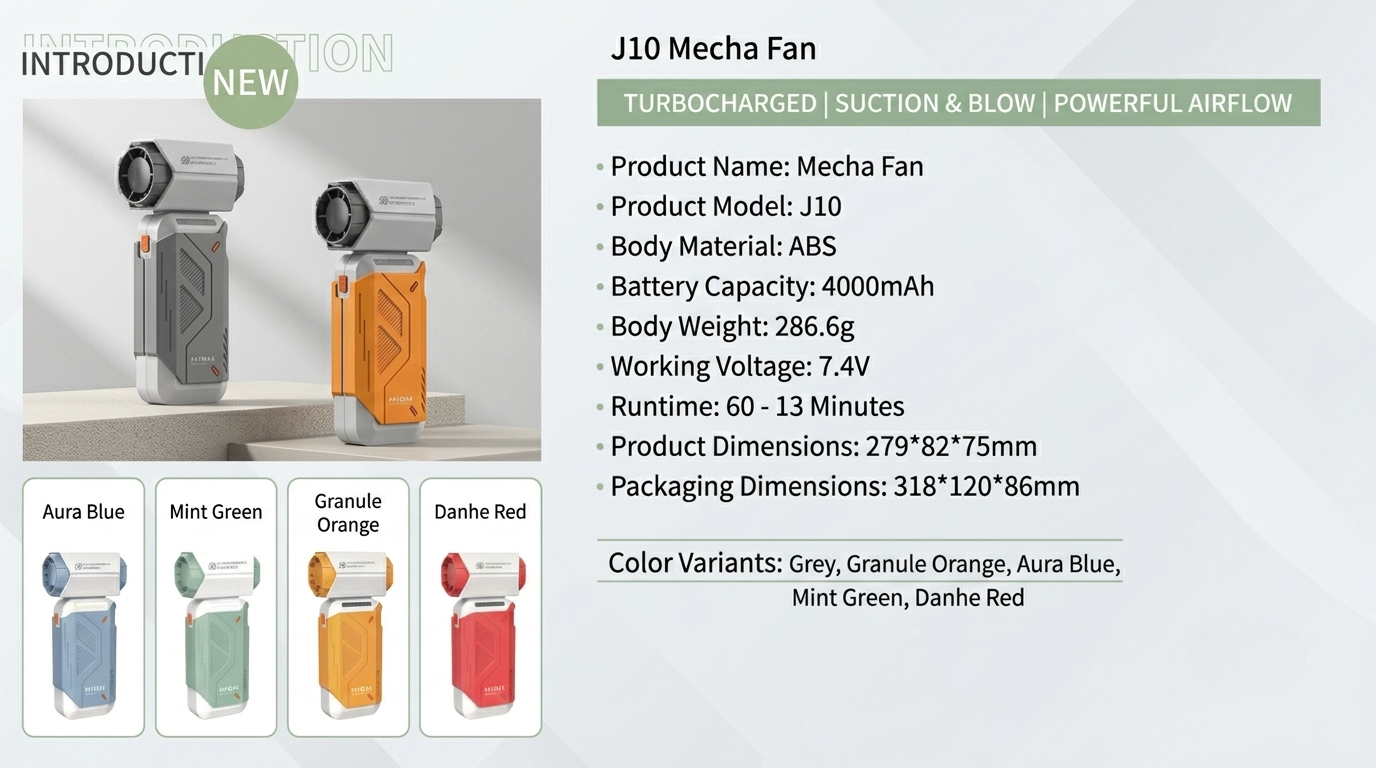
Handheld personal fans traditionally operated within modest 2.5W to 10W boundaries, relying on standard brushed or low-RPM brushless DC motors. Recent shifts toward multipurpose cleaning blowers, outdoor utility fans, and high-velocity personal cooling have driven the emergence of platforms reaching up to 160W peak power. When researching a portable fan OEM with 160W peak power Type-C fast charging, it is critical to understand that these peak ratings reflect transient dynamic output rather than continuous operational states.
To achieve 160W peak output, the motor controller must supply high burst current to a high-speed three-phase brushless motor. This requires robust electronic speed controllers (ESC) capable of handling transient inductive spikes without thermal breakdown. Importers evaluating these platforms must assess duty-cycle limits, as continuous operation at maximum power would deplete compact battery cells rapidly and generate unmanageable internal heat.
Type-C Fast Charging Protocols and Power Delivery Integration
Delivering high discharge capability necessitates equally capable replenishment systems. Integrating USB-C PD (Power Delivery) allows hardware to negotiate dynamic voltage profiles (such as 9V/2A, 12V/1.5A, or 20V configurations) rather than relying on standard 5V/1A or 5V/2A USB rails. When reviewing charging specs during procurement, engineering teams evaluate several protocol elements:
- PD Controller Handshake: Verification of hardware compatibility with standard PD 2.0, PD 3.0, or QC legacy protocols to ensure compatibility with varied consumer wall adapters.
- Step-Up/Step-Down Battery Charging: High-output platforms frequently utilize multi-cell series battery packs (2S, 3S, or 4S configurations). The onboard charging circuit must incorporate buck-boost topologies to charge higher-voltage cell packs safely from variable USB input voltages.
- Thermal Throttling on Charge: Fast charging generates heat in the power conversion stages. The firmware should systematically dial back input wattage if the ambient or pack temperature exceeds safety thresholds during replenishment cycles.
Thermal Management and High-C Battery Safety Considerations
Managing the electrical load of 160W peak output requires high-discharge lithium-ion cells, commonly rated for continuous C-rates well above standard consumer electronics. Standard 1C or 2C capacity cells suffer immediate voltage sag and severe thermal stress under high draw. OEM sourcing specialists prioritize cell selection and Battery Management System (BMS) logic to maintain long-term reliability.
Key safety and verification parameters include:
- Continuous vs. Burst C-Rate Rating: Ensuring cell chemistry (typically INR or IMR formulations) can sustain rapid pulse discharge without internal temperature spikes exceeding 60°C.
- Multi-Point BMS Protection: Protection against over-voltage, under-voltage, over-current, short-circuit, and dual-zone temperature sensing (monitoring both motor drivers and cell cores).
- Airflow-Coupled Dissipation: High-output designs often route a fraction of intake air across the motor casing and driver PCB to assist passive heat sinks.
- Regulatory Testing Standards: Compliance documentation must verify that packs satisfy UN38.3 transport standards, confirming stability against vibration, altitude, external short circuits, and thermal abuse.
Technical Factors for OEM Sourcing Evaluations
When conducting OEM sourcing for high-wattage personal fans, procurement teams should look beyond surface aesthetics and evaluate internal engineering trade-offs. Structural rigidity must withstand the mechanical torque and rotational forces produced by high-RPM impellers.
Sourcing from an established factory, such as XMT Global (Xinmeili Technology), requires an understanding of production infrastructure. Based in Dongguan, Guangdong, China, XMT Global operates a 3,000+ sqm facility with the capacity to produce 150,000+ units per month, supporting 30+ export markets. With over 10 years of experience as an OEM/ODM manufacturer, the factory maintains standardized commercial terms, such as an MOQ of 500 units and a typical lead time of 15 days, which buyers often use as a baseline for supply chain planning.
Comparison: Standard Handheld Fans vs. 160W Peak High-Velocity Units
The architectural divergence between everyday consumer fans and high-wattage airflow platforms spans motor topology, energy storage, and electrical safety standards:
| Specification Metric | Standard 5W USB Handheld Fan | 40W Brushless Utility Fan | 160W Peak High-Velocity Unit |
|---|---|---|---|
| Peak Motor Power | 3W - 5W | 30W - 40W | Up to 160W (Transient Peak) |
| Input Charging | 5V/1A (Standard) | 5V/2A or 9V/1.5A | USB-C PD (Up to 20V/5A) |
| Battery Config | 1S (3.7V) | 1S or 2S | 2S to 4S (7.4V - 14.8V) |
| Cooling Topology | Passive | Passive/Active | Active Airflow-Coupled |
Common Pitfalls in High-Speed Fan Procurement
Importers often encounter reliability issues when prioritizing cost over electrical architecture. A common error is neglecting the compatibility between the PD controller and the battery management system. If the charging handshake is poorly implemented, the device may fail to initiate a charge cycle with modern GaN chargers, leading to consumer returns. Additionally, failing to verify the specific C-rating of the lithium cells can lead to premature capacity fade, where the battery loses significant runtime after only a few dozen high-power cycles.
Frequently Asked Questions
- What certifications should I request for 160W portable fans?
- Buyers should confirm that the manufacturer provides documentation for CE, RoHS, FCC, UN38.3, UKCA, CCC, PSE, and KCC to ensure compliance with relevant regional market regulations.
- Why is 160W peak power difficult to achieve in portable devices?
- The difficulty lies in the thermal density. Managing the heat generated by the motor driver and the high-discharge battery cells in a handheld form factor requires advanced PCB layout and airflow path design to prevent thermal throttling.
- Does XMT Global (Xinmeili Technology) support private labeling?
- As an OEM/ODM manufacturer, XMT Global provides production services for brand owners, typically operating with a 500-unit MOQ and 15-day lead time for standard configurations.
- How does USB-C PD differ from standard charging for these fans?
- Standard USB charging is limited by voltage and current caps (usually 5V/2A). USB-C PD allows the device to negotiate higher voltages, enabling faster replenishment of the higher-voltage multi-cell battery packs required for 160W operation.