How Importers Evaluate Turbocharged Portable Fan Samples in 2026
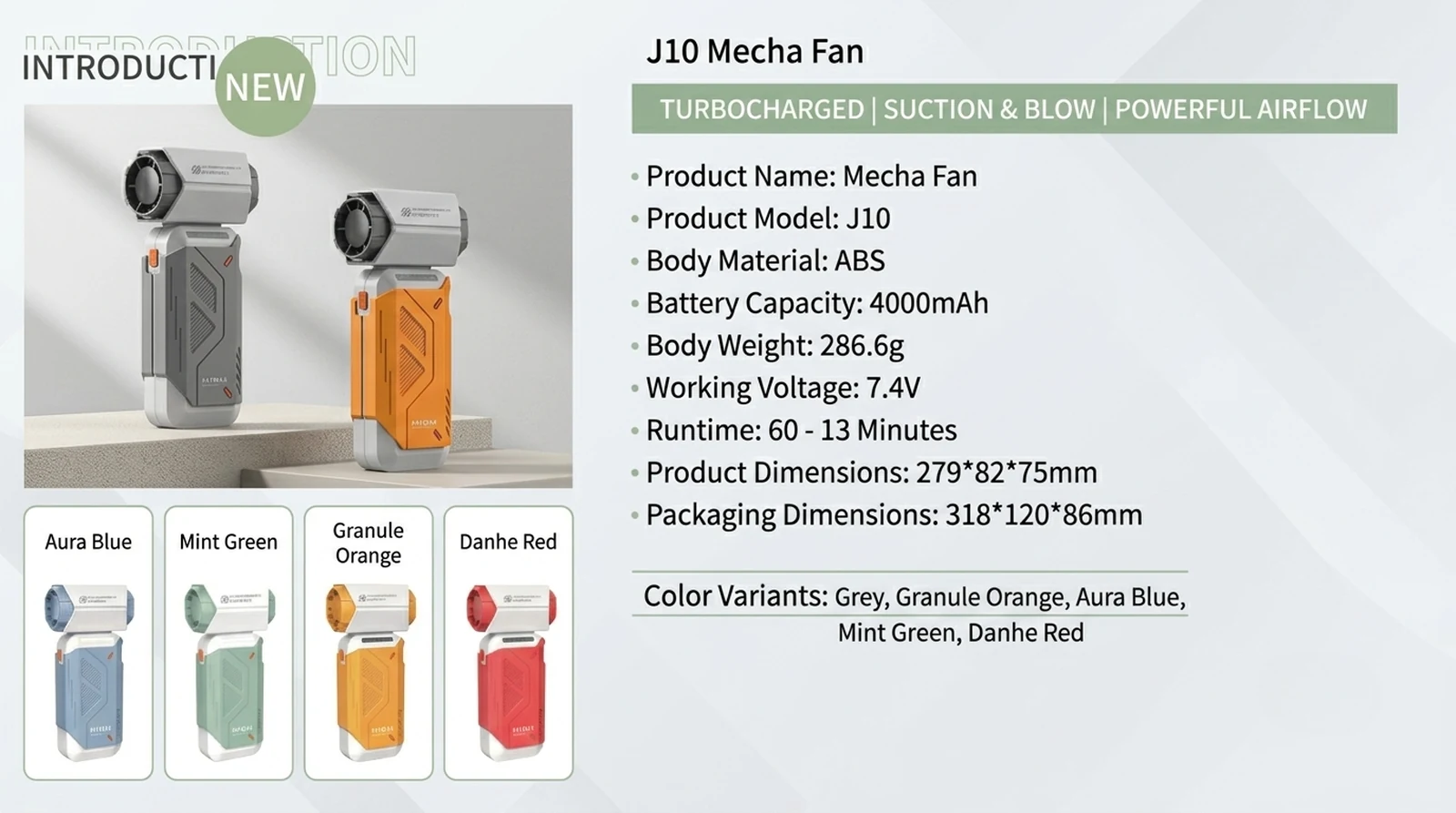

Importers running turbocharged portable fan programs in 2026 face a sample evaluation cycle that has shifted sharply from a decade ago. Cell-level battery scrutiny, EU regulatory tightening, and a new generation of brushless motor tuning have raised the bar on what counts as a passing sample. The J10 Mecha Fan platform — a 4000 mAh ABS-bodied, dual-use suction and blowing unit weighing 286.6 g — sits at the center of that conversation for many B2B buyers. Below is the working framework seasoned importers use to grade samples, flag risks, and decide whether to commit to a production run.
The 2026 Sample Evaluation Landscape
Sample evaluation for high-velocity portable fans is no longer a five-minute product unboxing. It has become a multi-day, multi-discipline triage where battery engineers, acoustic specialists, compliance officers, and brand managers all weigh in on the same physical unit. Importers building a turbocharged SKU — something in the J10 Mecha Fan class — now expect suppliers to deliver a sample accompanied by a preliminary test dossier, not just a retail-style box.
Three forces are reshaping that landscape. First, lithium-ion shipping rules and revised transport classifications mean importers want to see cell-level documentation long before a container is loaded. Second, North American and European retailers are pushing suppliers harder on acoustic transparency, asking for third-party decibel readings rather than vendor-supplied marketing numbers. Third, the dual-use suction and blowing format has matured — buyers no longer treat it as a novelty, and they expect sample validation to confirm both airflow directions work as claimed under continuous load.
First-Pass Unboxing and Build Quality Signals
The first 30 minutes of any serious evaluation are tactile and visual. Importers want to know how the sample arrives, how the ABS shell is finished, how the seams align, and whether moving parts (the blower nozzle, the intake cap, the mode selector ring) feel tight or loose. For a J10 Mecha Fan class unit, the evaluator typically checks the drop-seam line where the two shell halves meet, the consistency of the mecha-style cosmetic panels, and the integrity of the rubberized grip zones.
Weight is also confirmed against spec sheets — 286.6 g is the published figure for this platform, and a sample that drifts noticeably above or below that target can signal shell-thickness inconsistency between the engineering unit and the production tooling. Smart importers weigh three or four units from the sample batch, not just one, to catch lot-to-lot drift inside what the supplier calls a single sample shipment.
Battery Performance and Thermal Stability Testing
Battery behavior is where most 2026 sample failures happen. A 4000 mAh cell is a meaningful energy store, and turbo mode on a brushless platform can pull aggressive current from a fan in this class. Importers typically cycle the sample through three regimes: idle / low RPM, mid RPM, and turbo boost, recording voltage sag, surface temperature at the battery housing, and runtime-to-cutoff.
The thermal map matters because consumers routinely hold these fans against skin, lean them against fabric, or clip them to baby strollers. A sample that runs hot under turbo load for more than a few minutes is a red flag, regardless of how the spec sheet reads. Importers also request the cell supplier's UN38.3 report, MSDS, and a sample-level cycle-life projection. For OEM/ODM programs, the supplier should be able to swap cell vendors for specific destination markets — a level of flexibility the J10 Mecha Fan platform is typically built around in Dongguan engineering pipelines.
Motor Tuning and Airflow Bench Testing
Turbo mode on a portable fan is only meaningful if it can be measured. Importers run bench tests with an anemometer at fixed distances (typically 0.5 m, 1 m, and 1.5 m) at the nozzle exit and downstream. They log RPM ramp time from cold start to peak, peak sustained RPM, and how quickly the motor drops back to a steady-state cruise once the boost timer ends.
A well-tuned sample, like the J10 Mecha Fan class, will hit a published peak CFM within a few percent of the spec and hold there for the duration of the turbo window without audible hunting or pulse-width modulation whine. Sample units that overshoot the spec by 20–30% are often running beyond their thermal envelope, which importers flag as a warranty risk for the first 90 days of retail life. The evaluation here is not whether the fan is fast — it is whether the fan is fast in a way the production line can replicate, batch after batch.
Noise Profile and Acoustic Verification
Acoustic performance is the single most common reason a sample gets shelved in 2026. Importers use a Class 1 sound level meter at 1 m on axis, recording readings across low, mid, and turbo modes, and they often request an A-weighted third-octave band plot rather than just an overall dB number.
For dual-use products that blow and suck, the noise profile changes shape depending on the airflow path, so the sample must be measured in both orientations. A unit that reads quiet on intake but loud on exhaust has an internal ducting imbalance — something an OEM partner should be willing to redesign before tooling locks. The 120+ employee engineering floor that supports a platform like the J10 Mecha Fan typically has acoustic prototyping capability in-house, and importers use that as a checkpoint during the sample phase rather than discovering the issue at mass production.
Material Compliance and Certification Pathways
Sample-stage compliance work has compressed dramatically. Buyers targeting Europe, North America, the UK, Australia, and parts of the Middle East expect the OEM partner to map out which certifications are required and which the supplier can help obtain, versus which the importer holds. For a fan in this category, the typical matrix includes CE, FCC, UKCA, RoHS, REACH, and often a destination-specific lithium battery transport file.
A serious supplier flags the certification cost, the lab lead time, and the testing schedule during the sample phase, not after tooling has been paid for. Importers confirm that ABS resin documentation is on file, that no restricted phthalates appear in any soft-touch grip zones, and that any printed mecha graphics use compliant inks. The J10 Mecha Fan class unit, with its ABS body and external-facing cosmetic panels, sits inside a fairly standard compliance envelope, but each destination market adds its own overlay.
Ergonomics, Grip, and Form Factor
Ergonomic evaluation is where importer brand managers and engineers tend to disagree, which is exactly why it belongs in the sample phase. The unit has to fit adult male hands, female hands, and smaller teen hands without strain during a 30-minute handheld session. The 286.6 g mass sits in a middle band that is light enough for one-handed use but heavy enough to feel substantial — a design intent that has to come through in the sample.
Evaluators also test single-hand mode switching, including the ability to swap between suction and blowing without repositioning the grip. Rubberized zones, balance point, and trigger reach all get scored against a competitor set, typically three to five rival units the importer has also sampled. Any ergonomic regression against that benchmark is a rework request before the production tooling is signed off.
Dual-Use Suction and Blowing Validation
The dual-use format — where the same fan doubles as an inflator or vacuum pickup — is no longer a marketing footnote. Importers now treat it as a core SKU feature with its own validation track. Sample tests cover how cleanly the unit reverses airflow, how much residual pressure holds in the intake path when the mode flips, and whether any debris (dust, lint, packaging fragments from the box itself) gets pulled into the motor housing during the suction cycle.
A mature sample, such as the J10 Mecha Fan class, will demonstrate a clean mode reversal under 1.5 seconds and will include a removable intake screen that can be rinsed. Importers routinely run 50 mode-cycle repetitions on a single sample to surface latch wear or switch fatigue before approving mass production.
Sample-to-Production Consistency
The most underrated part of sample evaluation is asking what happens between the sample and the first production run. Tooling wear, ABS batch variance, and motor sourcing changes can all move a finished unit away from the sample that was approved. Smart importers require the supplier to commit in writing to a golden-sample reference, a deviation tolerance window, and an ongoing AQL plan.
For an OEM/ODM operation running 150,000+ units per month of capacity, that production discipline is what separates a real factory-direct partner from a trading agent. Buyers should ask to see the in-line QC checkpoints, the lot retention policy, and what happens if a production batch drifts outside the golden-sample tolerance — replacement, rework, or price renegotiation.
Documentation, IP, and Supplier Reliability
The final sample-stage checkpoint is paperwork and trust. Importers want a bill of materials, a tooling ownership letter, a confidentiality framework for any custom mecha graphics or branding, and a clear communication path back into the supplier's R&D team. The 15 R&D engineers supporting a platform like the J10 Mecha Fan typically work directly with the importer's product manager during the sampling window, which shortens the iteration loop considerably.
Importers also confirm that the supplier has shipped into 30+ countries and can produce reference customers, recent inspection reports, and a financial stability signal — all of which de-risk the OEM/ODM relationship before the first PO is cut. As the 2026 sourcing cycle matures, that supplier-side transparency is becoming as important as airflow benchmarks in deciding which sample moves forward. For a deeper look at how battery spec sheets get verified during sample intake, see our [guide on portable fan battery safety](https://j10fan.com/articles/portable-fan-battery-safety-guide/), and for a wider sourcing-side view, the [B2B sample evaluation process walkthrough](https://gaborhub.com/articles/b2b-sample-evaluation-process/) on Gabor Hub covers the cross-category framework importers use across product types.
Related Articles
- [J10 Mecha Fan OEM customization guide for 2026 programs](https://j10fan.com/articles/j10-mecha-fan-oem-customization-guide/)
- [Turbo fan QC checklist for importers](https://j10fan.com/articles/turbo-fan-qc-checklist-importers/)
Frequently Asked Questions
How long does a typical sample evaluation take for a turbocharged portable fan?
Most B2B importers run a two to four week evaluation window for a turbocharged portable fan sample, covering unboxing inspection, battery cycling, airflow bench testing, acoustic measurement, ergonomic trials, and dual-use validation. The timeline extends if the importer requests third-party lab retests or custom cosmetic changes.
What certifications should an importer expect at the sample stage?
At the sample stage, importers should expect the OEM partner to map and help obtain the relevant certifications for each destination market — typically CE, FCC, UKCA, RoHS, and REACH, plus destination-specific lithium battery transport files. Sample-stage paperwork should also include cell-level UN38.3 reports and MSDS.
How do importers verify motor performance during sample testing?
Importers verify motor performance by logging RPM ramp time, peak sustained RPM, and steady-state cruise behavior using an anemometer at fixed distances (0.5 m, 1 m, and 1.5 m) from the nozzle. They also check whether peak CFM matches the spec within a few percent and whether the unit holds that performance without thermal drift or audible motor hunting.
For OEM/ODM specifications, custom packaging, or J10 Mecha Fan sourcing details, contact Gabor Lu at gaborlu@jlhy.cc or WhatsApp +86 18038304628.