When selecting handheld fan materials for high-speed personal electronics, structural integrity and thermal dissipation serve as critical engineering baselines. High-RPM devices generate internal motor heat and mechanical vibrations that place sustained stress on internal ribs, motor mounts, and outer enclosure shells. Sourcing teams and product managers commonly evaluate housing materials under commercial OEM/ODM manufacturing standards to ensure enclosures maintain dimensional stability across international supply chains.
The structural framework of a premium handheld fan must support a high-speed brushless motor assembly while providing adequate impact resistance against accidental drops. Outer housing materials must also resist deformation near thermal zones surrounding the stator and lithium-ion battery compartment. Selecting an appropriate resin and metal combination helps prevent housing cracking, acoustic resonance, and thermal degradation over the operational lifespan of the unit.
Primary Housing Polymers: ABS Plastic vs. PC Alloys
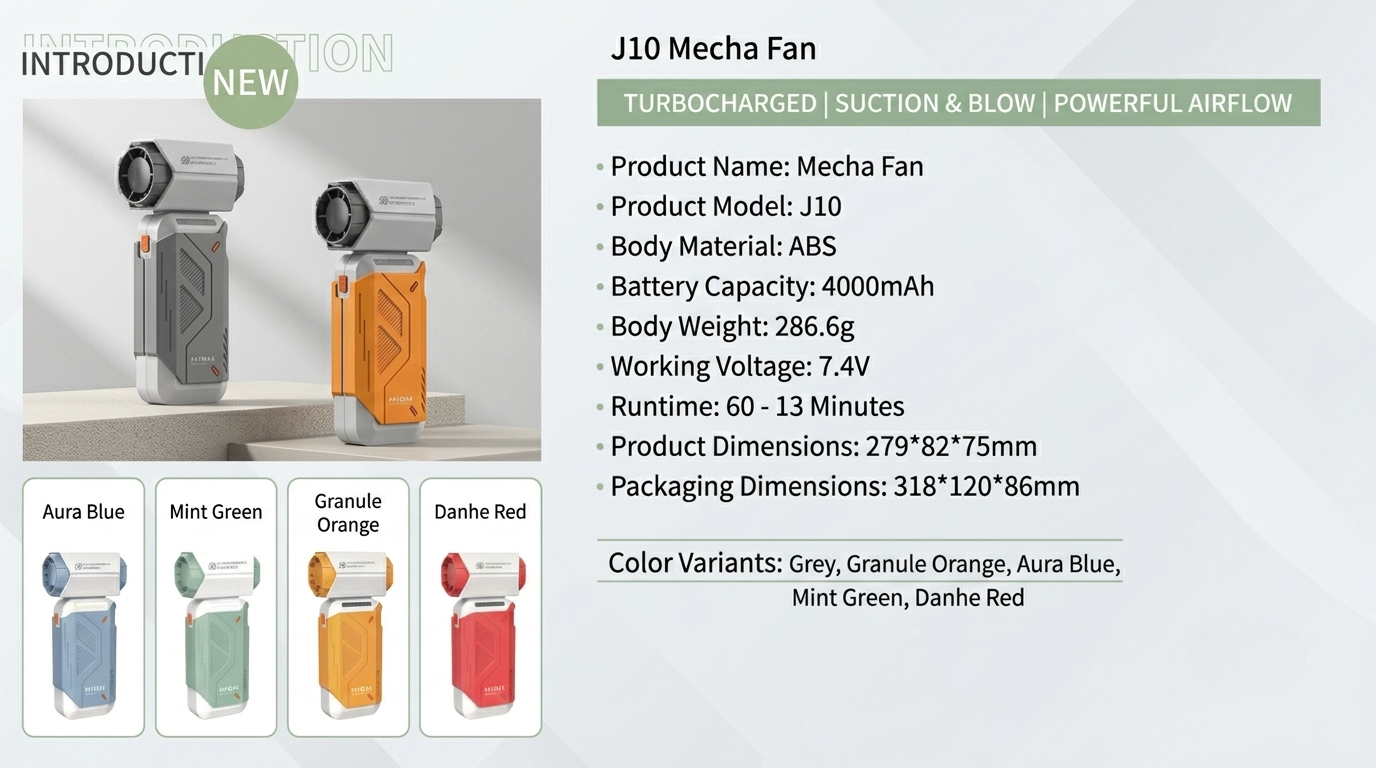
Acrylonitrile Butadiene Styrene (ABS plastic) is a widely utilized polymer resin for personal fan housings due to its balanced mechanical properties, stable injection molding shrinkage, and cost efficiency. Standard ABS plastic provides reasonable rigidity and consistent surface gloss, making it common for everyday consumer electronic housings.
For high-performance mecha fans, engineering teams frequently specify Polycarbonate (PC) or PC/ABS blends. Polycarbonate raises heat deflection thresholds and significantly improves drop impact resistance compared to standard ABS plastic alone. Sourcing managers evaluating handheld fan materials generally review three main polymer options:
- Standard ABS Plastic: Cost-effective material offering moderate impact strength and good surface coating compatibility. Suitable for baseline handheld housings operating under standard ambient temperatures.
- PC/ABS Alloy: Combines the molding fluidity of ABS plastic with the higher thermal threshold and structural toughness of polycarbonate. Commonly evaluated for high-velocity fans containing high-RPM motors.
- Flame-Retardant PC/ABS (V-0 Rated): Specified around battery housings and electronic circuitry where heightened flame-retardant compliance is required by destination market import regulations.
Metal Reinforcements: The Role of Aluminum Alloy
Integrating metallic elements into handheld fan construction serves both mechanical and functional purposes. Aluminum alloy is frequently specified for structural rings, internal heat transfer brackets, air duct bezels, and decorative trim pieces. Due to its low density and favorable thermal conductivity, aluminum alloy provides reinforcement without introducing excessive hand-carry weight.
In high-speed mecha fan architectures, aluminum alloy bezels and motor collars assist in dissipating heat away from the brushless stator and driver circuit. Precision-machined aluminum components also provide structural rigidity along seams, helping the assembled casing resist twisting or flex when subjected to external pressure.
Surface Finishes and Decorative Coating Technologies
The choice of surface treatment influences tactile feel, wear resistance, color uniformity, and long-term durability against environmental exposure. Common surface coating methods for high-speed handheld fan enclosures include:
- Matte Spray (Soft-Touch Feel): Delivers an even, glare-free matte appearance and smooth hand grip, though buyers usually evaluate abrasion resistance over extended friction testing.
- UV Protective Clear Coating: Provides a hard, scratch-resistant barrier that helps mitigate discoloration caused by sun exposure and skin oils.
- Electroplating: Deposits a thin metallic layer onto ABS plastic substrates, delivering a metallic gloss for air intake grilles, side accents, and control rings.
- Anodizing (for Aluminum Alloy Components): An electrochemical process applied to aluminum alloy parts that generates a durable oxidation layer resistant to corrosion, enabling precise metallic color matching.
Comparative Material Selection Matrix for B2B Importers
The following table outlines standard material combinations used in high-speed handheld fan manufacturing, comparing structural performance, thermal behavior, weight, and tooling considerations:
| Enclosure Material Combination | Drop Impact Resistance | Thermal Resistance | Relative Weight | Tooling & Production Impact |
|---|---|---|---|---|
| Standard ABS Plastic | Moderate | Standard (<85°C) | Lightweight | Standard tooling; lowest unit material cost |
| PC/ABS Alloy | High | High (<110°C) | Lightweight to Moderate | Standard tooling; stable cycle times |
| PC/ABS + Aluminum Alloy Accents | Very High | High (<110°C) | Balanced Hand Feel | Requires secondary CNC or stamping fixtures |
| Full Aluminum Alloy Shell | Maximum | Maximum (>150°C) | Heavier | Higher tooling investment; slower cycle time |
Factory Sourcing, Tooling, and Quality Standards
Evaluating material durability requires reviewing the supplier's production environment and quality control framework. An established OEM/ODM manufacturer operating from industrial manufacturing centers like Dongguan, Guangdong, China, maintains standardized injection molding, surface coating, and assembly lines under controlled conditions. Facilities supporting scalable manufacturing—such as operations with 150,000+ units/month capacity across 3,000+ square meter footprints—routinely run standardized drop testing, thermal cycle evaluations, and fitment checks across high-volume production batches.
For international consumer electronics brands distributing across global channels, material choices must directly align with regulatory compliance. Enclosure materials, internal plastics, and battery brackets should be qualified to clear mandatory testing regimes, including CE, RoHS, FCC, UKCA, CCC, PSE, and KCC. Furthermore, complete handheld fan units containing rechargeable lithium cells require verified UN38.3 compliance to ensure transport safety during air and ocean freight.
Brand owners planning custom colors or metal accent trims should also evaluate commercial order parameters. Established OEM/ODM supplier programs, such as those coordinated through XMT Global (Xinmeili Technology), commonly offer accessible entry thresholds such as a 500-unit minimum order quantity (MOQ) and production lead times around 15 days, allowing brands to launch customized colorways without excessive inventory exposure.
Common Sourcing Mistakes in Material Specification
Commercial buyers sourcing handheld fan materials should guard against several frequent specification pitfalls:
- Underestimating Motor Thermal Output: Selecting standard low-temperature ABS plastic for high-RPM fans can lead to enclosure warping near motor mounts during extended operational run times.
- Overlooking Wall Thickness Uniformity: Inconsistent wall sections in injection tooling can cause sink marks, warping, or internal stress points that compromise drop resistance.
- Ignoring Chemical Resistance: Enclosure surfaces regularly contact sunscreen, hand lotions, and skin oils; omitting protective UV or hard coatings may result in early surface peeling.
- Focusing Exclusively on Metal Construction: While all-metal housings provide premium rigidity, they add significant unit weight and increase tooling expenditure without necessarily improving air velocity performance.
Frequently Asked Questions
Why is PC/ABS alloy preferred over pure ABS plastic for high-speed handheld fans?
High-speed fans utilize motors operating at higher rotational speeds, generating localized heat and structural vibration. PC/ABS alloy provides higher heat deflection temperatures and superior impact resistance compared to pure ABS plastic, reducing the risk of casing deformation or cracking during drop events.
How do aluminum alloy accents affect handheld fan manufacturing lead times?
Incorporating secondary aluminum alloy components requires separate stamping, CNC machining, or anodizing steps prior to final assembly. However, working with a standardized OEM/ODM manufacturer allows parallel parts processing, often maintaining turnaround schedules within standard 15-day production lead times for standard catalog-based configurations.
What material certifications are required for importing handheld fans into retail markets?
Importing into major regional markets requires documented proof of material safety and electrical compliance. Importers should confirm that housing plastics and finished units hold certifications including CE, RoHS, and FCC, along with UN38.3 documentation for the internal lithium battery assembly.
What is the typical minimum order quantity (MOQ) for custom-colored handheld fan materials?
While custom tooling requires substantial order volumes, standard color injection or established finishing options through OEM/ODM suppliers like XMT Global can often be arranged at accessible thresholds, typically starting around 500 units per production run.