J10 Mecha Fan Versus Regular Portable Fans: What B2B Buyers Should Compare
Portable fans have split into two visual and functional camps: the conventional pocket-sized blower and the mecha-styled industrial design led by products like the J10. This guide breaks down what importers and category buyers should actually compare.
J10 Mecha Fan Versus Regular Portable Fans: What B2B Buyers Should Compare
The portable fan category has quietly split into two distinct product directions. On one side sit the familiar slim, palm-sized rechargeable blowers that have filled travel kits and office desks for the better part of a decade. On the other side sits a newer aesthetic — chunky, industrial, knurled, and clearly inspired by sci-fi props and tactical gear. The J10 Mecha Fan is the clearest expression of that second direction on the market today, and it raises a real sourcing question for B2B buyers: are you comparing two products that target the same shelf, or two products that target genuinely different shoppers?
This guide walks through the comparison categories that actually matter when you are evaluating mecha-style fans against conventional portable fans for retail, e-commerce, or promotional distribution. We focus on form factor, motor and battery characteristics, use-case fit, and the downstream retail appeal that drives reorder velocity.
What "Regular" Versus "Mecha-Style" Actually Means in This Category
Before comparing specifications, it helps to define the two design languages, because the difference is more than cosmetic.

**Regular portable fans** are defined by a few recurring design choices: a thin oval or rounded-rectangle housing, a flat or slightly recessed blade guard that integrates seamlessly into the shell, soft-touch plastic finishes, and a generally discreet visual footprint. The form language prioritizes blending in — on a desk, on a nightstand, in a tote bag, or clipped to a stroller.
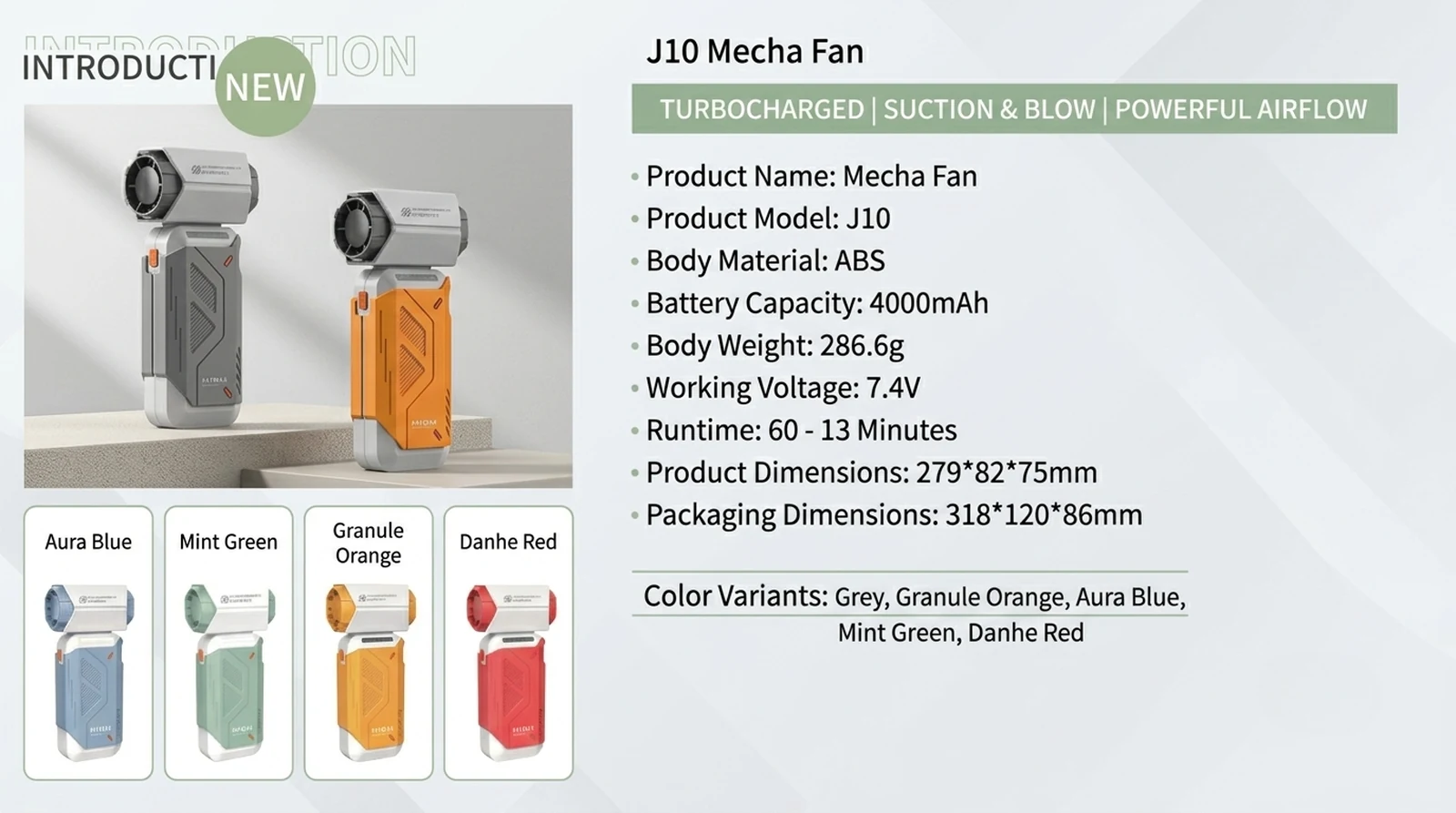
**Mecha-style portable fans** borrow directly from industrial, tactical, and sci-fi prop design. The J10 and its closest peers feature exposed fasteners, knurled grip surfaces, ribbed barrel housings, accent panels in contrasting colors, and visible structural lines that suggest a piece of equipment rather than a consumer accessory. The blade guard is often raised or recessed in a way that mimics an intake vent, and tactile controls (dials, switches, guarded buttons) replace the smooth touch interfaces common in the conventional category.
The aesthetic difference is the most obvious one, but it carries through into the underlying engineering choices — heavier gauge plastics, more structural ribs in the housing, and visible component segmentation — which is why mecha-style fans tend to feel denser in the hand even when overall dimensions are similar.
Form Factor, Weight, and In-Hand Feel
Form factor is where the J10 and a conventional portable fan diverge most visibly, and it is the single biggest factor influencing how a buyer describes the product on shelf and online.
**Dimensions.** Most regular portable fans are designed to disappear into a laptop sleeve or jacket pocket. They prioritize a thin profile, typically under three centimeters at the thickest point, and a footprint no wider than a smartphone in landscape orientation. The J10, by contrast, is built around a barrel-style housing that reads as a small piece of equipment rather than an accessory. Its proportions are taller and more cylindrical, which means it occupies a different pocket geometry — it fits in a jacket pocket or cargo pocket comfortably but is not designed to slip flat into a tablet sleeve.
**Weight.** Weight comparison is straightforward: regular portable fans are engineered for minimum carry weight, often landing in the 150-gram range without accessories. Mecha-style fans, including the J10, deliberately trade a small amount of carry weight for in-hand presence. The added mass is partially structural reinforcement and partially the result of larger battery packs and more substantial motor assemblies. In practice, this means the J10 sits on a desk with a planted, tool-like steadiness that lighter fans do not.
**Tactile feedback.** Regular fans rely on capacitive buttons or membrane switches that are flush with the housing. The J10 uses raised, knurled controls that give a more deliberate actuation feel. For B2B buyers, this is worth flagging because the tactile difference is one of the first things retail reviewers mention, and it tends to polarize opinions — buyers should sample both before committing to a category direction.
**Materials and finish.** Conventional fans lean on soft-touch matte plastic with minimal surface variation. Mecha-style finishes typically combine matte and satin textures, sometimes with metallic-effect accents. Both approaches use ABS and polycarbonate in the main shell, but the J10's segmented panel construction makes secondary finishing steps more visible and gives QC teams more individual surfaces to inspect.
Battery Life and Motor Specifications That Matter to Buyers
Buyers who only look at headline battery numbers miss the variables that actually determine end-user satisfaction. The honest comparison requires looking at three things in parallel: cell capacity, runtime at realistic settings, and the motor's airflow-per-watt efficiency.
**Battery capacity.** Both categories use single-cell lithium-ion packs in the 3.7V to 5V range, charged over USB. Capacity is comparable across the two styles at similar price tiers — what differs is how that capacity is consumed. Mecha-style fans often drive larger brushless motors at higher RPM ranges to deliver the more aggressive airflow their housing shapes suggest, which can pull runtime down at the highest setting. Regular fans are tuned for longer endurance at moderate output.
**Realistic runtime.** Manufacturers quote runtime at the lowest speed setting, which is almost never how the product is actually used. Buyers evaluating the J10 should request runtime curves at minimum, medium, and turbo settings from the supplier, and compare those curves against the same three points on any conventional fan they are evaluating. A mecha-style fan at medium setting should be benchmarked against a conventional fan at medium setting, not against a conventional fan's lowest setting quoted on the box.
**Motor type.** Brushless DC motors have become standard across both categories. The relevant differentiator is motor size and the blade geometry it drives. Mecha-style fans tend toward slightly larger blade diameters and higher RPM, which produces a more directional, concentrated airstream. Conventional fans produce a wider, softer cone of airflow. Neither is objectively better; they serve different use cases.
**Charging interface.** USB-C is increasingly standard in both categories, but legacy Micro-USB still appears at the budget tier. For B2B buyers selling into markets where charging cable standardization matters (corporate gifting, travel retail), USB-C is worth confirming as a spec line item rather than assumed.
**Indicators and controls.** Regular fans typically use LED dot indicators or a simple LED ring. Mecha-style fans often feature a small integrated display or LED bar that surfaces battery percentage and speed tier. From a B2B perspective, the more granular indicator reduces customer support tickets around "is my fan charged" questions — a small detail with real downstream cost.
Use-Case Fit: Which Buyers Prefer Which Type
A clear-eyed use-case matchup prevents you from stocking the wrong product for your channel.
**Office and desk.** Regular fans dominate here. Quiet operation, slim profile, and a soft airflow cone fit unobtrusively into shared workspaces. The J10's higher maximum output is unnecessary at desk distance and its louder top-end setting can be disruptive in open offices.
**Travel and commuting.** This is split territory. Regular fans win on weight and pocket flatness for commuters packing light. The J10 wins for users who carry a backpack or bag and want a fan that doubles as a tactile object — a category of buyer that has grown significantly around mecha-style accessories.
**Outdoor and event use.** The J10 has a structural advantage here. The heavier housing resists tip-over on uneven surfaces, the grip surfaces make it easier to operate one-handed, and the higher output is genuinely useful in warm-weather outdoor settings. Buyers supplying outdoor retailers, festival merchandise programs, or summer promotional campaigns should weigh the J10 more heavily.
**Gifting and corporate merchandise.** Regular fans are the safe choice. Mecha-style fans like the J10 are the memorable choice. For programs where the goal is brand recall rather than budget discipline, the mecha aesthetic delivers more unboxing impact per unit.
**Collector's and enthusiast channels.** Mecha-style fans have a meaningful enthusiast following that overlaps with the EDC (everyday carry), tactical gear, and mechanical keyboard communities. This is a buyer segment that does not exist for conventional portable fans in any meaningful way.
J10 Strengths That Resonate With Retail Customers
Three specific J10 characteristics consistently come up in retail reviews and unboxing content, and they translate into concrete B2B advantages.
**First, the in-hand presence.** The J10 reads as a piece of equipment rather than a disposable accessory, which justifies a higher perceived value on shelf. For e-commerce specifically, this matters because product photography of the J10 communicates category differentiation in a thumbnail, while conventional portable fans can blur together visually in a search results page.
**Second, the variable speed control and visible feedback.** The combination of granular speed settings and a clear indicator makes the J10 feel responsive in use. Customers who feel in control of a product rate it more favorably in post-purchase surveys, which directly correlates with lower return rates — one of the more important hidden metrics in the portable fan category.
**Third, the cross-over appeal.** The J10's aesthetic overlaps with mechanical keyboard, custom flashlight, and EDC gear communities. Buyers with existing relationships in those channels can introduce a portable fan as a complementary SKU without cannibalizing their core inventory, opening up bundle and cross-promotion opportunities that conventional fans do not unlock.
Where to Evaluate the J10 Mecha Fan
If the mecha-style direction fits your channel and customer profile, the next step is a hands-on evaluation rather than a spec-sheet comparison. The [J10 Mecha Fan product page](https://jlhy.cc/products/j10-mecha-fan/) is the right starting point for spec confirmation, sample request, and bulk inquiry terms. B2B buyers should treat any sample order as an opportunity to run the same three-setting runtime test referenced earlier — it is the single most useful data point for forecasting reorder cadence.
For category planning purposes, the most useful internal exercise is to compare the J10 not against the cheapest portable fan on the market but against the fan you would have stocked in the same slot a year ago. The category has moved, and the buyers who notice the shift earliest tend to be the ones who capture the new shelf position before competitors reprice into it.

Frequently Asked Questions
**Is the J10 Mecha Fan louder than a regular portable fan?**
At comparable airflow output, the J10 and conventional portable fans produce similar decibel readings. The J10's higher maximum setting is louder than a regular fan's maximum, but buyers rarely compare at maximum — they compare at the setting they actually use, where the gap narrows significantly.
**Can the J10 be private-labeled or customized for retail programs?**
Most mecha-style fans in this category accept standard customization such as colorway variants, logo placement on the housing, and packaging customization. Buyers should confirm minimum order quantities for custom colorways specifically, as housing color changes typically require a higher MOQ than logo-only customization.
**What MOQ should a first-time importer expect when sourcing the J10?**
MOQ depends on the supplier's production schedule and the level of customization requested. Buyers evaluating the J10 for the first time should request a sample order for QC evaluation, then negotiate production MOQ separately. Sample and production quantities are typically structured as two distinct orders.
**How does the J10 compare on shipping durability to regular portable fans?**
The heavier housing and ribbed structural design offer some advantage in shipping durability, but the exposed dial and switch surfaces can be vulnerable to impact damage. Buyers should confirm that retail packaging includes molded insert protection for the control surfaces regardless of the product's structural rating.
**What is the most common sourcing mistake when adding a mecha-style fan to an existing portable fan line?**
The most common mistake is treating the J10 as a direct replacement for an existing SKU rather than as an adjacent category entry. The two products serve overlapping but distinct customer segments, and the most successful retail programs position them as complementary rather than substitutable.
Frequently Asked Questions
Is the J10 Mecha Fan louder than a regular portable fan?
At comparable airflow output, the J10 and conventional portable fans produce similar decibel readings. The J10's higher maximum setting is louder than a regular fan's maximum, but buyers rarely compare at maximum — they compare at the setting they actually use, where the gap narrows significantly.
Can the J10 be private-labeled or customized for retail programs?
Most mecha-style fans in this category accept standard customization such as colorway variants, logo placement on the housing, and packaging customization. Buyers should confirm minimum order quantities for custom colorways specifically, as housing color changes typically require a higher MOQ than logo-only customization.
What MOQ should a first-time importer expect when sourcing the J10?
MOQ depends on the supplier's production schedule and the level of customization requested. Buyers evaluating the J10 for the first time should request a sample order for QC evaluation, then negotiate production MOQ separately. Sample and production quantities are typically structured as two distinct orders.
How does the J10 compare on shipping durability to regular portable fans?
The heavier housing and ribbed structural design offer some advantage in shipping durability, but the exposed dial and switch surfaces can be vulnerable to impact damage. Buyers should confirm that retail packaging includes molded insert protection for the control surfaces regardless of the product's structural rating.
What is the most common sourcing mistake when adding a mecha-style fan to an existing portable fan line?
The most common mistake is treating the J10 as a direct replacement for an existing SKU rather than as an adjacent category entry. The two products serve overlapping but distinct customer segments, and the most successful retail programs position them as complementary rather than substitutable.