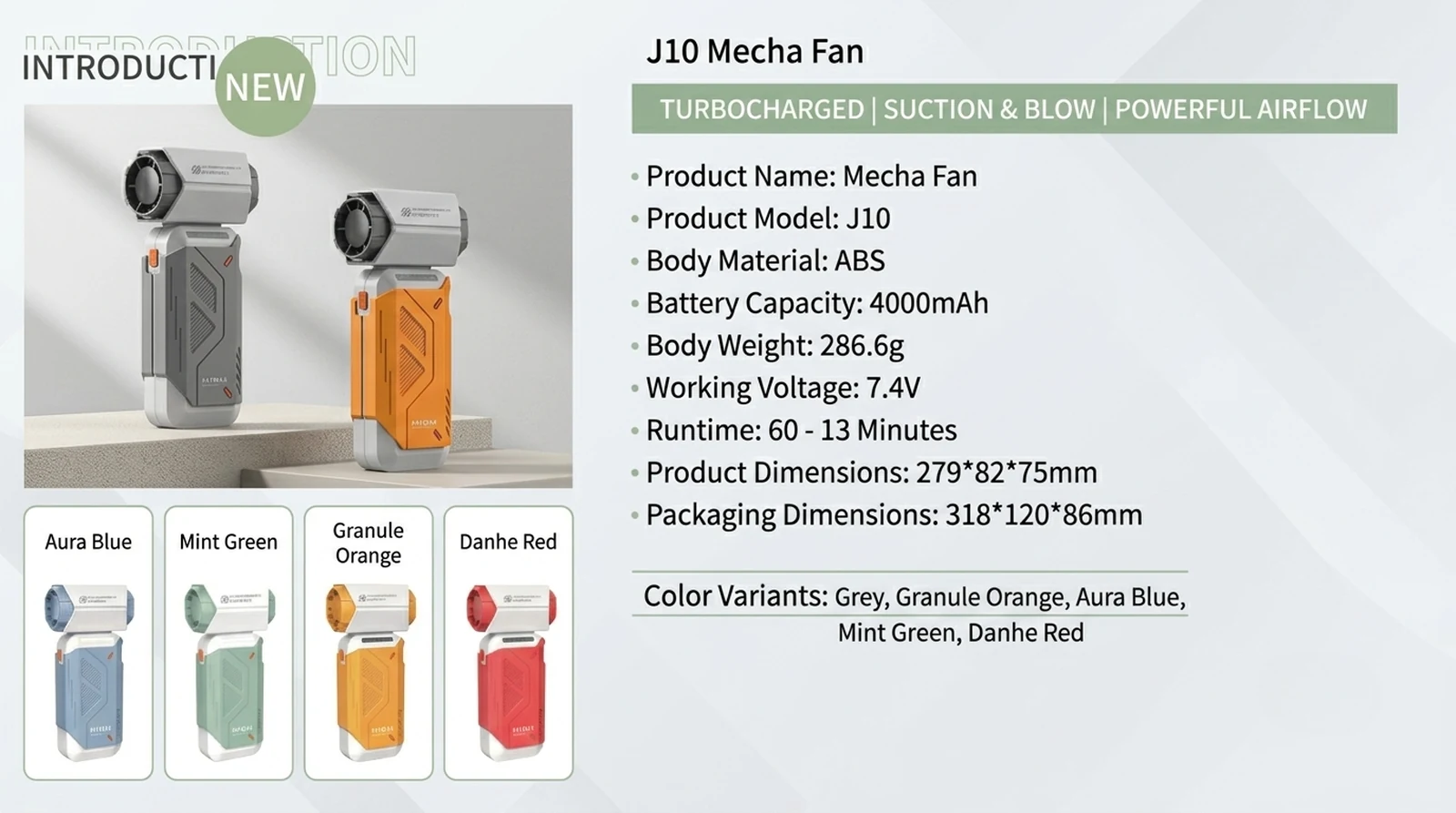
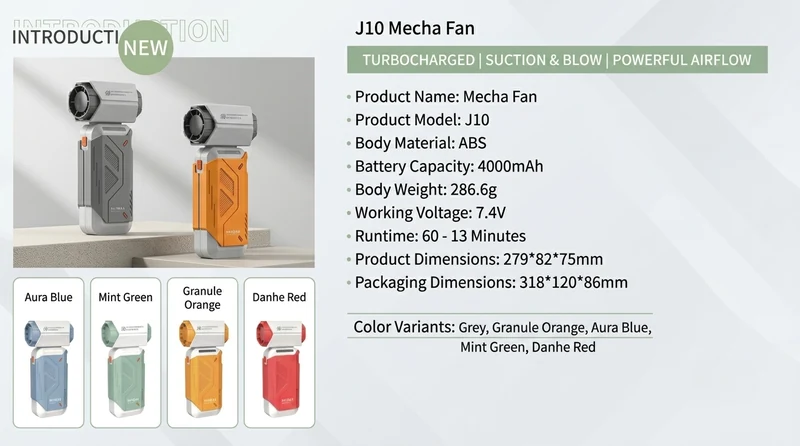
J10 Mecha Fan Design Details That Support Strong Shelf Appeal
The J10 Mecha Fan combines industrial-inspired design language with practical ergonomics, giving retailers a visually distinct SKU that holds attention in crowded point-of-sale displays. From surface finish to grip geometry, every detail has been considered for shelf presence and shopper engagement.
Why Design Language Matters in the Personal Fan Category
Personal fans have evolved far beyond simple utilitarian cooling tools. In a category crowded with similar-looking products, the units that earn repeat purchase and brand recognition are usually the ones whose industrial design carries a clear point of view. The **J10 Mecha Fan** is one such unit: rather than mimicking the soft, minimalist silhouettes that dominate the segment, it commits to a mecha-inspired aesthetic that reads instantly on a shelf, in a lifestyle photograph, or in the first three seconds of a short-form video.

For B2B buyers, distributors, and merchandising teams evaluating which portable fan to stock, design is not a decorative extra. It is a sales tool. Every chamfer, panel line, color split, and packaging cue either earns or loses the shopper's attention. The remainder of this article breaks down the specific design details that make the J10 Mecha Fan commercially distinct, and why those details matter in both brick-and-mortar and e-commerce contexts.
Visual Design Elements That Catch Retail Attention
A Silhouette That Reads From Three Meters Away
In a busy endcap or pegboard display, the eye tends to lock onto objects with strong silhouettes before it processes color or branding. The J10 Mecha Fan was developed with this in mind. Its outline mixes curved transitions on the grip with sharper, more angular cuts around the head and intake, producing a hybrid silhouette that visually separates it from the rounded, pebble-shaped competitors that dominate the category.
Key visual anchors include:
- A defined parting line between the motor housing and the handle, which creates a clear "head" and "body" reading
- Recessed vent geometry on the rear intake that doubles as a graphic element
- A wider barrel-to-handle ratio than typical pocket fans, giving the unit more visual mass without making it feel heavy in hand
- Sculpted transitions at the head that suggest motion even when the unit is stationary
These are not arbitrary choices. Each one is engineered to register as a distinct object silhouette when scanned at retail distance, which is a measurable factor in point-of-sale conversion.
Modular Composition as a Visual Story
Mecha design language draws on the visual grammar of robotics, armored vehicles, and modular equipment. The J10 Mecha Fan leans into that vocabulary by treating the body as a composition of interlocking panels rather than a single molded shell. From a design-review perspective, this gives the unit a built-by-engineers feel that resonates strongly with the target buyer profile: tech-adjacent consumers, gift buyers, and lifestyle-driven shoppers who respond to industrial aesthetics.
The visible panel breaks also serve a manufacturing function. They allow the upper housing, lower housing, and rear intake to be molded as separate components, which simplifies tooling and opens the door to color-block combinations without secondary processes.
Color Choices and Surface Finish
Two-Tone Color Blocking
Color strategy in the personal fan category typically falls into two camps: monochrome neutrals (white, gray, black) that blend into a display, or saturated candy colors that shout for attention. The J10 Mecha Fan uses a third approach — a controlled two-tone color block with the handle in a deeper shade and the motor housing in a lighter accent. This delivers shelf contrast without resorting to high-saturation finishes that age poorly in product photography.
Standard configurations emphasize:
- Cool grays paired with gunmetal accents for an industrial mood
- A matte-on-matte finish combination that suppresses glare under retail lighting
- Optional accent panels that allow regional buyers to localize the SKU without committing to a full custom mold
Surface Finish and Tactile Feedback
Surface finish is often the most underestimated design lever in small appliances. A high-gloss housing photographs beautifully in a studio but becomes a fingerprint magnet the moment a shopper picks it up. The J10 Mecha Fan uses a low-sheen matte finish across the main housing, with selectively grained panels around the grip. This combination does three things at once:
1. Reduces visible smudging in-store and during unboxing
2. Adds a tactile cue that communicates "premium" without a soft-touch rubber overmold
3. Holds up better against the UV exposure that often degrades plastic finishes in display windows
The matte grain on the handle is also functionally relevant: it increases purchase confidence by giving the consumer a sense of control the moment the unit is lifted off the hook.
Mecha-Inspired Aesthetics: Form Language and Detailing
Mecha design language translates into consumer products through specific, repeatable cues. The J10 Mecha Fan incorporates several of these without crossing into costume or novelty territory.
Hard-Edge Geometry Around the Air Outlet
The front air outlet uses a faceted ring rather than a smooth round bezel. This single detail does more brand work than the printed logo. It signals to a passing shopper that this product belongs to a different design family than the soft-edged competitors.
Visible Mechanical Lines
Where most fans hide their parting lines and fastening points, the J10 Mecha Fan exposes a deliberate panel-line pattern along the body. These lines are not functional — the unit still assembles with hidden fasteners — but they read as mechanical detail in a way that supports the mecha theme.
Intake Grille as Graphic Element
The rear intake uses a directional grille pattern. From a merchandising standpoint this matters because it gives the product a strong rear-face visual, which is important when the unit is displayed facing outward from a peg hook or arranged in a fan-shape merchandising block.
Packaging Design and Shelf Presence
A retail-grade product is only as strong as its packaging. The J10 Mecha Fan ships in a printed retail box designed to do three jobs simultaneously: protect the unit in transit, communicate the product story at the shelf, and survive the unboxing moment that drives social content.
Box Structure
The outer carton uses a tuck-end mailer-style structure with a hang-tag option for pegged retail. The internal tray is formed rather than foam-padded, which keeps the unboxing consistent across shipping conditions and avoids the sustainability criticism that often falls on foam inserts.
Front-Panel Hierarchy
On the front of the box, the visual hierarchy is intentional:
- The product hero shot occupies the largest share of the panel
- A clean line of feature callouts runs along the lower third
- The brand mark sits in the upper corner where retail planograms typically expect it
- Color-blocked side panels mirror the unit's two-tone finish, reinforcing continuity between package and product
This hierarchy matters because it lets a shopper absorb the value proposition in roughly two seconds — the average dwell time on a crowded peg wall.
Giftability and Display Versatility
Because the box stands upright on its own and includes a hang tab, the J10 Mecha Fan can be merchandised in three configurations: pegged, shelf-stacked, or counter-displayed in a clustered block. For buyers planning seasonal promotions, this flexibility is a real cost-of-merchandising advantage.
Ergonomic Considerations in Handle and Grip Design
Design appeal is meaningless if the unit fails in hand. The J10 Mecha Fan's grip geometry was developed alongside its visual design rather than after, which is why the two systems reinforce each other.
Grip Diameter and Reach
The handle uses a mid-diameter profile — narrower than a desk-fan stand but wider than a slim stick fan. This middle-ground diameter fits the largest cross-section of adult hands while still leaving room for the integrated control surface.
Control Placement
The power and speed buttons sit where the thumb naturally falls when the unit is held in a standard forward grip. There is no need to rotate the wrist or shift hand position to change speed, which improves both usability and the perceived quality of the product in the first ten seconds of evaluation.
Weight Distribution
Mass is biased slightly toward the head, which keeps the unit from feeling tippy when set down on a flat surface between uses. For retail display, this is a quiet but important detail: a fan that sits stably on the shelf is a fan that gets picked up more often.
Single-Hand Operation
All primary functions — power, speed adjustment, and head orientation where applicable — can be operated one-handed. For commuters, travelers, and outdoor event use cases, this is the operation mode the buyer expects, and the grip design delivers on that expectation.
Design Details That Resonate With Online Shoppers
E-commerce introduces a different set of design demands. Shoppers are not picking the product up; they are scrolling past it, comparing thumbnails, and reading listings. The J10 Mecha Fan's design choices translate to the online context in several specific ways.
Thumbnail Performance
The unit's two-tone color block, faceted outlet ring, and matte surface finish all help the product hold its visual identity at thumbnail scale. Where glossy competitors wash out under listing-photo lighting, the J10's matte surfaces retain contrast and edge definition.
Lifestyle Photography
The mecha aesthetic photographs well in lifestyle contexts — workshop settings, gaming desks, outdoor event styling, and tech-adjacent flat lays. For listing teams and content creators, this expands the range of usable hero imagery without forcing artificial staging.
Unboxing Content
The packaging structure was designed to support the kind of slow unbox content that performs well on short-form video platforms. The form tray lifts cleanly, the product reveals in a single motion, and the accessory layout is predictable enough that creators can plan their shots.
Feature-to-Visual Mapping
Every printed feature on the box corresponds to a visible design element on the unit itself. This matters because it eliminates the disconnect shoppers often feel when a package advertises a feature that has no visual equivalent on the product. Closing that gap builds review credibility.
Where to See the Full Design Specification
For buyers, distributors, and merchandising teams who want to evaluate the J10 Mecha Fan against their existing portable-fan SKU mix, the complete design specification, configuration options, and factory-direct inquiry form are available at the [J10 Mecha Fan product page](https://jlhy.cc/products/j10-mecha-fan/). The page includes high-resolution imagery, dimensional drawings, and configuration details useful for planogram planning and listing development.
Closing Notes on Design-Driven Merchandising
The personal fan category rewards differentiation, and the J10 Mecha Fan uses industrial design as its primary differentiator. From the silhouette and color strategy through to the packaging hierarchy and grip geometry, each detail is engineered to do commercial work — earning attention, communicating value, and supporting confident purchase decisions. For buyers building a portfolio that needs to stand out on the shelf and in the feed, that design discipline is worth weighing alongside the more familiar specs of battery life and airflow output.

Frequently Asked Questions
**What makes the J10 Mecha Fan's design stand out from typical portable fans?**
The unit combines a mecha-inspired silhouette, two-tone matte color blocking, and visible mechanical detailing to create a distinct visual identity that reads at retail distance and holds up in e-commerce thumbnails.
**Can the J10 Mecha Fan be merchandised on pegboards and shelves?**
Yes. The packaging includes a hang-tab option for pegged display and a tuck-end structure that supports upright shelf placement, giving buyers flexibility across planogram formats.
**Does the matte finish affect cleaning or long-term appearance?**
Matte finishes tend to hide fingerprints better than gloss finishes and resist visible smudging in-store and during shipping. Routine cleaning with a soft dry cloth is sufficient for normal retail handling.
**Is the design suitable for gift and seasonal merchandising?**
The boxed presentation, color-blocked packaging, and gift-friendly unboxing experience make the J10 Mecha Fan well suited for seasonal and gift-channel merchandising, including clustered counter displays.
**How does the design support online listing performance?**
The faceted outlet ring, two-tone finish, and matte surface keep the product visually defined at thumbnail scale, while the packaging structure supports the kind of unboxing content that performs well on short-form video platforms.
Frequently Asked Questions
What makes the J10 Mecha Fan's design stand out from typical portable fans?
The unit combines a mecha-inspired silhouette, two-tone matte color blocking, and visible mechanical detailing to create a distinct visual identity that reads at retail distance and holds up in e-commerce thumbnails.
Can the J10 Mecha Fan be merchandised on both pegboards and shelves?
Yes. The packaging includes a hang-tab option for pegged display and a tuck-end structure that supports upright shelf placement, giving buyers flexibility across planogram formats.
How does the design support online listing performance?
The faceted outlet ring, two-tone finish, and matte surface keep the product visually defined at thumbnail scale, while the packaging structure supports unboxing content that performs well on short-form video platforms.