How to Present the J10 Mecha Fan to Retail Buyers and Online Shoppers
A senior editor's guide to positioning a portable mecha fan for both offline retail buyer conversations and online product listings, with photography tips, copy frameworks, and bundle ideas.
Why a Dedicated Presentation Strategy Matters for Portable Mecha Fans
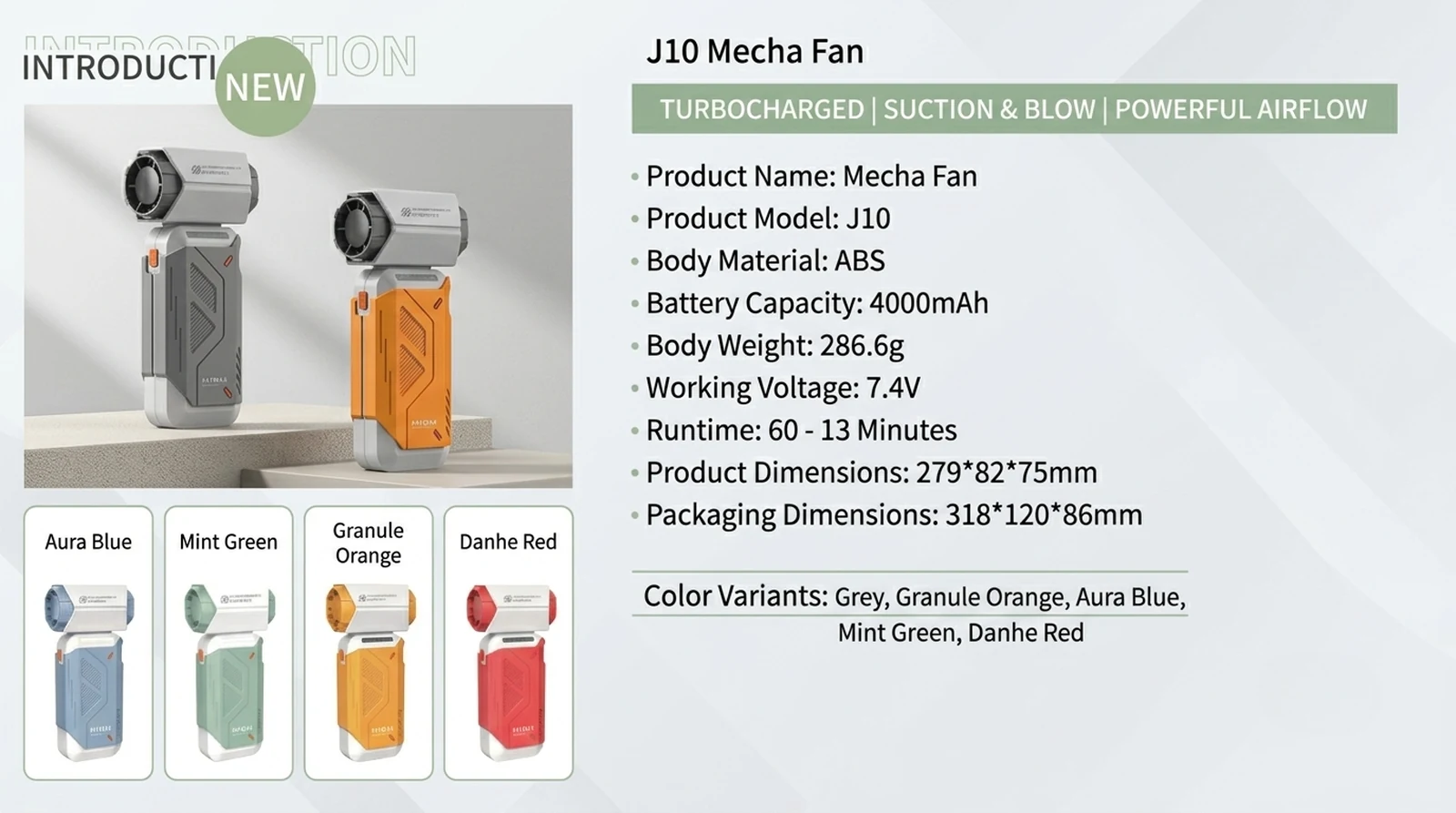
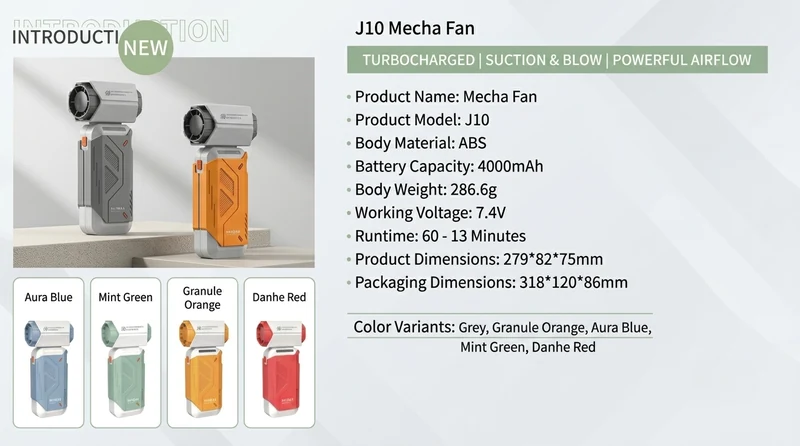
The portable mecha fan category sits at an unusual intersection of three audiences: gifting buyers looking for a desk-shelf novelty, productivity shoppers who want a focused airflow tool, and resellers evaluating a portable SKU with strong gift potential. Pitching [the J10 Mecha Fan](https://jlhy.cc/products/j10-mecha-fan/) to any of these groups without a tailored presentation almost always underperforms. The product reads differently to a buyer scanning a sample at a trade show than it does to a shopper scrolling a marketplace listing, and the copy that converts in one channel often feels flat in the other.

This guide walks through both halves of that equation: how retail buyers should be approached in person or over video call, and how the same product should be presented on an e-commerce storefront. The underlying principle is the same in both cases — anchor the story in tangible product benefits, not vague category hype — but the tactics diverge significantly once you start writing bullets, choosing photography, or fielding objections.
1. Key Selling Points for Retail Buyer Conversations
When you sit across from a category buyer or jump on a sourcing call, you have roughly three minutes of focused attention before their eyes start to glaze. Treat that window as a structured pitch rather than a feature dump.
Lead with form factor, then function
Most portable fans in the market are cylindrical towers or simple hinged-blade units. The mecha form factor is the visual hook. Open with it, then immediately translate it into the operational benefit it unlocks:
- **Directional control without a fixed base.** A mecha-style head and articulated body let the user aim airflow precisely, which matters for desk-side productivity use.
- **Novelty shelf presence.** The silhouette gives the SKU genuine gift-aisle and collector-aisle appeal, expanding the buyer pool beyond the standard summer-cooling cohort.
- **Compact footprint.** Because the form factor folds into a small volume, the unit ships and stores efficiently — a meaningful talking point for buyers managing cube and pallet constraints.
Anchor the second half of the pitch in build and compliance
After the visual hook, pivot to the things procurement teams actually care about:
- **Material and finish consistency across production runs.** Talk about the QA cadence, sample approval workflow, and any inspection documentation the factory provides on request.
- **Compliance posture.** Buyers in regulated markets ask about CE, FCC, RoHS, and battery transport (UN 38.3 for the lithium cell). Confirm what the factory can supply and what the buyer would need to procure or test independently. Never claim certifications the factory has not verified.
- **Packaging and unboxing experience.** For gifting channels, the box is half the product. Walk through the unboxing sequence, inlay protection, and accessory inclusion list.
- **After-sales support structure.** Warranty length, replacement-parts availability, and the contact path for end-consumer issues are all questions a sophisticated buyer will ask before signing anything.
Close with commercial terms without quoting numbers
At this stage of the conversation, avoid publishing any numeric pricing in your pitch deck or follow-up email. Instead, frame the commercial conversation around:
- MOQ flexibility and tier ladder
- Lead time from PO to ex-factory dispatch
- Packaging customization (private label, gift box, multilingual manuals)
- Sample policy (paid sample, refundable sample, courier arrangement)
- Deposit and balance split in industry-standard terms
- Shipping Incoterms preference (FOB, EXW, DDP options to discuss)
Specific dollar figures, FOB tiers, and commission structures should only move into a private quote once the buyer has confirmed interest and a viable order profile. This protects your margin and keeps the negotiation professional.
2. How to Present the J10 Story in E-Commerce Listings
The listing is your silent salesperson. It needs to do the work of the in-person pitch without the benefit of eye contact, body language, or a sample unit in hand.
Structure the listing in three reading layers
Buyers scan, skim, then read. Build the page to serve all three:
1. **Above-the-fold scan layer** — hero image, one-line value proposition, price tier indicator (e.g., "request a quote" or a non-numeric tier label), and a clear primary CTA.
2. **Mid-page skim layer** — three to five bullet benefits, a short product description, and a specifications table.
3. **Deep-read layer** — comparison imagery, application scenarios, FAQ accordion, and trust signals (compliance notes, warranty terms, customer service contact).
Write the title and one-liner carefully
The title is the highest-leverage copy on the page. A good portable-fan title typically combines:
- Product type ("Portable Mecha Fan")
- Primary use case or audience cue ("Desk" / "Travel" / "Gift")
- Differentiating feature ("Articulated" / "Rechargeable" / "Compact")
For the J10 Mecha Fan, a balanced title might read: *"J10 Mecha Fan — Portable Articulated Desk Fan for Travel, Office, and Gifting."* Avoid stuffing the title with every spec — the bullet cluster handles that.
Use bullets, not paragraphs, for the benefit block
Buyers do not read paragraphs on product pages. Use six to eight bullets, each opening with a bolded benefit keyword:
- **Aim** — Articulated mecha head for precise directional airflow
- **Travel** — Foldable body fits carry-on and laptop bag sleeves
- **Recharge** — USB-C charging with multi-hour runtime per charge
- **Quiet** — Low-noise profile suitable for shared workspaces
- **Gift** — Premium unboxing suitable for direct-to-recipient gifting
- **Build** — Matte finish with stable weighted base
The bullet list also serves as prime real estate for search engines, so weave in the natural-language queries shoppers actually use.
Specs table vs. marketing prose
A specs table removes ambiguity. Include, where applicable:
- Dimensions (collapsed and extended)
- Weight
- Battery capacity and rated runtime
- Charging port and input rating
- Noise level in dB
- Materials
- In-box accessories
- Compatible regional plug variants
Honest specs win more trust than aspirational ones. If a figure is measured under a specific condition (e.g., "lowest speed setting, ambient 25 °C"), say so.
3. Photography Angles and Copy Angles That Work for the J10
Photography and copy work as a pair. A good image earns the click; good copy earns the add-to-cart.
Photography angles to plan
A complete image set for a portable mecha fan should cover:
- **Hero shot** — three-quarter angle, eye-level, on a clean neutral background. This is your thumbnail.
- **Scale shot** — the fan next to a familiar object (smartphone, water bottle, laptop) so the size is unambiguous.
- **Action shot** — the head tilted mid-rotation, ideally capturing the articulated joint range.
- **In-context shot** — on a desk with a laptop, in a hotel room, on a bedside table.
- **Detail shots** — control buttons, charging port, hinge mechanism, base pad.
- **Unboxing shot** — flat-lay showing the box, foam inlay, fan, cable, and paperwork.
- **Group/lifestyle** — two or three units in different colors if a range is offered.
Copy angles by audience segment
- **Productivity shoppers** — focus on airflow direction, low noise, and uninterrupted focus. "Aim the breeze exactly where you need it" lands harder than generic "powerful wind."
- **Travel shoppers** — emphasize folded dimensions, charging convenience, and the ability to live in a backpack.
- **Gifting shoppers** — talk about the box, the wow moment, and the absence of need to wrap it.
- **Resellers** — highlight packaging consistency, unit consistency across batches, and the unit's display-ability on a peg or shelf.
A common mistake is writing copy that tries to serve all four at once. The hero listing copy should pick a primary segment and lead with it. Variant copy or sub-listings can serve the others.
4. Cross-Sell and Bundle Opportunities with Other Portable Devices
The J10 Mecha Fan pairs naturally with several adjacent portable SKUs. Bundles raise average order value, reduce per-unit shipping cost, and give the buyer a stronger reason to check out.
High-fit bundle pairings
- **Portable fan + power bank.** A small-form-factor power bank extends the fan's runtime on trips and removes the "where do I plug in" objection.
- **Portable fan + neck pillow or eye mask.** Targets the same travel-bag audience and reads as a coherent travel-comfort bundle.
- **Portable fan + USB-C hub or cable kit.** Solves the cable sprawl problem and gives the fan a permanent home in the buyer's setup.
- **Portable fan + desk accessory set (mouse pad, cup warmer, LED bar).** Builds an at-the-desk productivity bundle with strong AOV potential.
How to position the bundle
When you list a bundle, do not just stack the SKUs — frame the use case:
- "Travel Comfort Bundle" — fan, eye mask, cable organizer
- "Hot Desk Bundle" — fan, USB-C hub, low-profile desk mat
- "Gift-Ready Bundle" — fan in premium gift box with handwritten card sleeve
Bundles also create a private-label opportunity: the box, the insert card, and the outer wrap can all be co-branded with a single artwork file, which simplifies the factory's job.
5. Handling Common Retail Buyer Questions
A handful of questions come up in nearly every retail-buyer conversation. Have answers ready, and never bluff through a question you don't know the answer to.
- **"What's your MOQ?"** Answer with a tier ladder rather than a single number. Typical structure is a low introductory tier for first orders, a standard production tier, and an economy tier for repeat buyers. If you don't have tiers yet, say so and propose one.
- **"Can you do custom colors or private label?"** Most factories can. Clarify the artwork file format they accept, the print method (pad print, UV print, laser engraving), the lead-time impact, and the per-color setup cost structure.
- **"What about warranty and returns?"** State the standard warranty term and the process for end-consumer claims. Specify whether the buyer or the factory handles RMAs.
- **"How do you handle quality issues?"** Walk through incoming material inspection, in-line checks, and pre-shipment inspection (PSI). Offer third-party inspection as an option.
- **"Can you ship to our warehouse in [country]?"** Confirm DDP availability for major destinations or stick to EXW/FOB and let the buyer arrange freight.
- **"How fast can you deliver?"** Quote a realistic ex-factory lead time plus a buffer. Promising too tight a timeline is a fast way to lose the buyer's trust.
For a deeper dive into the back-and-forth mechanics of buyer communication — message templates, response cadence, and negotiation sequencing — our team publishes regular playbooks over at [gaborhub.com](https://gaborhub.com). It's a useful complement to this guide for any sourcing-side professional who wants a more granular view of B2B communication tactics.
6. A Final Note on Consistency Across Channels
Whatever story you build for the J10 Mecha Fan in the listing and in the buyer pitch, keep it consistent. The buyer who samples the unit at a trade show should see the same headline, the same four-pillar benefit structure, and the same kind of photography on your storefront that they saw on your booth banner. Inconsistency is the fastest way to lose trust between the sample decision and the reorder decision.
Build a single product-positioning document — one page, internally — that locks in the core message, the visual identity, and the buyer-persona priorities. Every channel asset should reference it. Over time, that document becomes the institutional memory of the product, surviving personnel changes and channel expansion.

Frequently Asked Questions
What is the most important thing to lead with when pitching the J10 Mecha Fan to a retail buyer?
Lead with the mecha form factor as a visual differentiator, then immediately tie it to the operational benefit — directional airflow in a compact, giftable body. Buyers respond best when the visual hook is paired with a practical reason to stock the SKU.
How should an e-commerce listing for a portable mecha fan be structured?
Use three reading layers: a scannable above-the-fold block with a hero image and one-line value proposition, a mid-page skim layer with bullets and a specs table, and a deep-read layer with application scenarios, FAQ, and trust signals. Bullets outperform paragraphs on product pages.
What bundles work well with the J10 Mecha Fan?
The strongest pairings are portable power banks, travel comfort accessories (neck pillows, eye masks), USB-C cable kits, and desk accessory sets. Each bundle should be anchored to a clear use case — travel, hot desk, or gifting — rather than presented as a generic SKU stack.
Frequently Asked Questions
What is the most important thing to lead with when pitching the J10 Mecha Fan to a retail buyer?
Lead with the mecha form factor as a visual differentiator, then immediately tie it to the operational benefit — directional airflow in a compact, giftable body. Buyers respond best when the visual hook is paired with a practical reason to stock the SKU.
How should an e-commerce listing for a portable mecha fan be structured?
Use three reading layers: a scannable above-the-fold block with a hero image and one-line value proposition, a mid-page skim layer with bullets and a specs table, and a deep-read layer with application scenarios, an FAQ, and trust signals. Bullets outperform paragraphs on product pages.
What bundles work well with the J10 Mecha Fan?
The strongest pairings are portable power banks, travel comfort accessories (neck pillows, eye masks), USB-C cable kits, and desk accessory sets. Each bundle should be anchored to a clear use case — travel, hot desk, or gifting — rather than presented as a generic SKU stack.