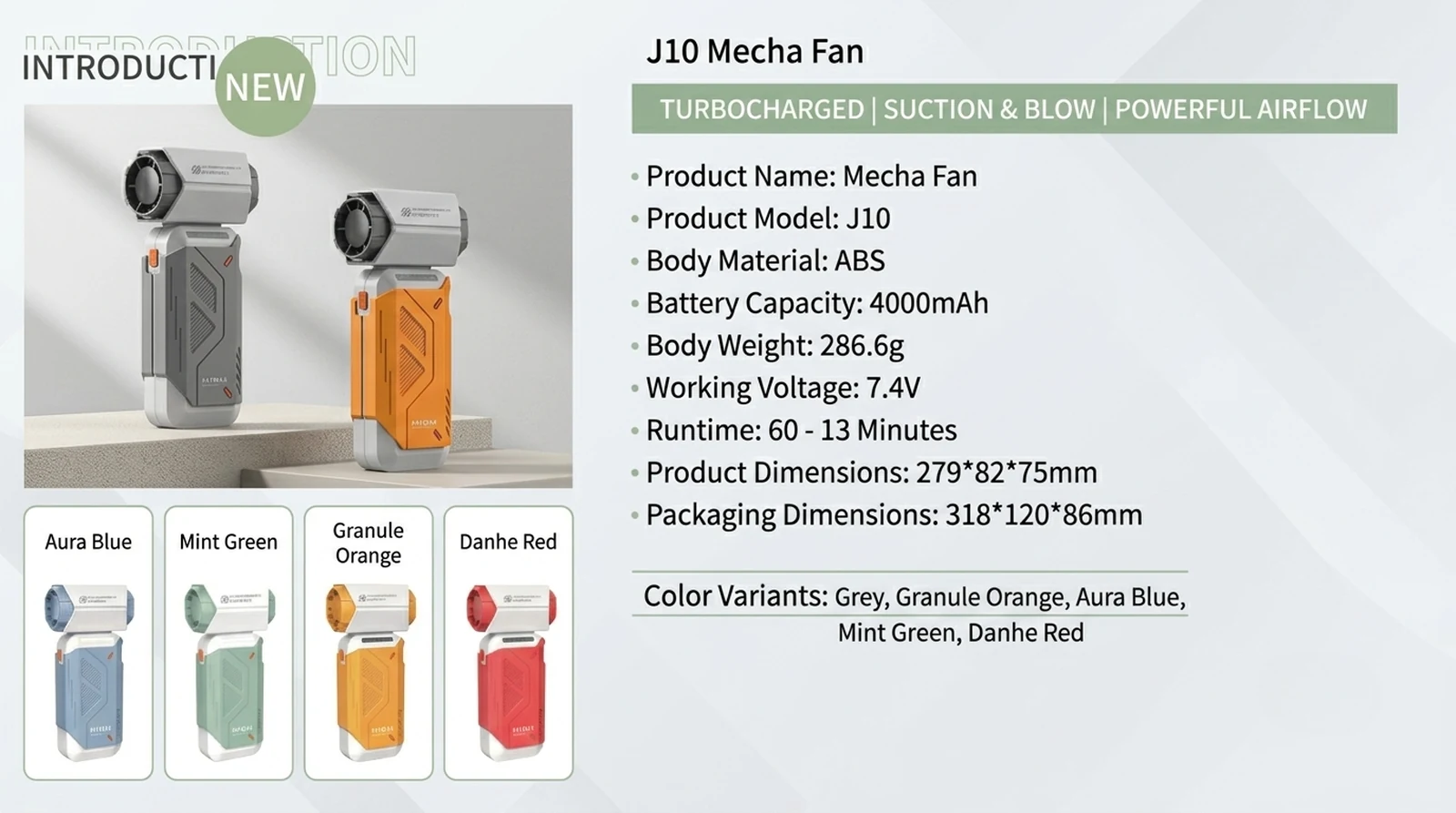
J10 Mecha Fan Reliability Testing: From Prototype to Shipment
Reliability testing is the bridge between an interesting prototype and a retail-ready portable fan. Here is how a disciplined test program protects buyers, retailers, and brand reputation long before shipment.
J10 Mecha Fan Reliability Testing: From Prototype to Shipment
Why Reliability Testing Matters in Portable Fan Development
A portable fan lives a harder life than almost any other consumer electronics accessory. It travels in backpacks, sits on hot dashboards, gets knocked off nightstands, and runs on battery cells that demand their own safety discipline. Reliability testing is the discipline that turns a working prototype into a product a retailer can stand behind.

For B2B buyers sourcing personal cooling products, the reliability question is rarely about whether a fan spins. It is about whether it still spins — quietly, safely, and with full battery integrity — after months of daily commuter abuse. The J10 Mecha Fan, documented at [jlhy.cc/products/j10-mecha-fan/](https://jlhy.cc/products/j10-mecha-fan/), is positioned around that exact promise, and the testing program behind it is worth examining in detail.
This article walks through what a serious portable fan reliability program looks like: the mechanical tests, the environmental tests, the electrical and battery tests, the production-line gates, and the documentation retailers should ask for before signing a purchase order.
Mechanical Stress Testing: Drop, Vibration, and Impact
Mechanical durability is the first line of defense. A portable fan that cracks on its second drop is a return waiting to happen.
Drop Test Expectations
Industry practice treats a portable handheld fan as a Class A drop-test subject, which means the unit is expected to survive a series of controlled falls onto hard surfaces from a defined height — usually tested at multiple orientations to expose corner, edge, and face weaknesses.
A representative drop sequence includes:
- Dropping onto each face, edge, and corner from a standardized height onto a hard surface such as steel or concrete
- Performing the sequence multiple times per unit to expose cumulative damage
- Re-checking battery integrity, switch function, blade balance, and cosmetic finish after each drop series
- Inspecting for hairline cracks in the housing, especially around the seam line and the grille-to-body junction
The point of the drop test is not to certify the fan as indestructible. It is to ensure that realistic mishandling — a fall from a desk, a slip out of a backpack pocket — does not produce a safety hazard or a non-functional unit.
Vibration Test Expectations
Vibration testing simulates the long-term wear caused by motors running continuously and by shipping transport. A portable fan experiences continuous internal vibration from its own motor as well as external vibration during transit by truck, sea container, or air freight.
A standard vibration test sequence includes:
- Sweep vibration across a defined frequency range on each of three axes
- Extended dwell time at the motor's resonant frequency to expose weakness
- Verification that the blade assembly remains balanced and the housing does not loosen
- Confirmation that fasteners, grilles, and battery compartments do not back out under sustained vibration
The vibration profile catches the failures that drop tests miss — loose internal screws, hairline solder joint fatigue, and battery cell movement inside an under-tightened pack.
Impact and Tumble Testing
Beyond drop and vibration, a complete mechanical program often adds tumble and pendulum-style impact tests. These simulate the chaotic motion of a fan bouncing around inside a tote bag or being knocked off a car seat during a sudden stop. The post-test inspection looks for cosmetic damage, grille deformation, and any change in airflow performance.
Temperature Cycling and Environmental Endurance
Portable fans are sold across climate zones. A unit that performs well in an air-conditioned office may behave differently in a hot delivery van or a cold warehouse. Temperature cycling exposes those weaknesses before the product reaches a customer.
Standard Temperature Cycle Profile
A typical reliability temperature cycle runs units through repeated exposure to hot and cold extremes. The intent is to stress:
- Plastic housing integrity during expansion and contraction
- Battery cell performance at temperature extremes
- Motor lubrication and bearing behavior in cold conditions
- Indicator function across the full operating range
Representative test conditions include extended dwell at low temperatures, often below freezing, followed by a transfer to elevated temperatures well above typical room conditions, with the cycle repeated multiple times. Between cycles, the fan is inspected for housing cracks, battery swelling, motor starting reliability, and switch responsiveness.
Humidity and Salt Spray Considerations
For retailers distributing into coastal or tropical markets, humidity testing is often added to the program. Salt-spray exposure is less common for indoor portable fans but may be requested for rugged outdoor variants. These tests guard against corrosion of metal grilles, switch contacts, and battery terminals — the three most common failure points in humid climates.
Battery and Electrical Safety Verification
The battery is the single highest-risk subsystem in any portable fan, and a serious reliability program treats it accordingly.
Cell-Level and Pack-Level Testing
Battery testing typically includes:
- Overcharge and over-discharge protection verification
- Short-circuit protection at the cell, pack, and charger level
- Thermal abuse testing to confirm the cell does not enter thermal runaway under fault conditions
- Cycle life testing to confirm the pack retains usable capacity after a defined number of charge-discharge cycles
- Drop and vibration testing of the bare pack to confirm it survives mechanical stress without internal damage
The retail buyer does not need to see every raw test report, but the supplier should be able to summarize the battery cell chemistry used, the protection circuit features, and the cycle-life result on demand.
Electrical Safety and EMC
Electrical safety testing covers charger input protection, output voltage stability, and insulation integrity. EMC testing addresses both emissions (whether the fan interferes with other devices) and immunity (whether the fan tolerates external interference). Retailers operating in regions with mandatory conformity marks should confirm the relevant compliance status before shipment.
Production-Line Testing: What Happens After Engineering Sign-Off
Engineering validation is only the front half of reliability. Once a design is locked, every production unit must pass through a sequence of gates before it ships.
In-Line Functional Tests
A typical production-line test sequence for a portable fan includes:
- Power-on self-test, verifying motor start, indicator lights, and mode switching
- Airflow measurement against a defined target band
- Noise measurement against a defined decibel ceiling at each speed mode
- Battery voltage and capacity verification
- Charging function and charge-time verification
- Cosmetic inspection against an AQL sampling plan
End-of-Line and AQL Sampling
End-of-line testing covers everything in-line testing covers, with the addition of a final drop simulation on a sampling basis, depending on the buyer's quality agreement. AQL sampling defines how many units per lot are pulled for cosmetic and functional inspection. Retailers importing in volume should agree on an AQL plan up front rather than discovering it after the first shipment arrives.
Burn-In and Run-In Testing
Some portable fan programs include a burn-in or run-in step where units are powered on for an extended period before packaging. Burn-in catches early-life failures — the units that would have failed in the customer's first week of ownership. The cost of a burn-in step is real, but it is dramatically lower than the cost of a customer return, a marketplace complaint, or a recall.
Documentation That Supports Retail Buyer Confidence
Reliability testing is only as useful as the documentation that supports it. Retail buyers should expect to receive, at minimum:
- A test plan listing each mechanical, environmental, and electrical test performed
- Pass/fail criteria for each test, with quantitative thresholds where applicable
- Sample size and test conditions for each protocol
- A summary report with photos of test setups and post-test unit conditions
- Battery cell specification and protection circuit description
- Applicable regional compliance certificates and test reports
- Production-line AQL plan and end-of-line test procedure
This documentation does not need to be exhaustive, but it does need to exist. A supplier who cannot produce a test plan on request is signaling that reliability is informal rather than engineered.
How Reliability Testing Reduces After-Sales Risk
The business case for reliability testing is straightforward. Every prevented failure saves the cost of a return, a refund, a replacement unit, a customer service interaction, and a potential marketplace review damage. For a portable fan sold at a competitive factory-direct price tier, those per-unit costs compound quickly across a shipping container of inventory.
A disciplined reliability program also reduces brand risk. A single viral review of a swollen battery or a cracked grille can undo years of careful brand building. Retail buyers sourcing white-label or private-label product carry that brand risk even when they do not manufacture the unit themselves.
Reliability testing is, in effect, an insurance policy with a measurable return. The cost of running drop tests, vibration profiles, temperature cycles, and battery abuse tests is small relative to the avoided cost of even a modest return rate increase.
Where to Find Full QC Documentation
For buyers evaluating the J10 Mecha Fan, the full QC documentation package — including test plans, AQL sampling plans, battery specifications, and production-line procedures — is available on request through the official product page. Retailers and distributors can review the engineering documentation directly at [jlhy.cc/products/j10-mecha-fan/](https://jlhy.cc/products/j10-mecha-fan/), where the supplier maintains the current revision of the quality manual and the latest test summary report.
A good supplier welcomes that kind of scrutiny. If a vendor is unwilling to share test plans, sample-size rationale, or battery cell documentation, that is a signal — not of confidential technology, but of a reliability program that does not exist.

Frequently Asked Questions
**What reliability tests should a portable fan pass before shipment?**
A retail-ready portable fan should pass drop, vibration, temperature cycling, battery abuse, and EMC testing during engineering validation, plus a production-line functional and cosmetic gate on every unit. Battery cycle life and protection circuit verification are especially important because the battery is the highest-risk subsystem.
**How long does a typical portable fan reliability program take?**
Engineering validation runs in parallel with industrial design and tooling, with the most aggressive programs completing critical mechanical and electrical tests before tooling is locked. End-of-line and burn-in testing continues for the entire production run. The exact timeline depends on test cycle counts, but retailers should expect several weeks of structured validation before mass production is approved.
**Where can a retailer review QC documentation before placing a PO?**
Request the test plan, sample-size rationale, AQL plan, battery cell specification, and applicable regional compliance certificates directly from the supplier. For the J10 Mecha Fan, this documentation is available through the official product page at jlhy.cc, and the supplier will provide current revisions on request to qualified retail and distribution buyers.
Frequently Asked Questions
What reliability tests should a portable fan pass before shipment?
A retail-ready portable fan should pass drop, vibration, temperature cycling, battery abuse, and EMC testing during engineering validation, plus a production-line functional and cosmetic gate on every unit. Battery cycle life and protection circuit verification are especially important because the battery is the highest-risk subsystem.
How long does a typical portable fan reliability program take?
Engineering validation runs in parallel with industrial design and tooling, with the most aggressive programs completing critical mechanical and electrical tests before tooling is locked. End-of-line and burn-in testing continues for the entire production run. The exact timeline depends on test cycle counts, but retailers should expect several weeks of structured validation before mass production is approved.
Where can a retailer review QC documentation before placing a PO?
Request the test plan, sample-size rationale, AQL plan, battery cell specification, and applicable regional compliance certificates directly from the supplier. For the J10 Mecha Fan, this documentation is available through the official product page at jlhy.cc, and the supplier will provide current revisions on request to qualified retail and distribution buyers.