
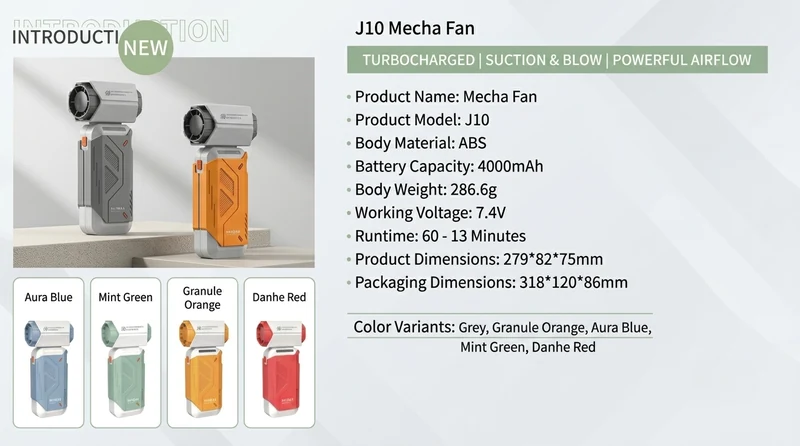
How Noise Control Shapes the J10 Mecha Fan User Experience
For portable fans, noise is more than a spec sheet entry — it shapes whether the device disappears into the background or competes with conversation. Here's how engineering choices define the sound profile of modern mecha-style fans.
Why Noise Matters in Portable Fan Design
Portable fans live in close quarters. They sit on a desk, ride on a bedside table, perch on a workshop bench, or travel inside a bag on a long commute. In every one of those settings, the human ear is rarely more than a meter away from the motor and blade assembly. That proximity changes the calculus of acoustic design compared to a ceiling fan or a tower unit placed across a room.

Noise in a portable fan is felt in three practical ways. First, it competes with speech. A fan that hums above 50 dB at one meter will force people to raise their voices in a quiet room. Second, it competes with focus. Steady broadband noise — particularly when it carries a tonal whine from an unbalanced rotor — is more intrusive than its loudness alone would suggest. Third, it competes with sleep. A fan used overnight has to stay below the level at which the brain tags it as something worth monitoring, even if a sleeper does not consciously wake.
Acoustic comfort is therefore a primary user-experience metric, not a secondary one. Buyers who only look at airflow numbers often discover, after a week of use, that the fan they thought was powerful is the one they keep turning off.
The Sound Sources Inside a Portable Mecha Fan
A portable mecha-style fan is a compact mechanical system. The noise it generates comes from a handful of predictable sources, and each can be addressed with different engineering choices.
**Motor noise** is the dominant source in many designs. Brushed DC motors tend to produce a higher-pitched whine; brushless DC (BLDC) motors run quieter because there are no brushes making contact and commutation is electronic. The switching frequency of the motor controller can also be tuned to push tonal noise above the range where the human ear is most sensitive.
**Aerodynamic noise** comes from the blade assembly. Turbulent airflow over blade surfaces, tip vortices, and pressure fluctuations on the downstream grille all contribute. Blade count, blade shape, blade tip clearance against the housing, and the grille pattern all shape the character of this noise.
**Mechanical vibration** is the third source. Even a small mass imbalance in a rotor will produce a once-per-revolution tone that the ear picks up immediately. Bearing runout, loose fasteners, and resonance in plastic housings can amplify these vibrations into audible buzzes that have nothing to do with airflow at all.
**Grille interaction** is sometimes overlooked. If the grille strut pattern is poorly chosen, it can act as a siren, generating a clean tone each time a blade passes. Choosing a strut count that does not align with blade-pass frequency — or smoothing the airflow before it reaches the grille — keeps this source quiet.
Good design addresses all four sources. Bad design fixes one and ignores the others.
Motor Selection and Blade Balancing
Two engineering decisions do the heaviest lifting in setting a portable fan's noise floor: motor type and rotor balance.
Brushless vs Brushed Motors
Brushless motors have largely taken over the premium portable fan segment for one simple reason: they are quieter at the speeds people actually use. A brushed motor commutates mechanically; the brushes flick between segments, producing a small but audible tick or whine at the rotation frequency. A BLDC motor commutates electronically, with switching frequencies that can be pushed above 18 kHz and out of the most sensitive portion of human hearing.
BLDC motors also run cooler and last longer, which means the fan does not need aggressive thermal management that could itself become a noise source. For a portable unit that may be left on for hours, this matters.
Rotor Balancing
A rotor that is even slightly off-balance will produce a once-per-revolution vibration. At 2,000 rpm, that is 33 vibrations per second, well into the audible range, and the human ear is exceptionally good at picking the tone out of broadband noise. Static and dynamic balancing of the impeller during manufacturing is therefore non-negotiable for any design that aims to sound refined.
Quality control plays a role here. Manufacturers that perform individual rotor balancing on every unit — rather than relying on sample-based checks — deliver a more consistent sound profile across production batches.
Blade Geometry
Blade shape is closely tied to noise. Sickle-shaped blades, curved trailing edges, and carefully chosen chord lengths reduce tip vortices and the broadband noise they create. A fan that moves a lot of air with a small, aggressively pitched blade will often sound harsher than one that moves slightly less air with a larger, more gently pitched blade. There is a real engineering trade-off between maximum airflow and minimum sound, and the most comfortable designs tend to favor the latter within reason.
How Noise Shapes Different Use Cases
The same fan can feel perfectly quiet on a workbench and unacceptably loud on a nightstand. Use case changes the acoustic bar.
Office and Desk Work
At a desk, the fan competes with keyboard clicks, speech, and video calls. A fan that produces a low, broadband whoosh — without tonal whine — tends to disappear into the background. The presence or absence of a tone matters more here than the absolute loudness. A 40 dB fan with a clear 800 Hz tone is more intrusive than a 45 dB fan with a smooth spectrum.
Bedside and Overnight Use
Overnight, the brain treats any new steady sound as potentially significant. Fans that ramp down slowly when turned off, that lack click-on or click-off relay sounds, and that have a near-flat spectral profile tend to be easier to sleep near. Variable-speed fans that allow the user to land on the lowest setting they actually need — rather than stepping in large jumps — give more control over this.
Outdoor and Travel
Outdoors, ambient noise masks fan noise more easily, but travel use introduces new constraints. A fan in a backpack, a stroller, or a tent should not transmit vibration into the surfaces around it. Rubberized feet, isolated motor mounts, and balanced rotors are all more important than absolute dB numbers in this context.
Workshops and Industrial Settings
In a workshop, the goal shifts. A mecha-style fan used at a soldering bench or near machinery needs to be loud enough to be heard over tools, but the sound character still matters. A fan that screams at high speed is fatiguing over a long session; a fan that maintains tonal discipline at full power is more tolerable.
Comparing Noise Expectations Across Portable Fan Categories
Not all portable fans are designed for the same acoustic environment, and buyers who understand the category conventions can set realistic expectations.
**Personal clip-on fans** tend to be the loudest in absolute terms because they use small, high-rpm motors to push meaningful airflow through a tiny housing. They are designed to be worn or clipped close, often in already-noisy environments.
**Desk fans** sit in the middle. The best of them achieve a near-library sound profile on low settings while still moving enough air to be useful on a warm afternoon. This is the segment where BLDC motors and quality rotor balancing have the most impact.
**Handheld and travel fans** prioritize size and battery life. Acoustic refinement is often sacrificed for portability, and buyers should expect a higher-pitched character from this category.
**Mecha-style desk fans** — the segment the J10 belongs to — sit at the intersection of desk-fan refinement and a more distinctive industrial aesthetic. The mechanical styling is visual; the engineering underneath is closer to a premium desk unit than to a clip-on.
Setting expectations against these categories helps buyers interpret spec sheets. A noise spec is most meaningful when compared to other fans in the same category, not against a tower unit two rooms away.
J10 Design Choices That Support a Comfortable Sound Profile
The **J10 Mecha Fan** reflects several design choices that prioritize acoustic comfort alongside airflow performance.
The motor platform uses brushless architecture, which removes the commutator tick that gives brushed motors their characteristic whine. The motor controller is tuned to push switching harmonics above the band where the ear is most sensitive, so the dominant tone shifts from a clear pitch to a softer, broadband character.
Blade geometry has been iterated to balance airflow against tip-vortex noise. The impeller is individually balanced during assembly, which limits once-per-revolution tonal content and keeps the sound profile consistent from unit to unit — an area where some competitors fall short because they rely on batch sampling.
The grille pattern is selected to avoid coincidence with blade-pass frequency, which suppresses the clean siren-like tone that cheaper grilles can produce. The housing is designed to damp resonances rather than amplify them, so the case itself does not become a sounding board for internal vibration.
Variable-speed control lets the user settle on the lowest speed that meets their need, which is often the single biggest determinant of perceived noise. A fan with smooth speed adjustment and a useful low-end setting will be rated more comfortable than one with three coarse steps, even at the same measured dB.
The aesthetic is mecha, but the engineering brief is comfort. The visual styling sets expectations of mechanical presence; the acoustic delivery should not punish the user for choosing it.
For readers who want to see the design language in detail, the full product page for the J10 is at [jlhy.cc/products/j10-mecha-fan/](https://jlhy.cc/products/j10-mecha-fan/).
Practical Tips for Buyers Reading Noise Specs
Two fans with the same published dB figure can sound very different. A few practical rules help.
First, ask at what distance the spec is measured. A fan rated at one meter is meaningfully quieter at arm's length than one rated at the same dB at three meters. Second, ask whether the spec is a single number or a range across speeds — most fans vary significantly from low to high. Third, listen for tonal content. A fan with a strong tone at any speed will read as louder than its broadband level suggests.
If possible, evaluate a fan in the environment where it will be used. A bedroom test tells you more than a spec sheet, and most reputable suppliers will ship sample units for review on request.

Frequently Asked Questions
**What dB level should I look for in a quiet portable desk fan?**
A fan that produces roughly library-level ambient noise on its lowest setting — in the general range that allows normal conversation at one meter — is a reasonable target for desk and bedside use. Exact figures vary, but the absence of tonal whine matters as much as the headline number.
**Are brushless motors always quieter than brushed motors in portable fans?**
In practice, yes. Brushless designs remove the mechanical commutation source and let the controller push switching noise above the most sensitive portion of the human hearing range. The difference is usually clearly audible at the speeds portable fans operate at.
**Why does one fan sound harsh while another with similar airflow sounds smooth?**
The character of the noise comes from blade geometry, grille interaction, rotor balance, and motor type. A fan that produces a clean tone from blade-pass frequency, an unbalanced rotor, or grille resonance will sound harsher even if its broadband loudness is similar to a smoother competitor.
**Can a portable mecha-style fan be quiet enough for sleep?**
Yes, when it uses a brushless motor, individually balanced impeller, and offers a low speed setting without strong tonal content. Variable-speed control is the key user-facing feature, because it lets the user match airflow to need rather than overshooting into a louder range.
Closing Thoughts
Noise control in a portable fan is a system-level problem. Motor selection, blade geometry, rotor balance, grille design, housing resonance, and speed-control behavior all combine to set the user experience. The fans that feel the most refined are usually the ones whose engineers treated acoustic comfort as a primary deliverable rather than a line on a spec sheet. For buyers in the mecha-style category, that distinction is worth weighing as carefully as airflow numbers and battery life.
Frequently Asked Questions
What dB level should I look for in a quiet portable desk fan?
Aim for a fan that produces roughly library-level ambient noise on its lowest setting, which is generally quiet enough to allow normal conversation at one meter. The absence of tonal whine matters as much as the headline dB number.
Are brushless motors always quieter than brushed motors in portable fans?
In practice, yes. Brushless designs remove the mechanical commutation source and let the controller push switching noise above the most sensitive portion of the human hearing range, which is clearly audible at typical portable-fan speeds.
Why does one fan sound harsh while another with similar airflow sounds smooth?
The character of the noise comes from blade geometry, grille interaction, rotor balance, and motor type. A fan with tonal content from blade-pass frequency, an unbalanced rotor, or grille resonance will read as harsher even at similar broadband loudness.