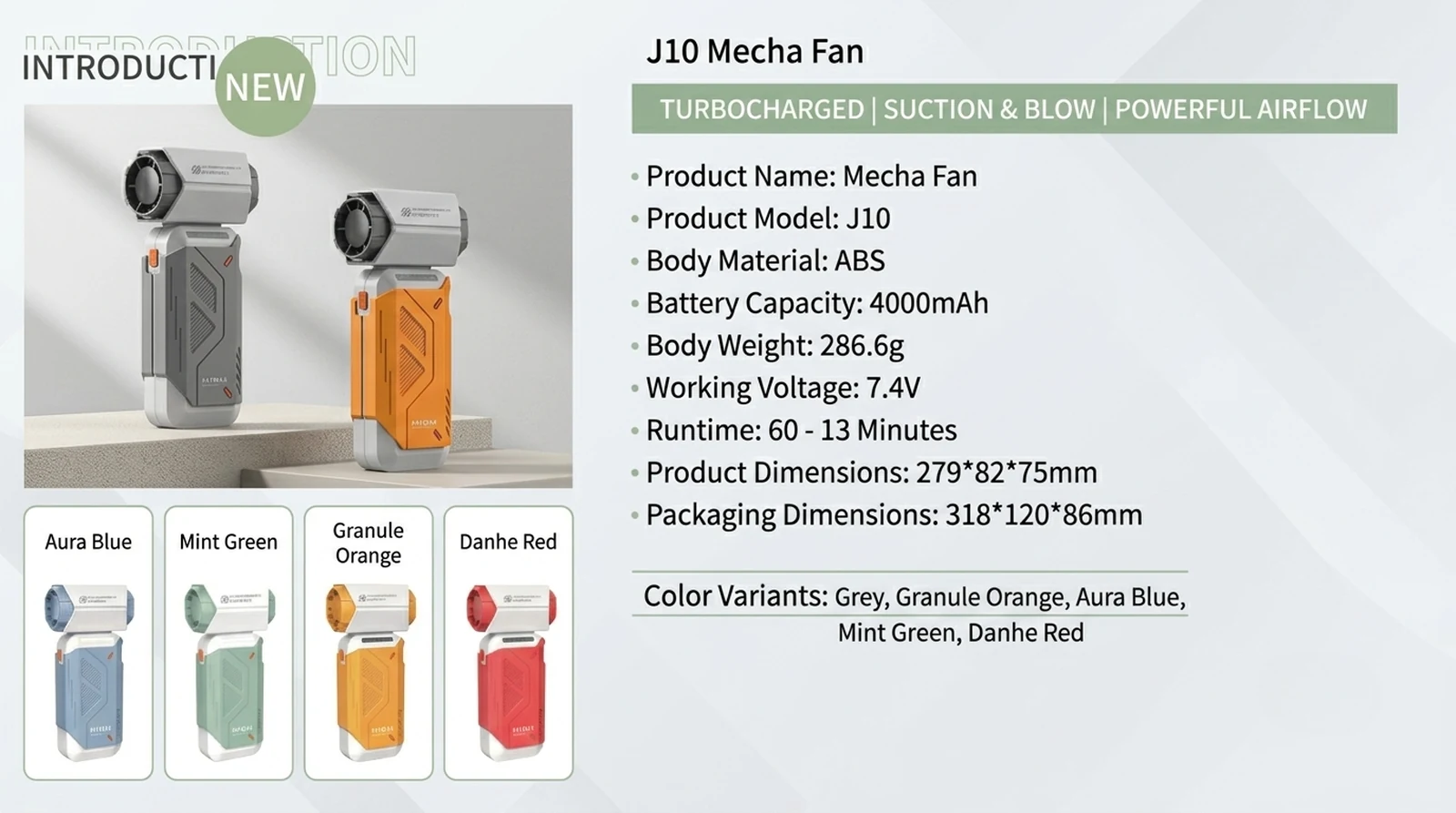
J10 Mecha Fan Airflow Design Explained for Importers and Distributors
Airflow is the single most important performance variable in any portable fan, and the J10 Mecha Fan takes a deliberate engineering approach to it. This guide walks importers and distributors through the design choices that shape the J10's air delivery, and how those choices translate into the experience a retail buyer will feel in the hand.
Why airflow engineering defines a portable fan
In the portable fan category, almost every other spec on a product sheet is secondary. Battery life, weight, noise, and aesthetics all matter, but none of them matter if the fan cannot move air effectively relative to its size. For importers, distributors, and private-label buyers evaluating a new SKU, understanding how a product achieves its airflow rating is the most reliable way to predict how it will perform on the shelf and in customer hands.

The J10 Mecha Fan is built around a specific airflow philosophy that combines a high-speed brushless motor, a multi-blade impeller, and a tuned internal air channel. Rather than treating those three subsystems as independent components, the design treats them as a single fluid-dynamics problem. This article walks through how that works, what it means for retail buyers, and how the J10 compares to more conventional handheld and neck fan designs.
The three pillars of portable fan airflow
Every portable fan, regardless of form factor, generates airflow through the interaction of three subsystems: the motor, the blade, and the air channel that guides air from the impeller to the outlet. Performance is rarely limited by a single one of these; it is the combination that determines the final airflow curve, the noise signature, and the efficiency at which battery power is converted into usable breeze.
Motor speed and torque characteristics
The motor sets the upper limit on how fast the impeller can spin, and how quickly it can recover speed when back-pressure increases. In a portable fan, the relevant metrics are not just peak RPM but also the motor's torque profile across its operating range. A motor that spins fast but has weak torque will stall easily when the outlet is partially blocked, such as when a user cups the fan in their hands or holds it close to skin or hair. A motor with a flatter torque curve maintains a more consistent CFM (cubic feet per minute) delivery across real-world usage conditions.
Brushless DC motors are now the standard in premium portable fans because they offer better efficiency, longer life, and a higher speed-to-size ratio than brushed alternatives. The motor in the J10 Mecha Fan is paired with an electronic control board that allows multi-speed operation, which is critical because a single fixed-speed design cannot serve the wide range of use cases a portable fan is expected to cover, from a desk breeze to active cooling during outdoor activity.
Blade geometry and pitch
Blade design is where most of the visible identity of a fan lives, but it is also where the most misunderstood engineering tradeoffs sit. The number of blades, the chord length, the twist angle (pitch), and the tip geometry all influence how much air is moved per revolution, and how much of that air arrives at the outlet as a focused stream versus a diffuse cloud.
A common mistake in cheaper fan designs is to use a large number of small blades with high pitch. This produces a strong on-paper CFM figure but generates significant turbulence, which translates into both noise and a less satisfying user experience. The blade set in the J10 follows a more conservative count with a refined pitch profile, which favors a smoother, more coherent air column over raw CFM numbers. The result, in practical use, is a breeze that feels more directional and less "buzzy" at the outlet.
Blade material also matters. Engineering-grade polymers with glass fiber reinforcement are widely used in this category because they allow tight dimensional tolerances while keeping mass low. Lower-mass blades require less torque to spin up, which reduces strain on the motor and improves battery efficiency.
Air channel and outlet geometry
The air channel is the often-overlooked third pillar. The space between the back of the impeller and the front grille determines how effectively air is captured, accelerated, and shaped into a usable column. A poorly designed channel creates recirculation zones where air spins in circles inside the housing rather than exiting the front. This robs the fan of effective output and can also amplify motor and bearing noise.
In the J10 Mecha Fan, the internal channel is contoured to reduce sharp transitions and to keep the cross-section as uniform as possible from impeller to outlet. The grille pattern at the front is also part of this system: the size, shape, and spacing of the openings influence both the perceived airflow and the noise floor. A denser grille restricts output, while a too-open grille reduces the air's directional focus. The compromise used in the J10 is balanced for a defined, focused stream that holds its shape over a useful working distance.
What airflow characteristics actually matter to retail buyers
When a consumer picks up a portable fan in a store, or unboxes one at home, the metrics on the spec sheet are invisible. What they experience is a small number of sensory inputs: how hard the air pushes against the skin, how far the air stream travels, how smooth or turbulent it feels, and how loud it is. Engineering choices that look small on a data sheet can completely change those sensory inputs.
Three airflow characteristics consistently drive retail satisfaction:
- **Throw distance.** This is how far the air stream remains usable. A fan with a high CFM but poor throw wastes much of that air in a tight cloud right at the outlet. Good design produces a stream that reaches the face or neck without the user having to hold the fan awkwardly close.
- **Smoothness of delivery.** A consistent, even stream feels stronger than a turbulent one at the same measured CFM, because the user's skin receptors respond to the peak velocity of the airstream rather than the average. Smoother delivery also reads as "more premium" in the hand.
- **Speed range usability.** A fan with a single fixed speed is rarely satisfying. A wide, well-mapped speed range lets users dial in a quiet desk breeze or a high-output active-cooling mode, and is a stronger predictor of repeat usage than a single impressive peak number.
Retail buyers also tend to value directional control. A fan that produces a tight, well-collimated stream can be aimed precisely, while a diffuse cloud is harder to direct. This is one of the most visible qualitative differences between entry-level and mid-tier portable fans.
How the J10 Mecha Fan compares to regular handheld and neck fans
The handheld fan category is dominated by two formats: the traditional pistol-grip handheld and the wearable neck fan. Each has very different airflow design constraints, and the J10 sits in a more performance-oriented position within that landscape.
Handheld fans
A standard handheld fan is typically optimized for low weight and modest cost. The motor is often smaller, the blade count is sometimes higher (which, as noted above, can trade efficiency for noise), and the air channel is usually short and simple. The result is a fan that produces a reasonable breeze at very close range but loses steam quickly over distance. For a B2B buyer, this segment is highly competitive on price but increasingly squeezed by mid-tier designs like the J10 that offer better performance at a modest cost premium.
Neck fans
Neck fans trade focused airflow for hands-free convenience. By their nature, they use multiple small impellers pointing upward toward the face and neck, and they cannot produce a single coherent stream. CFM per outlet is necessarily lower, and the user experience is more about ambient cooling than directed breeze. They are an excellent complement to a product line but rarely a substitute for a true handheld performance fan.
Where the J10 sits
The J10 Mecha Fan is positioned as a performance handheld. Its airflow design emphasizes a focused, well-collimated stream with a useful throw distance, supported by a multi-speed control system that allows the user to trade output for noise depending on context. Compared to a basic handheld, the airflow feels more deliberate and "premium." Compared to a neck fan, it is a different product category entirely, oriented toward users who want directed cooling on demand rather than ambient breeze.
For distributors building out a portable fan range, this positioning is useful: the J10 can serve as the performance tier above entry-level handhelds, while neck fans cover the convenience use case.
How airflow engineering drives user satisfaction and returns
Returns in the portable fan category are driven by a small number of consistent complaints: the fan feels weak, the fan is too loud, the fan does not last long enough on a charge, or the fan broke quickly. The first two of those are almost entirely airflow-engineering problems.
A weak-feeling fan is usually the result of poor air channel design, an under-spec'd motor, or blades with the wrong pitch profile. None of these are visible from the outside of the product, which is why two fans with similar published CFM figures can feel completely different in the hand. A loud fan, on the other hand, is often the result of turbulence at the blade tips, an inefficient motor controller, or a poorly designed grille that creates whistle artifacts. Addressing these issues at the design stage, as in the J10, is far more effective than trying to fix them with marketing.
For B2B buyers, this matters because the products that generate the fewest returns are the products that protect margins, reduce support load, and earn repeat orders. Airflow engineering is not a soft feature. It is the single most important determinant of long-term customer satisfaction in this category.
Sourcing and specification considerations for importers
When evaluating any portable fan for import or distribution, a few airflow-related questions are worth asking the supplier before placing an order:
- What is the measured airflow at each speed setting, and under what conditions was it measured?
- What is the noise level at each speed, expressed in dB at a standard distance?
- What is the motor type, and what is the rated life of the motor and bearings?
- How is the air channel tuned, and is there any CFD (computational fluid dynamics) validation behind the design?
- What testing has been done for continuous operation, blocked-outlet conditions, and thermal management of the motor and battery?
A supplier that can answer these questions clearly and provide supporting documentation is far more likely to deliver a product that performs consistently across production runs. This is also a useful filter for distinguishing serious OEM partners from trading operations that simply re-label existing designs.
For full specifications, performance data, and OEM inquiries, importers and distributors can review the complete J10 Mecha Fan product page at [https://jlhy.cc/products/j10-mecha-fan/](https://jlhy.cc/products/j10-mecha-fan/).
Final thoughts
Airflow is the most important variable in a portable fan, and it is also the variable that is most often oversimplified in product marketing. A serious B2B evaluation should look past published CFM figures and into the engineering choices that produce them: the motor, the blade, and the air channel, working as a single system. The J10 Mecha Fan is one example of a design that treats airflow as an integrated problem rather than a spec-line item, and that approach is the strongest predictor of how the product will be received by end users.
For distributors building a portable fan line, building around products with this kind of airflow discipline is the most reliable path to low return rates and high repurchase intent.
Frequently asked questions
**What makes the J10 Mecha Fan's airflow different from a regular handheld fan?**
The J10 uses a brushless motor, a refined multi-blade impeller, and a contoured internal air channel working together as a single system. The result is a more focused, smoother air stream with a useful throw distance, rather than the short, turbulent cloud typical of basic handhelds.
**Is the J10 Mecha Fan louder than a normal portable fan?**
No. The blade geometry, motor controller, and grille pattern are designed to minimize turbulence and tip-noise. At lower speed settings the fan is intended to be quiet enough for office and indoor use, while higher settings trade additional output for additional sound, as with any portable fan.
**How does the J10 compare to a neck fan for cooling?**
They serve different use cases. A neck fan provides hands-free ambient cooling through multiple small outlets and cannot produce a single focused stream. The J10 is a performance handheld that delivers a directed, higher-velocity breeze on demand, and is the better choice for users who want targeted cooling rather than passive ambient airflow.
**Does the airflow design affect battery life?**
Yes. Motor efficiency, blade mass, and air-channel design all influence how much battery power is required to produce a given airflow. A well-tuned design like the J10's delivers more usable breeze per watt-hour, which directly extends runtime at any given speed setting.
Frequently Asked Questions
What makes the J10 Mecha Fan's airflow different from a regular handheld fan?
The J10 uses a brushless motor, a refined multi-blade impeller, and a contoured internal air channel working together as a single system. The result is a more focused, smoother air stream with a useful throw distance, rather than the short, turbulent cloud typical of basic handhelds.
Is the J10 Mecha Fan louder than a normal portable fan?
No. The blade geometry, motor controller, and grille pattern are designed to minimize turbulence and tip-noise. At lower speed settings the fan is intended to be quiet enough for office and indoor use, while higher settings trade additional output for additional sound, as with any portable fan.
How does the J10 compare to a neck fan for cooling?
They serve different use cases. A neck fan provides hands-free ambient cooling through multiple small outlets and cannot produce a single focused stream. The J10 is a performance handheld that delivers a directed, higher-velocity breeze on demand, and is the better choice for users who want targeted cooling rather than passive ambient airflow.
Does the airflow design affect battery life?
Yes. Motor efficiency, blade mass, and air-channel design all influence how much battery power is required to produce a given airflow. A well-tuned design delivers more usable breeze per watt-hour, which directly extends runtime at any given speed setting.