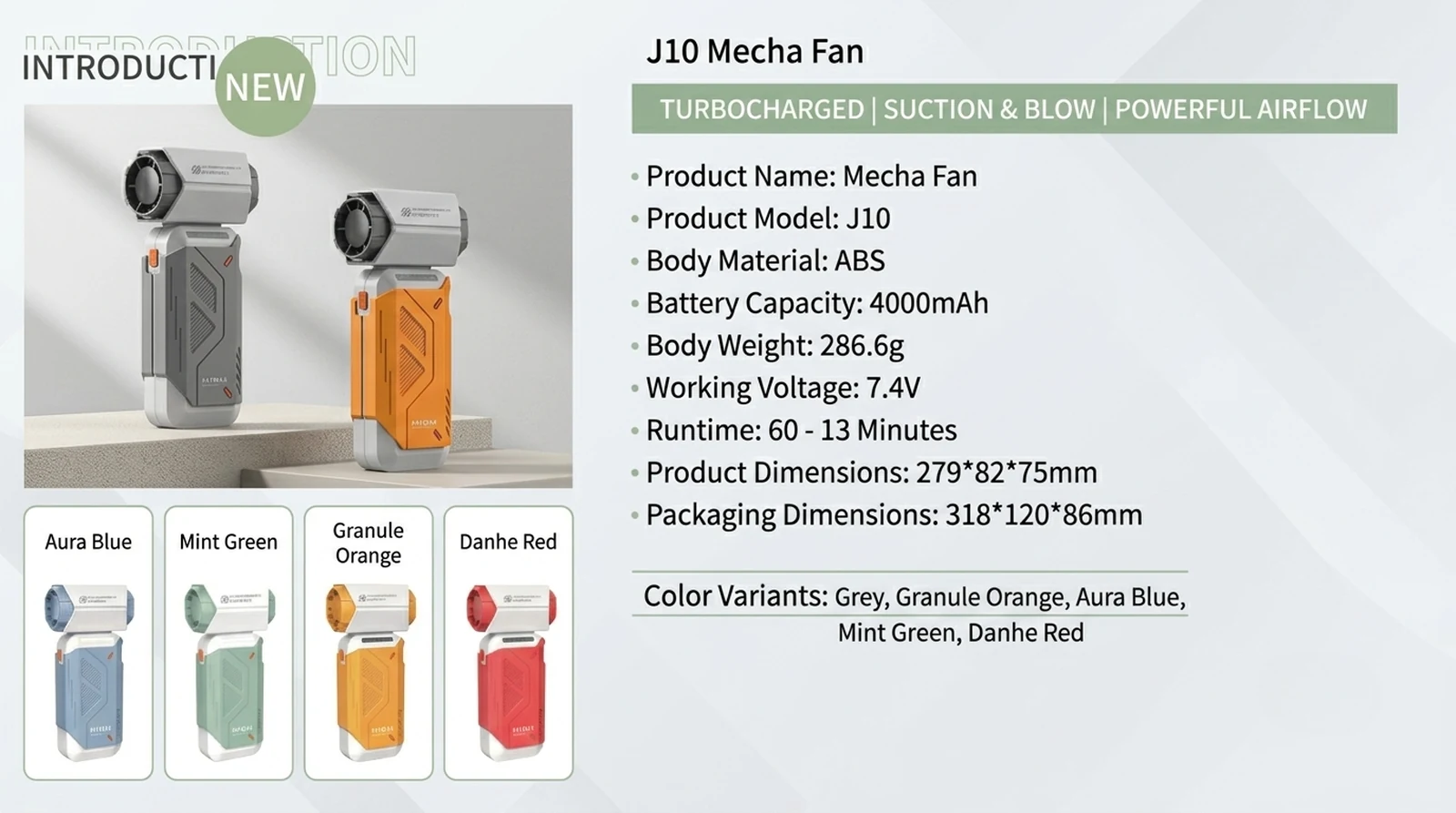
J10 Mecha Fan Materials and Surface Finishing for Everyday Durability
Material choice and surface finishing quietly determine whether a portable fan survives daily use or ends up in a drawer. This editorial breaks down how the J10 Mecha Fan approaches ABS construction, finishing options, and the documentation buyers should review before placing a wholesale order.
Why Materials and Finishing Matter for a Portable Fan
A portable fan lives a harder life than almost any other consumer-electronic accessory on a buyer's sourcing list. It rides in backpacks, gets shoved under airline seats, sits on desks next to coffee mugs, and travels in summer heat that softens the wrong kind of plastic. The choice of body material and the quality of the surface finish do more than set the look of the unit — they decide whether the housing yellows, cracks, or scratches within a season, or whether it still looks presentable on a retail shelf two years later.

For B2B buyers evaluating the J10 Mecha Fan — a compact, mech-inspired portable fan — the materials conversation is often the difference between a SKU that earns repeat orders and one that gets returned. Below is a structured breakdown of the engineering decisions behind the body, the finishing options available for retail-grade presentation, and the durability questions buyers should ask before signing off on a purchase order.
1. The ABS Body: Why Acrylonitrile Butadiene Styrene Is the Default
The J10 Mecha Fan's primary housing material is ABS, a thermoplastic blend widely used across the consumer-electronics category. ABS is favored for several practical reasons that line up well with a portable fan's use profile:
- **Impact resistance.** The butadiene component gives the shell enough toughness to absorb small drops — the kind that happen when a fan slips off a nightstand or falls out of a tote bag — without cracking the way a more brittle polymer would.
- **Dimensional stability.** ABS holds tight tolerances during injection molding, which matters when a fan body has to mate cleanly with grilles, button caps, USB-C ports, and battery compartments. Loose tolerances create rattle, creak, and visible seam gaps that buyers notice immediately.
- **Finish compatibility.** ABS takes paint, soft-touch coatings, and selective textures more predictably than many alternative polymers. This makes it easier to deliver a uniform retail-grade finish across high-volume production runs.
- **Cost-to-durability ratio.** For a category where price tier and ruggedness both matter, ABS occupies a balanced middle ground — heavier than polypropylene but tougher in everyday handling, lighter than polycarbonate but easier to mold at scale.
Buyers should note that ABS is not a single material grade. The exact formulation — including the proportion of butadiene and any additives for UV protection or flame retardancy — will change the feel, the colorfastness, and the cost of the finished part. Sourcing teams should request the specific grade data sheet from the supplier rather than relying on the generic "ABS" label.
2. Surface Finishing Options for Retail-Grade Presentation
Material selection is only half of the durability story. The surface finishing determines how the J10 Mecha Fan actually feels in the hand, how it photographs in retail listings, and how it survives contact with keys, zippers, and bag interiors.
**Matte and soft-touch coatings.** A matte or soft-touch finish reduces the visibility of fingerprints and minor scuffs. For a portable fan that will be handled frequently, this finish category is the most forgiving for everyday wear.
**High-gloss paint.** Gloss finishes photograph beautifully and reinforce the mech-inspired visual language of the J10 Mecha Fan, but they expose every micro-scratch and fingerprint. Retail buyers who want gloss presentation should pair it with protective packaging inserts to limit transit scuffing.
**Selective texturing.** The mold itself can carry fine textures — brushed-metal-look lines, knurled grip zones, or micro-matte panels — that deliver visual interest without a secondary finishing step. These textures also disguise light wear.
**Two-tone and accent finishing.** The mech-aesthetic color blocking on the J10 Mecha Fan typically uses molded-in color rather than post-paint processes, which reduces the risk of chipping along the edges where two colors meet.
Buyers evaluating OEM/ODM runs should ask suppliers which of these finishes are stock options versus custom add-ons. Some finishes require additional masking, curing time, or hand inspection, which influences minimum order quantities and lead times even when unit pricing is held constant.
3. Scratch, Drop, and UV Resistance: The Three Real-World Stress Tests
A portable fan faces three predictable stress categories once it leaves the warehouse. The J10 Mecha Fan's material and finishing strategy is shaped around each.
Scratch Resistance
ABS in its natural form is a medium-hardness polymer. On the Mohs-equivalent scale for plastics, it sits below polycarbonate but above polypropylene, which means it can be scratched by harder materials — coins, keys, metal zippers — but resists casual contact abrasion well. The finishing layer applied over the ABS is often the deciding factor:
- Hard-coat finishes improve scratch resistance but add cost and may alter the tactile feel.
- Matte coatings tend to mask micro-scratches because their diffuse surface scatters light evenly.
- Gloss finishes show scratches more readily and benefit from protective film during shipping.
For wholesale buyers, the practical question is not "is ABS scratch-proof" — no consumer-grade plastic is — but "how visible is the wear after three months of regular use." The J10 Mecha Fan's finishing options are tuned to keep that wear threshold low enough for retail satisfaction.
Drop Resistance
The butadiene content in ABS gives the housing real impact tolerance. A typical ABS shell can survive short drops onto hard indoor surfaces from desk or counter height without structural failure, though corner impacts may produce visible marks. For buyers concerned about drops, the relevant engineering questions are:
- What is the wall thickness at the corners and around the battery compartment?
- Are there internal rib reinforcements at high-stress points?
- Does the supplier test drop performance to any recognized standard?
The grille and blade assembly also factor into drop performance. Buyers should ask how the front grille is fastened — ultrasonic welding, mechanical clips, or screws — and whether it remains seated after repeated impacts.
UV and Heat Resistance
Portable fans sit in sunlight. Car interiors, beach bags, and outdoor patios all expose the housing to UV radiation and elevated temperatures. Standard ABS has moderate UV resistance; without additives, prolonged sun exposure can lead to yellowing, surface chalking, and embrittlement over time. Buyers serving outdoor or warm-climate markets should request:
- Confirmation that UV-stabilized ABS is used, or that a UV-inhibitor additive has been specified.
- Heat-deflection temperature data for the chosen grade.
- Any accelerated weathering test results the supplier can share.
For the J10 Mecha Fan, buyers can review the published materials overview at jlhy.cc to see how the current production run is specified for outdoor and travel use.
4. How Material Selection Drives Long-Term User Satisfaction
Material and finishing decisions show up in customer reviews six months after a product ships. The patterns are consistent across the portable-fan category:
- **Yellowing complaints** trace back to non-UV-stabilized ABS or to clear-coat finishes that break down under sunlight.
- **Hinge and seam cracks** usually point to wall sections that were too thin, or to a polymer grade that was too rigid for the part geometry.
- **Finish peeling** tends to appear on parts where paint adhesion was compromised by mold-release residue, or where the coating chemistry was incompatible with the substrate.
- **Rattle and creak** typically come from tolerance stack-up between molded parts, often when the supplier shifted ABS grades between samples and mass production.
For B2B buyers, the takeaway is that material choice is a brand-protection decision, not just a cost decision. A fan that looks tired in three months damages the retailer's reputation even when the electronics inside still work perfectly. Sourcing teams who push for UV-stabilized ABS, consistent grade sourcing between samples and production, and finish options suited to the sales channel tend to see lower return rates and stronger repeat orders.
5. Documentation Buyers Should Review on Material Specs
Before confirming any wholesale order for the J10 Mecha Fan — or any portable fan in this category — buyers should assemble a documentation package that covers the following:
- **Material data sheet.** The specific ABS grade, including manufacturer and product code if available, plus additives for UV or flame retardancy.
- **Finish specification.** A written description of the surface treatment, gloss or matte level where measurable, and any reference standards cited by the supplier.
- **Drop and impact test reports.** Even informal factory testing is more useful than no testing at all. Ask whether the supplier has conducted any standardized drop or tumble tests.
- **Accelerated aging or UV exposure data.** Critical for outdoor-channel buyers.
- **Color management documentation.** Pantone or RAL references for molded-in color parts, plus approved variance ranges.
- **Compliance documentation.** RoHS, REACH, and any regional certifications relevant to the destination market. Buyers should verify these documents are current and reference the actual production run, not a generic corporate certificate.
The J10 Mecha Fan product page at jlhy.cc consolidates the materials and finishing specifications that the supplier publishes for buyer review. Sourcing teams should treat that page as the starting point for their own due diligence, then request supplemental documentation directly for any parameters that are mission-critical to their channel.
6. Translating Material Quality into Sourcing Decisions
A materials review is most useful when it changes a buying decision in a measurable way. A few practical applications:
- **For premium retail channels,** prioritize UV-stabilized ABS and matte or soft-touch finishes that survive handling and sunlight exposure.
- **For promotional and gift-channel buyers,** gloss finishes photograph better for marketing but should ship with protective film and retail-ready packaging.
- **For outdoor and travel-channel buyers,** request heat-deflection and UV data explicitly, and consider whether a darker molded-in color will hide any future yellowing better than white or pastel.
- **For private-label and ODM projects,** confirm early that custom color or finish requests do not shift the supplier off the production-grade ABS they use for standard runs. Material changes between sample and mass production are a common source of quality drift.
Across all channels, the underlying principle is the same: the housing is the part of the fan the user touches, photographs, and judges. Investing in the right ABS grade and the right finishing pays back across the product's life cycle, not just at unboxing.
Closing Thought
Materials and surface finishing rarely make the headline spec list for a portable fan, but they decide whether a SKU earns a second order or a return label. The J10 Mecha Fan's ABS-based construction and retail-grade finishing options are designed to balance cost, durability, and presentation — a balance that becomes visible only after months of real-world use. Buyers who take the time to read the materials documentation and ask the right questions before placing a PO are the ones who see the strongest long-term results.
For the full materials specification and current finishing options available on the J10 Mecha Fan, sourcing teams can review the product page directly at [jlhy.cc](https://jlhy.cc/products/j10-mecha-fan/).

FAQ
**What material is the J10 Mecha Fan housing made from?**
The primary body material is ABS (Acrylonitrile Butadiene Styrene), selected for its impact resistance, dimensional stability during molding, and compatibility with retail-grade surface finishes.
**Does the J10 Mecha Fan resist yellowing in sunlight?**
Buyers should request confirmation that UV-stabilized ABS is specified for their production run. Standard ABS without UV inhibitors can yellow over time with prolonged sun exposure, so the specific grade matters.
**What surface finishes are available for wholesale orders?**
Common finishing options include matte and soft-touch coatings, high-gloss paint, and selectively textured mold surfaces. Stock versus custom availability varies by order volume, so buyers should confirm finish options directly with the supplier before finalizing their PO.
Frequently Asked Questions
What material is the J10 Mecha Fan housing made from?
The primary body material is ABS (Acrylonitrile Butadiene Styrene), selected for its impact resistance, dimensional stability during molding, and compatibility with retail-grade surface finishes.
Does the J10 Mecha Fan resist yellowing in sunlight?
Buyers should request confirmation that UV-stabilized ABS is specified for their production run. Standard ABS without UV inhibitors can yellow over time with prolonged sun exposure, so the specific grade matters.
What surface finishes are available for wholesale orders?
Common finishing options include matte and soft-touch coatings, high-gloss paint, and selectively textured mold surfaces. Stock versus custom availability varies by order volume, so buyers should confirm finish options directly with the supplier before finalizing their PO.