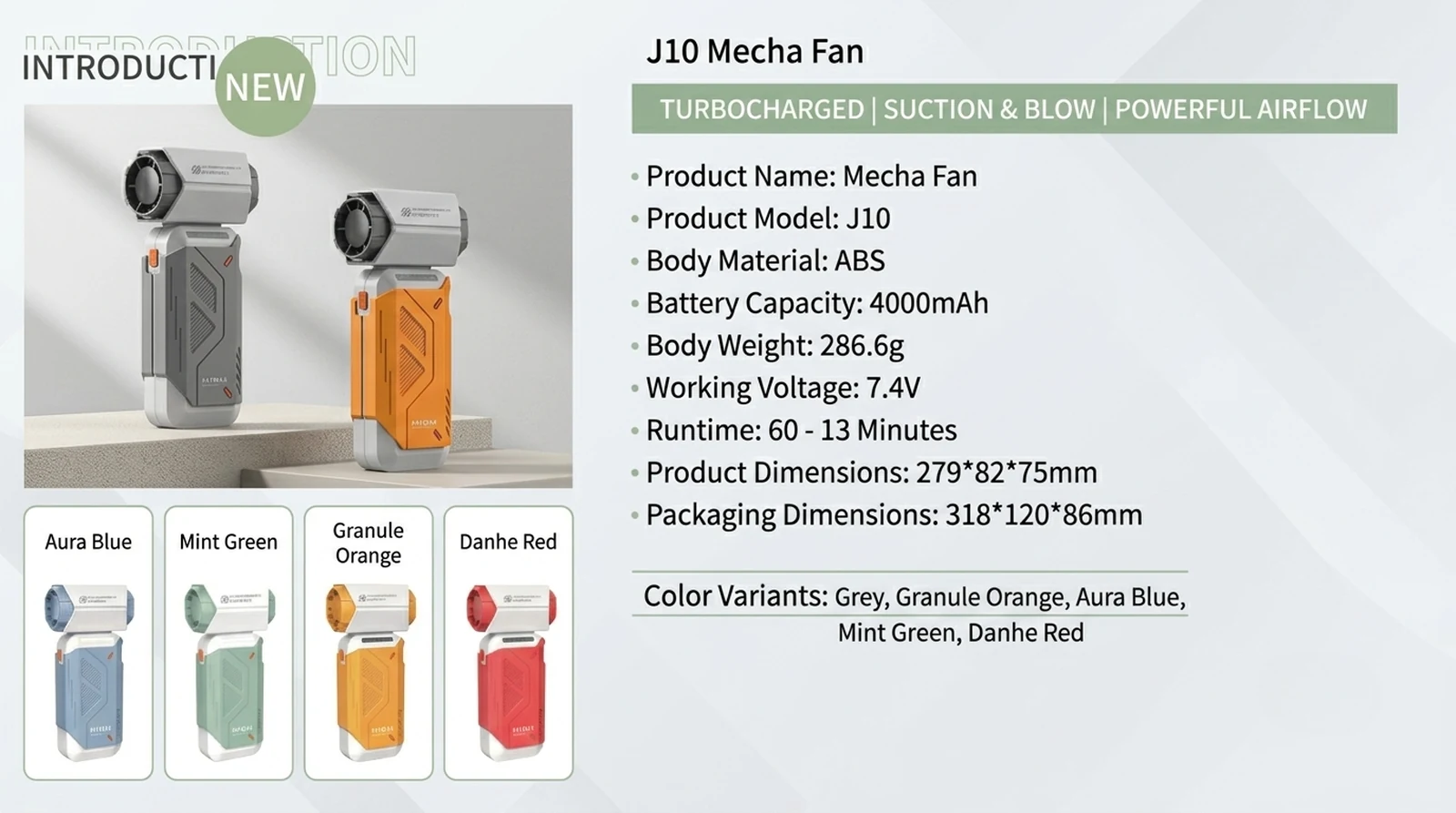
What Importers Should Know Before Adding the J10 Mecha Fan to a Product Line
Adding a portable fan like the J10 Mecha Fan to a product line takes more than a good-looking spec sheet. This guide walks importers through the practical pre-commitment steps that separate smooth launches from costly reworks.
A Practitioner's Checklist for Importing the J10 Mecha Fan
Portable fans have moved well beyond impulse-buy gadgets. For importers serving outdoor retail, gifting, promotional merchandise, and direct-to-consumer channels, a compact, design-forward unit like the J10 Mecha Fan can be a meaningful category addition. But the difference between a low-friction launch and a stalled shipment usually comes down to preparation work done *before* a purchase order is placed.

This guide walks through the seven checkpoints an importer should clear before committing inventory, capital, and shelf space to a new SKU. It is written for sourcing managers, category buyers, and small-batch brand operators who are evaluating the J10 Mecha Fan (or any comparable portable-mecha-style fan) as a serious line extension rather than a one-off drop.
---
1. Build a Working Knowledge Base Before the First Email
Before approaching any supplier, importers should be able to answer — in their own words — what the product is, who it is for, and how it competes on shelf. Skipping this step leads to conversations led entirely by the seller, which is rarely in the buyer's interest.
A practical knowledge baseline includes:
- **Mechanical profile.** Understand the device's motor type, blade configuration, battery architecture, and housing assembly. Portable mecha-style fans typically pair a brushless or brushed DC motor with a multi-blade rotor, a rechargeable lithium-ion cell, and a plastic or metal-alloy shell. Knowing which architecture the J10 Mecha Fan uses informs your noise, runtime, and durability expectations.
- **Use case envelope.** Outdoors (camping, festivals, job sites), desk use (home office, study), travel (carry-on companion), or promotional/tactical gifting. Each use case places different weight on weight, water resistance, charging method, and noise output.
- **Competitor context.** Where does the unit sit relative to handheld, neckband, and clip-on fans already in your assortment? Editors at J10Fan Editorial generally advise treating claims about "industry-leading" output with caution; instead, map the unit against two or three comparable designs on a feature grid.
- **Margin and category economics.** Without publishing numbers here, importers should be honest about whether the category supports the unit economics of a portable fan — freight share, return rates, accessory attach rates — and whether the J10 Mecha Fan fits the price tier you sell into.
The strongest importers walk into supplier calls already knowing more than the supplier expects. That asymmetry is the foundation of every checkpoint below.
---
2. Treat Sample Evaluation as the Real Conversation
A sample is the single most valuable unit you will ever receive from a factory. Treat the sample process as the actual commercial negotiation — everything before it is forecasting, everything after it is execution.
A disciplined sample run covers four dimensions:
**A. Build and tactility.**
Unbox the sample yourself rather than relying on photo samples. Inspect seam lines, button travel, the integrity of any mechanical detailing unique to a mecha-style aesthetic, and the feel of any articulating or docking components. A unit that photographs well can still disappoint in hand.
**B. Functional performance.**
Run the fan across the full advertised speed range, ideally on a charger you control, with a stopwatch. Compare actual runtime to the listed battery life at each speed. Listen for bearing noise, vibration, and any RFI-style whine that might draw customer complaints.
**C. Durability spot checks.**
Drop the sample once from a desk-height onto a hard floor. Cycle the hinge or dock mechanism through rated repetitions. Leave it charging overnight to observe thermal behavior of the cell. None of these tests are definitive QC protocols, but they reveal whether the supplier is willing to stand behind the design.
**D. Documentation review.**
A factory that takes export seriously sends samples with a specification sheet, a bill of materials (BOM), battery test summaries, and at least draft versions of the compliance documents the unit will ship under. The absence of these papers is itself a signal.
For importers comparing the J10 Mecha Fan alongside other candidates, run identical sample protocols across every option. The goal at this stage is to make an apples-to-apples ranking on quality, not to negotiate.
---
3. Compliance and Certification: A Market-Specific Question
Portable fans with rechargeable lithium-ion cells are regulated goods in virtually every major import market. Compliance documentation is not a checkbox at the bottom of a supplier form — it is the architecture of whether your shipment clears customs at all.
Without naming a single jurisdiction's exhaustively, here is the framework importers should be running through with counsel and customs brokers:
- **Battery transport.** Lithium-ion cells fall under IATA Dangerous Goods regulations and equivalent national rules. UN 38.3 test summaries are the de facto baseline expected by air and sea carriers. Confirm the supplier holds current UN 38.3 reports for the cell configuration actually used in production, not a generic chemistry variant.
- **Electrical safety.** Major markets require testing to a national or regional electrical safety standard for plug-in chargers and any adapter that ships in-box. The standard differs — there is no universal one — so testing for the *destination* market must be on file.
- **Electromagnetic compatibility.** Emission and immunity requirements vary. A unit that has been tested only for one market's EMC profile will likely need supplementary testing before re-export.
- **Chemical and substance restrictions.** RoHS, REACH, Prop 65, and similar frameworks apply to plastics, metals, solders, and surface finishes. A supplier should be able to produce substance declarations that match the BOM.
- **Labeling and user information.** Local-language manuals, energy markings, recycling marks, and country-of-origin marking all sit inside this category. Treat translated instructions as a deliverable, not a favor.
A frequent pitfall: a supplier offers "CE- and FCC-ready" documentation in a single sentence. That is not a certification. Importer-side QA should request the certificate numbers, the issuing laboratory, the date, and the scope of the listed model. Independent verification through the listed lab is a small expense relative to a seized or recalled shipment.
---
4. Logistics and Packaging: The Hidden Half of the Landed Cost
Packaging and logistics rarely make it onto the importer's early brief, but they determine whether a unit is delivered intact, at acceptable freight cost, and in presentation form for retail.
Key topics to address before signing a purchase order:
- **Inner and outer pack design.** Confirm the export carton (typically a 5-ply corrugated) and the inner retail box. For the J10 Mecha Fan and similar compact SKUs, a robust inner tray is the difference between a 1% damage rate and a 6% one — particularly in e-commerce mixed pallets.
- **Battery classification in transit.** Cells above a certain watt-hour threshold may require specific markings, document packets, and carrier approvals. Confirm classification *before* the freight forwarder is booked so the unit moves on the correct service.
- **Palletization and container utilization.** Request the supplier's standard export pallet spec and a sketch plan for a 20-foot container. Side-by-side SKUs in the same container can be efficient but require accurate mixed-load manifests.
- **Retail-ready vs. plain carton.** Decide upfront whether the unit ships in retail-ready printed boxes or in plain inner packs plus an outer shipper. Retail-ready configurations dramatically reduce handling at your DC but increase the per-unit cost of any artwork change.
- **Accessories and inserts.** Charging cables, manuals, warranty cards, and any adapter variants should each be confirmed in the packing list. Missing accessories are a top-five driver of avoidable returns for consumer electronics.
Request a sample of the *export* carton, not the retail box alone. Inspect drop-test, compression, and humidity resistance personally before committing volume.
---
5. Supplier Vetting Signals That Travel Well Beyond This SKU
The factory behind the J10 Mecha Fan is, in practical terms, a partner for the life of the SKU — and possibly longer. Vetting should focus on the supplier's systems rather than its salesmanship.
Useful due-diligence checkpoints include:
- **Production evidence.** Independent verification of where the unit is physically made, ideally through a third-party inspection service, not just a self-declared brochure. Photos dated to within a recent quarter are a stronger signal than polished studio images.
- **QC system documentation.** A genuine ISO 9001-aligned or equivalent quality management system, with AQL levels disclosed for incoming, in-process, and final inspection, is the baseline. Anything less is a managed-by-conversation arrangement.
- **Engineering depth.** Can the factory talk coherently about design changes, component alternatives, and tooling? Sales-led suppliers often cannot; engineering-led suppliers usually volunteer more technical detail than the importer asks for.
- **Capacity and flexibility.** Confirm both the monthly output capability and the surge capacity for category spikes (summer season, Black Friday, gifting windows). A factory that is already at 95% utilization in the lead-up to your ship window is a delivery-risk exposure.
- **Communication cadence.** Set expectations on response time, escalation paths, and reporting intervals *before* the first PO. The supplier's behavior during sampling is the best predictor of behavior during mass production.
For importers who want a deeper framework on how to evaluate factories beyond these points, J10Fan Editorial regularly cross-references sourcing playbooks and supplier-evaluation commentary from partner sites; readers can compare notes over at gaborhub.com, where independent sourcing perspectives on factory vetting are discussed in greater depth.
---
6. What "Customization" Actually Means at MOQ
Many importers assume a low MOQ automatically implies a willingness to customize. The two are separate. Before requesting private-label or spec changes on the J10 Mecha Fan, clarify:
- The minimum order quantity at which artwork changes (color, logo, packaging print) become commercially viable for the factory.
- The minimum order quantity at which *engineering* changes (different cell, port layout, accessory kit) are realistic. These typically require tooling or new testing and bring MOQs up significantly.
- Whether the supplier can hold custom tooling between orders, or whether each run restarts tooling amortization.
A clear conversation on these points — supported by the supplier in writing — prevents the most common private-label disappointment: a custom-looking unit that is, in fact, the standard SKU with a sticker applied.
---
7. A Short List of Questions Worth Asking on the First Call
For importers who want to compress preparation into a single supplier conversation, here is a non-exhaustive list of high-value first-call questions:
1. Which battery cell is actually used in production, and what is its UN 38.3 status?
2. For which destination markets do you hold current, in-date compliance certificates — and can you share the certificate numbers?
3. What is your standard QC AQL for finished-goods inspection, and what third-party inspection firms have you worked with?
4. Can you provide a production-line video or recent on-site photo set?
5. What is the realistic lead time from PO to ex-factory, including any seasonal pinch points?
6. Can the export carton and inner tray be supplied for sample evaluation before bulk?
Strong suppliers answer these directly. Weak suppliers deflect. The pattern is more informative than any individual answer.
---
Closing Thoughts
Adding a portable fan such as the J10 Mecha Fan to an importer's catalog is, on paper, a routine sourcing decision. In practice, the gap between a clean launch and a problematic one is filled with sample discipline, compliance verification, packaging rigor, and supplier evaluation. Each of these checkpoints can be completed in a matter of weeks; collectively, they are the difference between a SKU that compounds over multiple seasons and one that quietly disappears from the assortment.
Approach the process as a sequence of gates rather than a single negotiation. The order matters: knowledge first, sample second, compliance third, logistics fourth, supplier vetting fifth — with customization and first-call questions running in parallel from the start.
For importers ready to move from preparation into product evaluation, the J10 Mecha Fan product page contains the specifications, accessory details, and documentation starting point for the next stage.
---

FAQ
**Q: How long does a typical J10 Mecha Fan sample-to-bulk cycle take?**
A: A realistic window from initial sample request to first production ex-factory is usually several weeks, depending on customization, compliance reissue for specific markets, and seasonal factory load. Importer-side review time for compliance paperwork should be added to that estimate.
**Q: What compliance documents should importers request before placing a bulk order?**
A: At minimum, request UN 38.3 reports for the installed battery cell, electrical safety certificates for the destination market, EMC documentation for the destination market, a RoHS/REACH-style substance declaration against the BOM, and a sample of the export carton markings. Certificate numbers and issuing laboratory details should accompany each document.
**Q: How can an importer tell whether a prospective supplier is genuinely manufacturing or reselling?**
A: Request recent, dated production-line evidence (videos or photos), ask which third-party inspection firms have audited the facility, and confirm whether the supplier can discuss component alternatives coherently. A reseller-led operation typically cannot describe the production line in technical detail. For a broader framework on supplier vetting, importers can also consult independent sourcing commentary from gaborhub.com alongside this checklist.
Frequently Asked Questions
How long does a typical J10 Mecha Fan sample-to-bulk cycle take?
A realistic window from initial sample request to first production ex-factory is usually several weeks, depending on customization, compliance reissue for specific markets, and seasonal factory load. Importer-side review time for compliance paperwork should be added to that estimate.
What compliance documents should importers request before placing a bulk order?
At minimum, request UN 38.3 reports for the installed battery cell, electrical safety certificates for the destination market, EMC documentation for the destination market, a RoHS/REACH-style substance declaration against the BOM, and a sample of the export carton markings. Certificate numbers and issuing laboratory details should accompany each document.
How can an importer tell whether a prospective supplier is genuinely manufacturing or reselling?
Request recent, dated production-line evidence such as videos or photos, ask which third-party inspection firms have audited the facility, and confirm whether the supplier can discuss component alternatives coherently. A reseller-led operation typically cannot describe the production line in technical detail. For a broader framework on supplier vetting, importers can also consult independent sourcing commentary from gaborhub.com alongside this checklist.