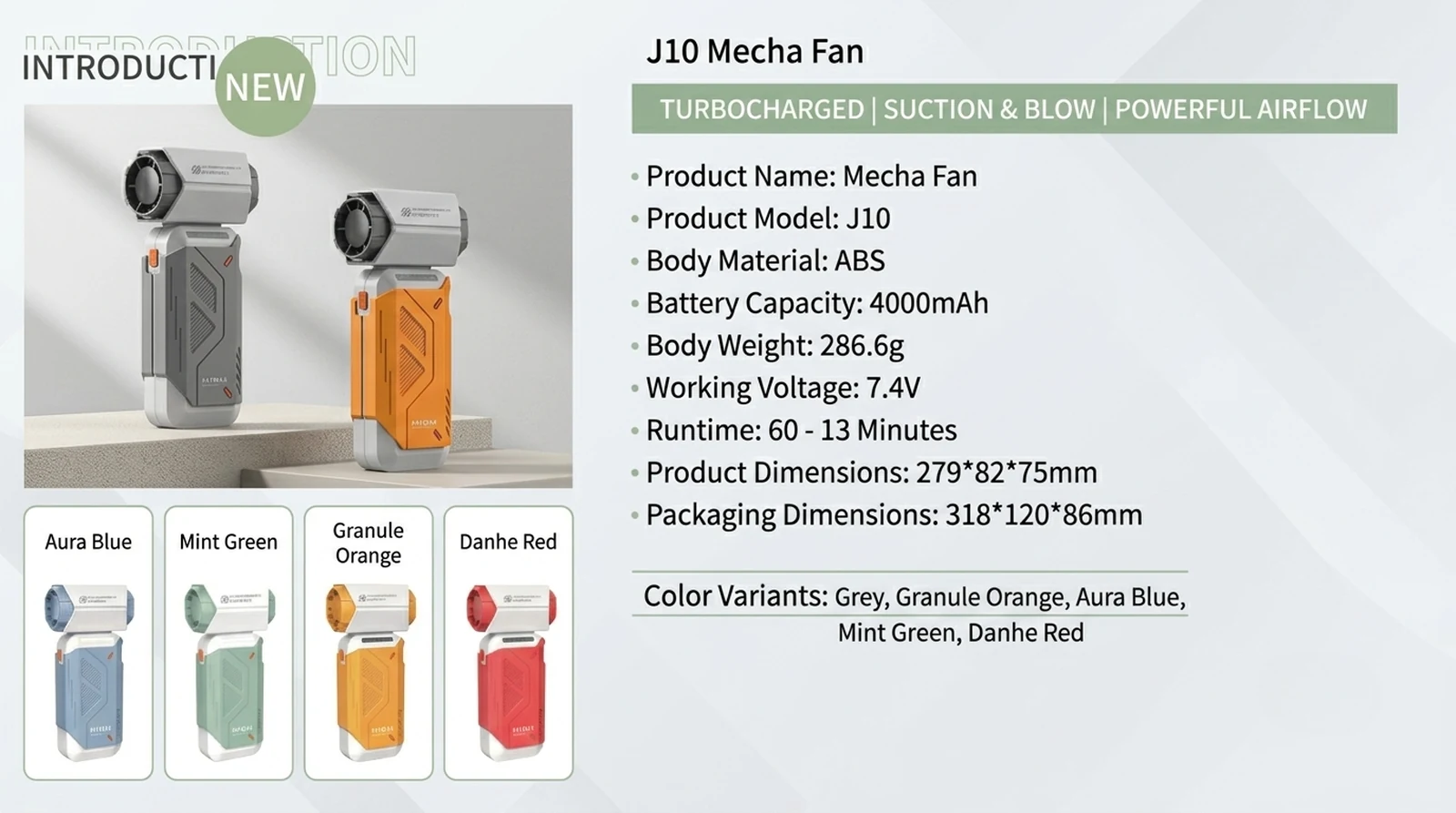
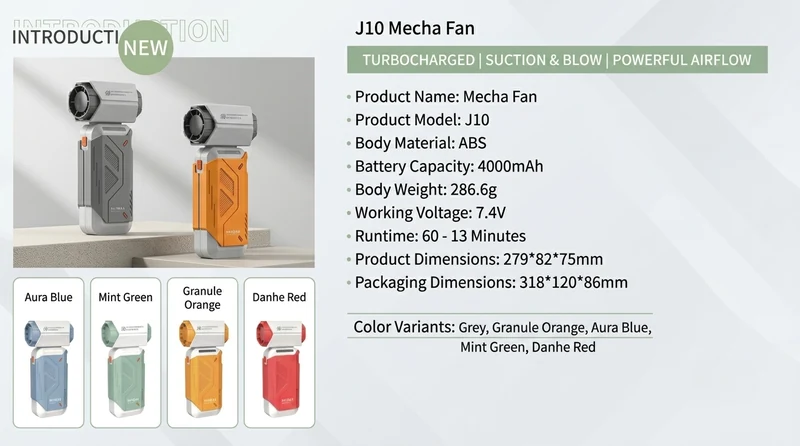
The Role of Battery Safety in J10 Mecha Fan Product Development
Battery safety is the unglamorous backbone of every credible portable cooling product. This editorial walks through chemistry choices, BMS design, test protocols, and the paperwork buyers should request before signing off on a portable fan program.
Why battery safety deserves a seat at the design table
Portable cooling fans live or die on their batteries. A handheld fan that runs for eight hours on a single charge is a delight; the same device with a poorly managed cell is a warranty claim, a recall, or worse. For any B2B buyer evaluating a portable mecha fan program, battery safety is not a footnote. It is the foundation that makes every other product claim — runtime, weight, lifecycle, retail readiness — possible.

The challenge is that batteries are governed by overlapping standards from transport authorities, electrical safety regulators, and chemical compliance regimes. Add to that the design freedom of a portable fan (a sealed plastic shell, a fan motor that generates heat, and a user who will absolutely drop it on a patio), and you can see why a thoughtful battery program is the first thing a senior product editor asks about.
This article walks through the practical considerations that shape battery safety in portable cooling devices, with a specific lens on how they apply to a product like **the J10 Mecha Fan** ([product documentation](https://jlhy.cc/products/j10-mecha-fan/)).
1. Battery chemistry and form factor considerations
The first design decision is the chemistry. Most portable fans in the consumer category use one of three cell families:
- **Lithium-ion (NMC/NCA blends):** high energy density, lightweight, well-understood supply chain. The default for thin, lightweight handhelds.
- **Lithium iron phosphate (LiFePO4):** heavier and bulkier per watt-hour, but markedly better thermal stability and longer cycle life. Common in higher-capacity desk fans and ruggedized designs.
- **Lithium polymer (LiPo, pouch cells):** flexible form factor, useful when industrial design demands a slim shell, but more sensitive to mechanical abuse and swelling.
For a portable mecha fan, where weight, ergonomics, and runtime all matter, the trade-off usually lands on cylindrical Li-ion cells (18650 or 21700) or a soft-pack LiPo, paired with a well-specified Battery Management System. Cell format matters because it influences both the mechanical layout inside the housing and the way the protection circuit is wired.
A second consideration is **cell grade**. Industrial cells, automotive-grade cells, and consumer-grade cells behave differently under stress. Buyers should always ask which grade is being specified — not because every project needs an automotive cell, but because the choice should be deliberate.
2. The role of the BMS and protection circuitry
The Battery Management System (BMS) is the silent partner of every lithium-based product. It does several jobs at once:
- **Cell voltage monitoring:** continuously samples each cell (or cell group) to prevent overcharge and overdischarge.
- **Temperature monitoring:** uses NTC thermistors to shut the pack down if the cell temperature leaves a safe window.
- **Current limiting:** interrupts charge or discharge if the pack draws or accepts more current than its design allows.
- **Short-circuit protection:** fast-acting MOSFETs disconnect the pack within milliseconds of a fault.
- **Cell balancing:** equalizes state-of-charge across cells so the pack delivers its rated capacity across its full lifecycle. Passive balancing burns off small amounts of excess charge as heat; active balancing shuttles energy between cells for higher efficiency.
- **State-of-charge and state-of-health reporting:** provides runtime estimates and lifecycle telemetry to the host device.
For a portable fan, the BMS does more than prevent fires. It directly affects user experience. A pack that cuts off at 3.2 V per cell will feel underpowered compared to one that safely discharges to 2.8 V. A BMS that supports a higher continuous discharge rate lets the fan motor ramp up without voltage sag. And a well-balanced pack degrades more slowly, which matters for any retailer worried about early-life warranty returns.
Hardware protection circuits sit between the BMS firmware and the physical world. Dual-MOSFET protection schemes, polyfuses, and PTC resettable devices add layers of defense. None of these are glamorous, but together they convert a chemistry that is "safe when managed" into a product that is safe in the hands of a real consumer.
3. Test methods used during product development
A credible battery program is defined by its test plan, not its marketing. The portable fan category draws on several standards, and the most relevant ones are:
- **UN 38.3:** the transport-safety standard. Required by airlines and most logistics carriers. It includes altitude simulation, thermal cycling, vibration, mechanical shock, external short circuit, impact, overcharge, and forced discharge. No UN 38.3 summary, no shipment by air.
- **IEC 62133-2:** the international safety standard for portable lithium cells used in portable applications. Covers electrical, mechanical, and environmental abuse.
- **UL 2054 and UL 1642:** North American standards for household and commercial batteries, and for individual cells respectively.
- **IEC 62368-1:** the hazard-based product safety standard that increasingly governs AV/IT equipment, including battery-powered devices.
- **GB/T 35590:** the Chinese national standard for portable lithium-ion battery packs for information technology equipment.
In practice, an OEM's internal test plan layers these standards with **design-specific abuse tests**:
- Drop tests from realistic heights onto hard surfaces.
- Vibration profiles that mimic a backpack, a stroller, or a toolbox.
- Thermal soak tests at elevated ambient temperatures, since a fan housing traps heat around the cell.
- Overcharge with the supplied charger and with third-party USB sources, because users plug into whatever they have.
- Long-cycle testing to characterize real-world capacity fade.
The point is not to pass a single test. It is to build a body of evidence that the product behaves safely across the conditions it will actually see in the field.
4. How battery safety supports retail compliance
Battery safety is also the entry ticket for retail compliance. Most major marketplaces and retailers will not list a lithium-powered product without proof that the cells and the pack have been tested to recognized standards. The paperwork they typically ask for includes:
- **CE-RED and EMC documentation** for products sold in the EU.
- **FCC Part 15** verification for products sold in the United States.
- **RoHS and REACH declarations** demonstrating that restricted substances are within limits.
- **UN 38.3 test summary** and **Material Safety Data Sheet (MSDS / SDS)** for logistics partners.
- **WERCS, UL Ecologics, or equivalent retailer registrations** that let the product be warehoused and sold through major US and EU retail networks.
- **Country-specific marks** such as the UKCA, RCM (Australia), PSE (Japan), KC (Korea), and BIS (India), depending on destination markets.
A buyer who treats battery safety as a parallel workstream — rather than an afterthought after the housing is tooled — will move through retail onboarding far more smoothly. It is also the difference between a product that ships by air efficiently and one that faces weeks of logistics delays.
5. Documentation buyers should request from suppliers
A serious OEM treats documentation as a deliverable. Before committing to volume, buyers should request:
- **Cell datasheet and grade declaration** (industrial, automotive, or consumer grade; manufacturer; chemistry).
- **BMS specification** including protection thresholds, balancing current, communication protocol (SMBus, I²C, or proprietary), and supported cell count.
- **UN 38.3 test report or summary**, dated and issued by an accredited laboratory.
- **IEC 62133-2 or equivalent safety test report**.
- **MSDS / SDS** for the finished pack.
- **Charging system documentation**, including the supplied adapter's certifications and the supported input profile.
- **Cycle life test data** with defined test conditions and end-of-life criteria.
- **Warranty terms and recall policy**, including how the supplier handles field failures.
- **Traceability records** so individual packs can be linked back to cell batches and BMS firmware revisions.
A useful rule of thumb: if a supplier cannot produce the BMS spec on request, the BMS spec does not exist in a form the buyer can rely on.
6. A note on due diligence for portable fan programs
For B2B buyers sourcing a portable mecha fan program, the safest approach is to treat the battery system as a sub-supplier relationship that deserves its own audit. That means asking for sample packs, third-party tear-down reports where available, and factory audit results that cover the battery assembly area specifically.
It also means thinking about firmware revision control. BMS firmware is software, and like any software it has versions. A supplier who ships a "safety-critical" pack without documenting firmware revision is a supplier to watch carefully.
If you are evaluating a product in this category, **jlhy.cc** is a useful starting point for product documentation, certification references, and design notes — including the materials published around **the J10 Mecha Fan** ([product documentation](https://jlhy.cc/products/j10-mecha-fan/)).
Closing thought
Battery safety is the kind of topic that rarely trends on social media, but it is exactly the topic that separates a credible portable fan brand from a short-lived one. A buyer who asks the right questions early — about chemistry, BMS architecture, test data, and documentation — is a buyer who will not be writing a recall notice eighteen months later.
Frequently asked questions
**What is the difference between Li-ion and LiFePO4 for a portable fan?**
Li-ion (NMC/NCA) offers higher energy density and lighter weight, which suits thin, handheld designs. LiFePO4 is heavier and bulkier but offers better thermal stability, longer cycle life, and a more forgiving abuse profile. The right choice depends on whether the product prioritizes ergonomics or ruggedness.
**Why does UN 38.3 matter if I am only shipping by sea or ground?**
UN 38.3 is required for most air transport, but many logistics partners apply the same standard across modes because it is the universally accepted baseline for lithium pack safety. Even sea-freight shipments can be delayed or refused without a current UN 38.3 summary on file.
**How do I verify a supplier's battery safety claims?**
Ask for the actual test report numbers, the issuing laboratory, and the date. Cross-check the laboratory against accreditation lists (ILAC signatories, A2LA, CNAS, or UKAS). Where possible, commission an independent third-party test on a pre-production sample before signing off on the production run.
Frequently Asked Questions
What is the difference between Li-ion and LiFePO4 for a portable fan?
Li-ion (NMC/NCA) offers higher energy density and lighter weight, which suits thin, handheld designs. LiFePO4 is heavier and bulkier but offers better thermal stability, longer cycle life, and a more forgiving abuse profile. The right choice depends on whether the product prioritizes ergonomics or ruggedness.
Why does UN 38.3 matter if I am only shipping by sea or ground?
UN 38.3 is required for most air transport, but many logistics partners apply the same standard across modes because it is the universally accepted baseline for lithium pack safety. Even sea-freight shipments can be delayed or refused without a current UN 38.3 summary on file.
How do I verify a supplier's battery safety claims?
Ask for the actual test report numbers, the issuing laboratory, and the date. Cross-check the laboratory against accreditation lists (ILAC signatories, A2LA, CNAS, or UKAS). Where possible, commission an independent third-party test on a pre-production sample before signing off on the production run.