High-Speed Mecha Fan Comparison: Technical Guide for B2B Sourcing
Evaluating handheld cooling devices for international retail and catalog expansion requires examining the structural and mechanical parameters that separate standard portable fans from high-speed mecha fan designs. Engineering teams and procurement managers evaluate differences in motor topologies, airflow dynamics, housing dampening, and manufacturing scalability to build reliable product lines.
As an established OEM/ODM manufacturer based in Dongguan, Guangdong, China with over 10+ years of OEM/ODM experience, XMT Global (Xinmeili Technology) produces hardware across a 3,000+ m² facility with a monthly capacity exceeding 150,000+ units, serving partners across 30+ export markets. Understanding the underlying engineering distinctions helps commercial buyers select hardware suited to their specific retail positioning.
Understanding the High-Speed Mecha Fan Category
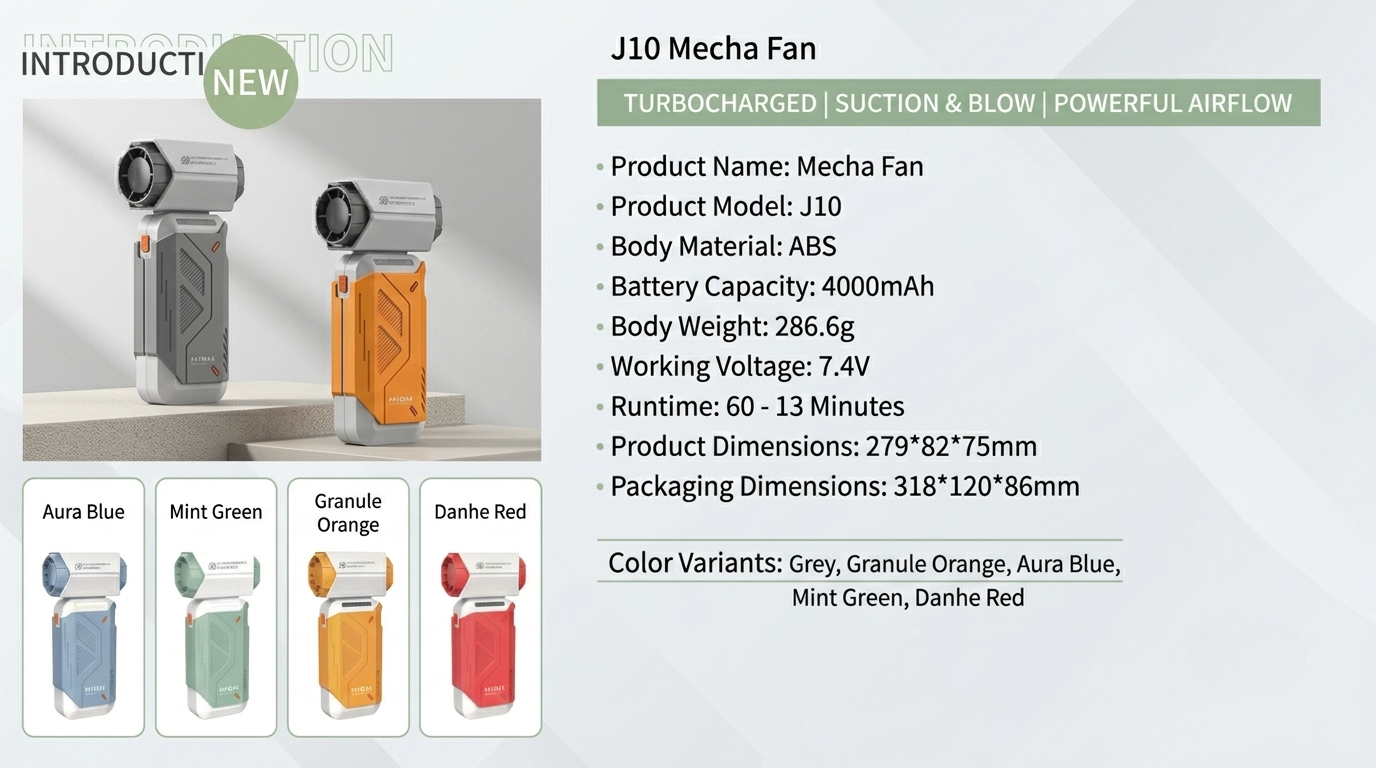
The high-speed mecha fan category is defined by industrial-inspired aesthetics combined with elevated static pressure and velocity capabilities. Unlike traditional handheld cooling fans that rely on wide, low-pitch fan blades for gentle air circulation, mecha-style designs draw structural inspiration from mechanical equipment, incorporating reinforced frames, technical detailing, and turbine-style impellers.
From a product management perspective, this category addresses consumer demand for concentrated airflow, industrial design styling, and durable hand-feel. Sourcing specialists evaluate these units to differentiate catalog offerings beyond entry-level plastic desk fans.
Key Structural and Motor Differences
The operational distinctions between standard units and mecha fans stem from motor construction, aerodynamics, and structural enclosures:
- Motor Topology: Conventional personal fans commonly use brushed DC motors or standard low-voltage brushless DC (BLDC) motors tuned for low operational speeds. High-speed mecha units utilize compact, high-velocity BLDC motors capable of sustaining significantly higher rotational speeds without thermal throttling.
- Impeller and Air Duct Architecture: Conventional fans feature open-face multi-blade impellers optimized for broad ambient air dispersion. Mecha units utilize enclosed ducted designs or turbine impellers that compress airflow to maintain static pressure across longer projection distances.
- Chassis and Vibration Isolation: Basic portable units often rely on lightweight standard ABS plastics. High-speed mecha fans utilize reinforced internal chassis, rigid polycarbonate (PC), and metallic accents designed to absorb operational harmonics generated by high-speed impellers.
Airflow Performance and Electrical Requirements
While standard portable fans deliver broad, low-velocity airflow suited for stationary indoor personal cooling, high-speed mecha fans produce focused, directional air streams. This concentrated stream functions effectively in outdoor environments, active commuting, or high-temperature ambient conditions.
However, running high-velocity BLDC motors increases power consumption. Engineering teams must specify internal power management circuits (PCBs) and lithium-ion battery cells with verified discharge ratings to handle sustained operational loads. Verifying cell safety and thermal management is critical during factory evaluations.
B2B Sourcing Criteria and Production Logistics
For distributors and brand owners reviewing product catalogs, procurement feasibility depends on production stability and factory capability. Production standards commonly evaluated by international sourcing teams include:
- Minimum Order Quantity (MOQ): Standard OEM/ODM production runs for high-speed mecha fan hardware generally require an MOQ of 500 units, allowing brands to test regional markets without excessive inventory commitments.
- Production Lead Time: Commercial assembly and packaging cycles typically operate on a standard 15 days lead time for volume fulfillments.
- Regional Regulatory Compliance: Sourcing managers must verify that the OEM/ODM manufacturer maintains market-appropriate compliance documentation. Essential certifications include CE, RoHS, FCC, UN38.3, UKCA, CCC, PSE, and KCC.
High-Speed Mecha Fan Comparison Matrix
The following technical matrix outlines typical engineering parameters, component configurations, and sourcing factors observed during product evaluations:
| Evaluation Metric | Standard Portable Fan | High-Speed Mecha Fan |
|---|---|---|
| Motor Technology | Brushed DC or Standard BLDC | High-Velocity Brushless DC (BLDC) |
| Impeller Architecture | Open-face multi-blade design | Ducted turbine impeller |
| Housing Construction | Standard ABS plastic molding | Reinforced PC with alloy accents |
| Airflow Profile | Wide-angle ambient dispersion | Directional high-velocity stream |
| Vibration Dampening | Minimal internal dampening | Reinforced mechanical balancing |
| Production Lead Time | 15 to 30 days depending on supplier | 15 days typical factory standard |
| Minimum Order Quantity | Variable by vendor | 500 units standard OEM/ODM baseline |
| Certified Market Standards | Region-dependent baseline | CE, RoHS, FCC, UN38.3, UKCA, CCC, PSE, KCC |
Common Sourcing Mistakes to Avoid
When selecting portable fans for regional distribution, commercial sourcing teams commonly encounter several technical pitfalls:
- Neglecting Vibration and Dynamic Balance: High-speed BLDC assemblies require dynamic balancing. Units lacking internal chassis reinforcement or balanced impellers can suffer from hand fatigue and premature bearing wear.
- Overlooking Battery Transport Documentation: High-speed motors require properly rated lithium-ion cells. Sourcing units without a valid UN38.3 transport report can lead to transit delays and customs clearance complications.
- Failing to Verify Local Compliance: Importers must ensure compliance documentation matches import destination mandates, whether requiring UKCA for Britain, CCC for China, PSE for Japan, KCC for South Korea, or CE/FCC/RoHS for broader international markets.
- Misjudging Factory Capacity: Sourcing from small assembly workshops lacking comprehensive manufacturing capabilities can result in production bottlenecks during peak seasons. Working with an OEM/ODM manufacturer with 150,000+ units/month capacity and established facilities provides delivery security.
Frequently Asked Questions
What are the primary performance advantages of a high-speed mecha fan?
High-speed mecha fans utilize advanced brushless motor assemblies and ducted turbine impellers to provide focused, high-velocity airflow and higher static pressure compared to the wide, gentle air dispersion of standard handheld fans.
What is the typical minimum order quantity and lead time for high-speed mecha fans?
For standard B2B production runs with an established OEM/ODM factory like XMT Global (Xinmeili Technology), the typical minimum order quantity is 500 units with a manufacturing lead time of 15 days.
Which regulatory certifications should buyers verify before importing?
Depending on the destination market, buyers should verify essential testing and compliance standards, including CE, RoHS, FCC, UN38.3 for battery transport, UKCA, CCC, PSE, and KCC.
What manufacturing capacity supports high-speed mecha fan production?
At XMT Global (Xinmeili Technology) in Dongguan, production is backed by a 3,000+ m² facility, 10+ years of OEM/ODM experience, and a monthly manufacturing capacity of 150,000+ units serving over 30+ export markets.
Evaluating high-speed mecha fan options against conventional portable units requires balancing mechanical durability, airflow characteristics, and supplier capabilities. Product managers who verify motor specifications, housing resilience, and regulatory certifications can successfully configure product lines tailored to their target retail channels.