Evaluating housing materials and surface treatments is critical when sourcing high-speed handheld fans for retail and brand distribution. This guide breaks down the structural properties of engineering plastics and metallic components, detailing how material density, heat tolerance, and finishing methods impact product longevity and tactile perception.
Understanding Core Materials in Handheld Fan Enclosures
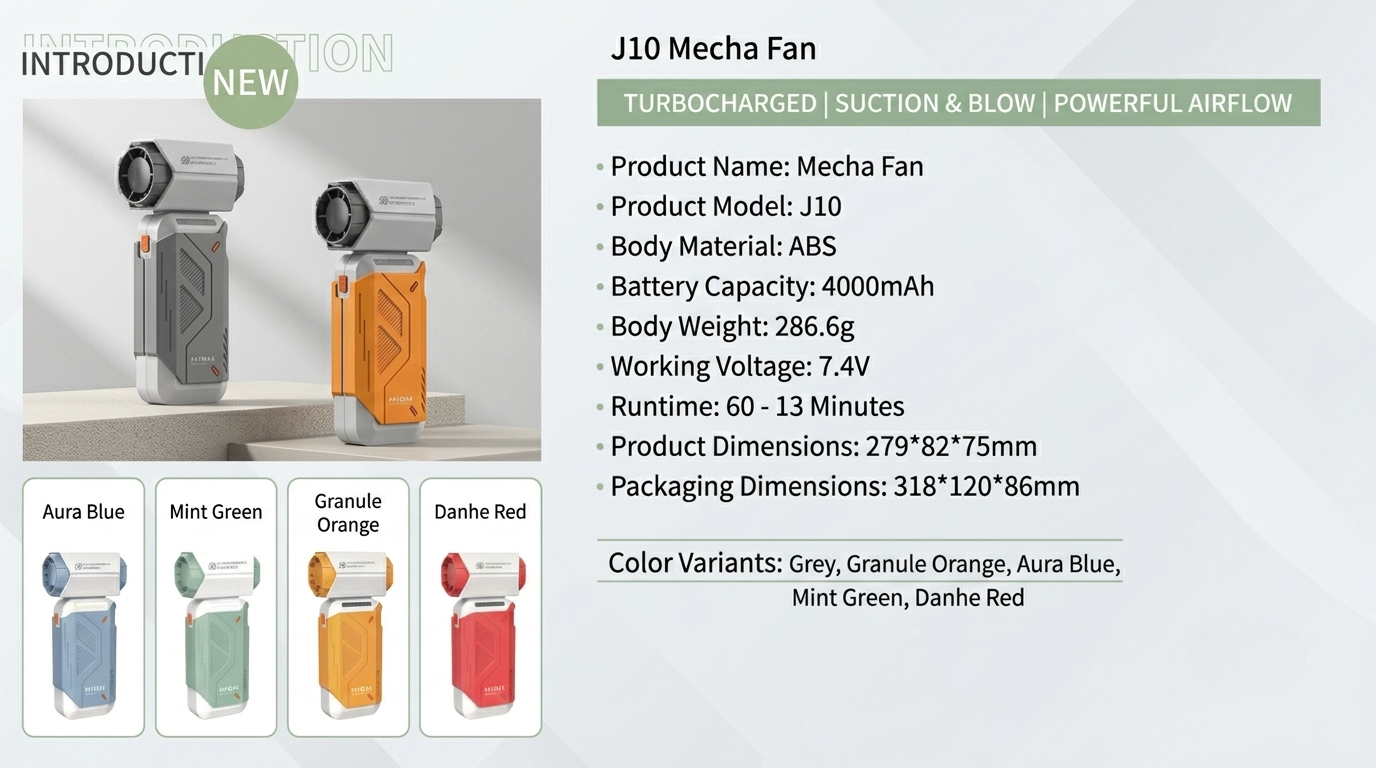
The primary enclosure of a high-speed handheld fan must withstand mechanical stress from internal motor vibrations, maintain structural integrity during accidental drops, and isolate thermal output from the user's hand. Choosing the correct handheld fan materials balances structural strength, total weight, thermal management, and production feasibility.
Most personal cooling devices rely on three main material categories:
- ABS Plastic (Acrylonitrile Butadiene Styrene): A standard thermoplastic polymer utilized for its impact resistance, dimensional stability, and straightforward injection molding characteristics. It serves as a baseline structural material for consumer electronic housings.
- Polycarbonate (PC) and PC/ABS Blends: Adding polycarbonate to ABS resin increases tensile strength, impact resistance, and heat deflection temperatures, making it a frequent choice for high-rpm motor mounts and structural turbine housings.
- Aluminum Alloy: Commonly selected for premium mecha-style enclosures, structural accents, intake rings, or heat sinks. Aluminum provides superior thermal conductivity and a rigid metallic feel that differentiates higher-tier models.
Surface Finishes and Tactile Treatments for Portable Fans
Surface treatments directly influence aesthetic presentation, scratch resistance, and grip quality. Sourcing teams commonly evaluate several finishing processes based on market positioning and brand requirements:
- Matte and Textured Mold Finishes: Formed directly via textured tool cavity steel (such as SPI or Mold-Tech standards). This method yields a clean, non-reflective surface that resists oil and fingerprints without requiring secondary spray lines.
- UV Coatings and Soft-Touch Sprays: Applied as secondary coatings to provide enhanced scratch resistance or a velvety grip. Sourcing teams typically verify curing controls to ensure coating stability across varying ambient humidity levels.
- Anodizing: An electrochemical surface passivation used for aluminum alloy elements. It hardens outer surfaces, guards against corrosion, and allows precise color tinting while preserving metallic grain.
- Electroplating: Deployed on decorative trims, rear air intake bezels, or buttons to produce bright metallic highlights over injection-molded components.
Material Selection and Acoustic/Thermal Performance
High-speed brushless motors operate at higher velocities than standard low-power handheld fans. Consequently, casing materials play a significant functional role beyond external aesthetics:
Vibration and Acoustic Dampening: High-speed rotation can generate micro-vibrations. Thin-walled ABS parts can sometimes amplify internal motor pitch if structural ribbing is insufficient. PC/ABS blends offer higher material stiffness and damping characteristics, which can assist in keeping operational noise down.
Thermal Dispersion: Internal motors, battery packs, and drive boards release heat during prolonged high-output runtime. While plastics act as thermal insulators, integrating aluminum structural components or alloy intake ducts helps conduct heat away from critical internal assemblies.
Material Comparison: ABS Plastic vs. PC Blends vs. Aluminum Alloy
Engineering teams weigh physical properties, tool construction complexity, and unit targets when finalizing material specifications.
| Material Category | Mechanical Strength | Weight Density | Heat Deflection | Typical Application |
|---|---|---|---|---|
| ABS Plastic | Standard impact resistance; balanced ductility | Lightweight (~1.04–1.07 g/cm³) | Moderate (Up to ~80°C) | Primary outer shells, ergonomic grips |
| PC / ABS Blend | High impact resistance; high tensile strength | Moderate (~1.12–1.18 g/cm³) | Elevated (Up to ~100°C) | Internal turbine brackets, chassis frames |
| Aluminum Alloy | High rigidity and crush resistance | Higher density (~2.70 g/cm³) | High thermal conductivity | Front/rear intake bezels, decorative rings |
OEM/ODM Manufacturing and Tooling at XMT Global
Manufacturing personal cooling hardware requires balancing material selection with consistent tooling execution. Operating from a 3,000+ m² facility in Dongguan, Guangdong, China, XMT Global (Xinmeili Technology) leverages over 10 years of OEM/ODM experience to support international brands across more than 30 export markets.
With a monthly production capacity of 150,000+ units, our facility manages injection molding, material compounding, secondary surface finishing, and assembly under standardized quality controls. Sourcing parameters include a minimum order quantity (MOQ) of 500 units and a standard 15-day production lead time. Products and manufacturing workflows support necessary international compliance standards, including CE, RoHS, FCC, UN38.3, UKCA, CCC, PSE, and KCC.
Brands developing customized handheld fan enclosures can evaluate material swatches, mechanical prototypes, or tooling options by submitting design criteria directly to our engineering team.
Frequently Asked Questions
Why is PC/ABS often preferred over standard ABS for high-speed handheld fans?
PC/ABS combines the injection flow properties of ABS with the mechanical strength, thermal tolerance, and impact resistance of polycarbonate. In high-speed fans, this blend better handles internal motor stresses and resists structural deformation during drop tests.
What certifications are required when sourcing handheld fans with metallic housings?
Regardless of housing material, global distribution requires electrical safety and battery transport documentation. Common verifications include CE, RoHS, FCC, and UKCA for general compliance, PSE for Japan, KCC for South Korea, and UN38.3 for lithium battery transport safety.
What is the minimum order quantity for custom color or finish configurations?
At XMT Global, standard OEM/ODM production runs start at an MOQ of 500 units, with a typical production lead time of 15 days from production sample approval.
Can aluminum components cause handheld fans to become excessively warm?
Aluminum acts as a heat conductor rather than an insulator. When designed properly as part of the airflow path, metallic rings and bezels dissipate thermal buildup from internal electronics without directing uncomfortable heat levels toward the user grip.