Brushless vs Brushed Fan Motors in Portable High-Speed Handheld Fans
Evaluating motor architectures is a key consideration when developing or sourcing portable high-speed handheld fans. The choice between Brushless DC (BLDC) motors and traditional brushed DC motors directly impacts airflow velocity, thermal management, operational noise, and long-term product durability.
Understanding Motor Architectures in Portable High-Speed Fans
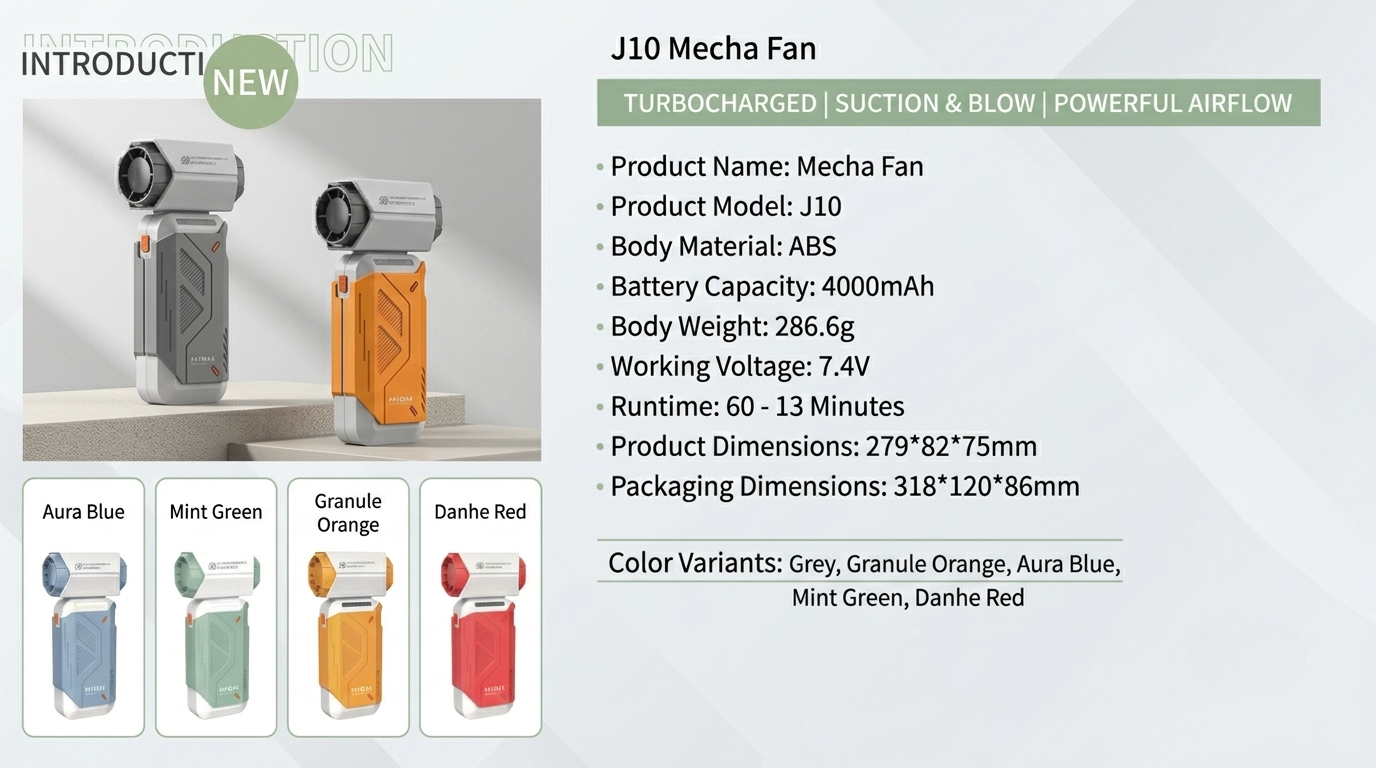
In high-speed handheld fans, the motor converts electrical energy from an internal battery into rotational kinetic energy to drive the impeller. Traditional brushed DC motors use mechanical carbon brushes and a commutator to switch electric current within the motor windings. While mechanically straightforward, this physical contact generates mechanical friction, wear, and electromagnetic noise.
By contrast, Brushless DC (BLDC) motors utilize electronic commutation. Permanent magnets sit on the rotor while the stator holds the copper coils. An integrated driver IC or electronic speed control (ESC) manages the switching of the magnetic field electronically. Eliminating physical brush contact reduces mechanical friction and allows higher rotational speeds suitable for high-speed airflow channels.
Key Technical Differences: Brushless vs Brushed Fan Motors
When analyzing brushless vs brushed fan motors for commercial sourcing, product managers commonly evaluate several structural differences:
- Frictional Resistance: Brushed motors suffer from mechanical brush friction, which creates electrical resistance and operational wear. BLDC motors rely on internal bearings without carbon brush contact along the electrical drive path.
- Thermal Distribution: In brushed designs, heat builds up around the internal rotor and commutator, making thermal dissipation through compact plastic enclosures difficult. In BLDC motors, heat is generated in the outer stator coils, facilitating heat transfer through the motor housing.
- Electromagnetic Emissions: Sparking along the mechanical commutator in brushed motors produces electromagnetic interference (EMI). BLDC motors operate electronically, simplifying compliance with international EMC guidelines.
- Speed Control: BLDC motors integrate with Pulse Width Modulation (PWM) speed controllers, allowing multi-stage airflow adjustments without heavy resistive losses.
OEM/ODM Sourcing Considerations for High-Speed Fans
For brand owners and importers evaluating supply chain partners, selecting the appropriate motor architecture depends on target market requirements, compliance standards, and production volumes. Specialized OEM/ODM manufacturers, such as XMT Global (Xinmeili Technology) based in Dongguan, Guangdong, China, support high-speed fan projects with tailored engineering specifications.
When planning a custom high-speed fan order, procurement teams should review operational metrics and logistics factors:
- Compliance & Certifications: Ensure the complete fan assembly satisfies international regulatory standards such as CE, RoHS, FCC, UN38.3, UKCA, CCC, PSE, and KCC.
- Production Scale & Lead Times: Facilities like XMT Global offer a production capacity exceeding 150,000 units per month, with standard minimum order quantities (MOQ) starting at 500 units and typical production lead times around 15 days.
- Thermal & Acoustic Testing: Validate motor performance in high-RPM impeller housings to ensure acoustic output remains within acceptable levels for consumer use.
Comprehensive Motor Technology Comparison
The table below compares general performance attributes of BLDC and brushed motors in handheld fan applications:
| Technical Parameter | Brushless DC Motor (BLDC) | Brushed DC Motor |
|---|---|---|
| Commutation Method | Electronic driver IC / ESC | Mechanical brushes & commutator |
| Wear Mechanism | Bearing wear only | Brush and commutator degradation |
| Acoustic Profile | Dominated by airflow dynamics | Includes mechanical brush whining |
| High RPM Capability | High (suited for specialized air ducts) | Constrained by brush friction |
| Heat Dissipation | Outer stator thermal path | Internal rotor thermal trap |
| System Circuitry | Requires electronic driver circuit | Direct DC power input |
Common Sourcing Mistakes to Avoid
When selecting fan motor specifications during product development, sourcing teams often encounter several common missteps:
- Focusing Solely on Unit Cost: Selecting lower-cost brushed motors for high-RPM applications can lead to higher return rates and shorter product operational lifespans.
- Underestimating Enclosure Heat: In compact mecha-style high-speed fans, heat from brushed commutators can raise internal ambient temperatures, potentially impacting battery stability over time.
- Overlooking Certification Alignment: Failing to verify regional certifications (such as PSE for Japan, KCC for South Korea, or UKCA for the UK) prior to mass production can delay market entry.
Frequently Asked Questions
Why are BLDC motors preferred for high-speed handheld fans?
BLDC motors eliminate mechanical brush friction, enabling higher rotational speeds, better energy efficiency, and longer operational life in compact high-airflow devices.
What certification standards apply to portable high-speed fans?
Depending on the destination market, fans generally require electrical safety, electromagnetic, and battery certifications including CE, RoHS, FCC, UN38.3, UKCA, CCC, PSE, and KCC.
What are standard OEM production parameters for portable fan projects?
Typical factory metrics for established suppliers like XMT Global include minimum order quantities (MOQ) starting at 500 units, monthly production capacities exceeding 150,000 units, and standard lead times of 15 days.